The Confidence Trick Playbook and How to Recognize It

The confidence trick is one of the oldest forms of fraud in existence. And one of the most effective. The game is simple: A fraudster gains your trust, then uses it against you to steal money, personal information, or account access.
Cons predate the internet by centuries, but digital technology has made them faster, cheaper, and far easier to run at scale. The increased availability of – and ease of access to – personal information has contributed to nearly three-quarters of the US population being targeted by these scams1.
In this guide, we cover how confidence tricks work, the most common types you’re likely to encounter, and the warning signs and practical steps that can help you stay one step ahead of scammers.
What Is a Confidence Trick?
A confidence trick (also known as a confidence game, confidence scam, or a con) is a form of fraud where the perpetrator or con artist wins a victim’s trust in order to exploit them later on. The word “confidence” is key here: Unlike theft or hacking, a con relies entirely on persuasion and deception rather than force.
The person being deceived is referred to as the mark. Con artists study their marks carefully and use psychological manipulation and social engineering to exploit human traits like trust, greed, compassion, and curiosity. Depending on the scam, the consequences can range from bruised egos to financial loss and identity theft.
Who Gets Caught By Confidence Tricks?
There’s a common misconception that only naïve or unsuspecting people fall for confidence tricks. In reality, there’s no consistent profile of a mark.
Con artists are charming, persuasive, and often highly intelligent, and they hone their tactics depending on who they’re targeting – including people who consider themselves too smart to be fooled.
They exploit traits like trust, curiosity, compassion, and the desire for financial security or opportunity to make their cons as attractive as possible to their intended marks. Which means that, unfortunately, no one is immune to having confidence tricks played on them.
The belief that an intelligent, educated person could never be conned because they would recognize an offer that sounded too good to be true can actually make you a more attractive target.
How a Confidence Trick Typically Works
There are many different types of confidence tricks, but most of them follow a recognizable pattern. Con artists work through a sequence of steps designed to lower your guard and build your trust before making their move. Understanding this anatomy can make it much easier to recognize when something isn’t right.
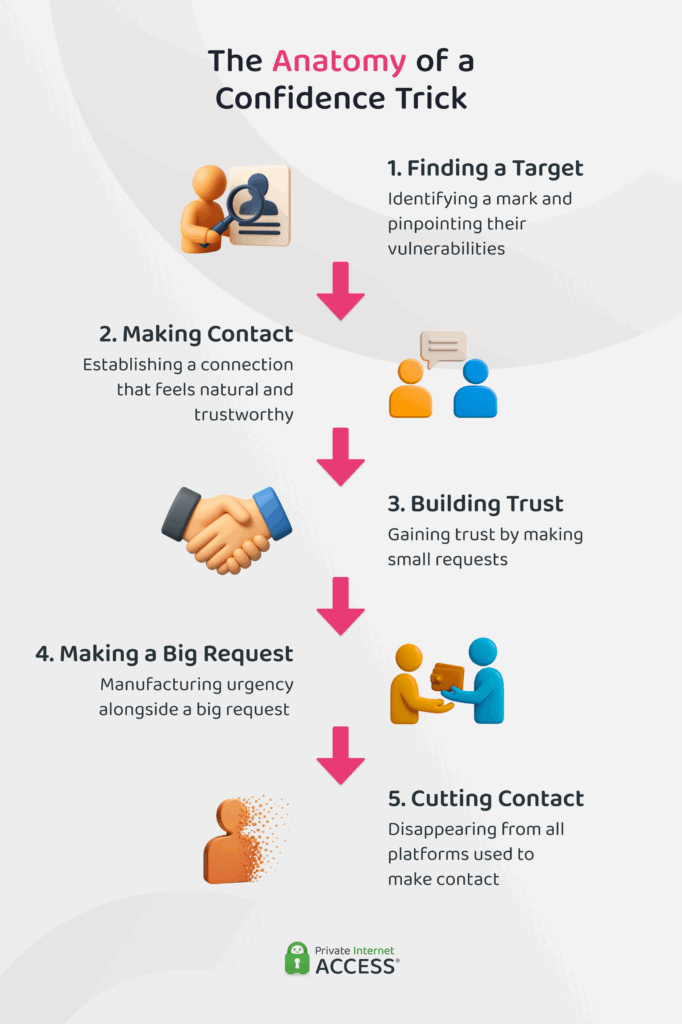
1. The Foundation: Finding a Target
Before they set the con in motion, the con artist identifies a suitable mark and pinpoints what makes them vulnerable. That vulnerability might be financial stress, loneliness, a recent life event, or simply a desire for a good opportunity.
This has become much easier in the digital age. Public social media profiles, online forums, and data exposed in breaches can all give a con artist the information they need to tailor their approach.
In the second quarter of 2025 alone, nearly 94 million data records were exposed in breaches, with personally identifiable information like names, email addresses, phone numbers, and other details that are useful to con artists being revealed2.
What they’re looking for is the right emotional entry point; something they can use to make their opening move feel personal, relevant, and hard to ignore.
2. The Approach: Making Contact
With a target identified, the con artist makes their move. How they make contact will depend on what they know about you and the type of con they’re running, but the goal is always the same: to establish a connection that feels natural and trustworthy.
Sometimes this looks like a friendly stranger striking up a conversation. Other times, it’s an email that appears to come from your bank, a phone call from someone claiming to be a government official, or a social media message from what looks like a legitimate business. In some more shocking cases, like bromance scams3, it might even be an actual friend.
At this stage, the con artist is just trying to get you to engage. They want to make you feel comfortable enough to keep the conversation going, so they’re unlikely to ask you for anything – yet.
3. The Build-Up: Inviting Trust and Sharing the Opportunity
Once they’ve got you talking, the con artist will start to build a deeper relationship with you. Their first requests will likely be small and non-monetary. Think getting you to reply to a message, take a phone call, or share some personal information.
This is a well-known psychological trick called the foot-in-the-door technique. It’s a persuasion strategy that leads people to comply with big requests by leading them to honor smaller asks beforehand.
Once you’ve agreed to a few small things, trust is established and the con artist introduces the opportunity. This could be an investment with impressive returns, a business deal, a prize, or an exclusive offer.
To make this feel real, the scammer may even let you see a small return for your efforts early on. It’s usually just enough to convince you the opportunity is legitimate and to lower your guard ahead of the bigger request that’s coming.
4. The Pay-Out: Making a Big Request
Now that they have your trust, the con artist will make their move and ask for something more significant like money, account access, sensitive personal data, or even legal control over your assets.
To push the mark into acting, they’ll typically manufacture a sense of urgency. The investment opportunity or prize is only available for a limited time. Or the problem needs to be resolved immediately to avoid tragic consequences.
This should be a big red flag. They don’t want you to stop and think because taking a moment to pause, consult someone you trust, or verify their claims is often enough to expose the con for what it is.
5. The Disappearance: Cutting All Contact
As soon as the con artist has what they came for, they vanish. Contact drops off, messages go unanswered, and the person you thought you knew turns out to be untraceable. This is by design.
Throughout the con, the scammer will have taken steps to make sure they can’t easily be found. They will likely have used a fake name, phone number, email address, or a social media profile that can be deactivated overnight.
This is one of the reasons why so many confidence tricks go unreported and unpunished. By the time the mark realizes what has happened, the trail has gone cold and the con artist has likely already moved on to their next target.
How Con Artists Take Advantage of Victims
Con artists are skilled psychological manipulators. They have a toolkit of specific tactics to keep their marks compliant and prevent them from stopping to question what’s happening:
- Emotional manipulation: Whether it’s fear, greed, compassion, or excitement, con artists identify which emotion is most likely to cloud your judgment and exploit it.
- Impersonating authority figures: Con artists frequently pose as bank officials, government agents, tech support representatives, and other trustworthy figures.
- Urgency and pressure: Scammers create artificial time pressure to stop you from thinking clearly and hopefully override your better judgment.
- Enticing offers: Unusually high investment returns, unexpected prizes, exclusive deals, and other offers are engineered to appeal to your best-case thinking and discourage you from asking questions.
What Happens to Victims of Confidence Tricks?
The damage caused by a confidence trick usually extends way beyond the end of the con. And the consequences can be wide-ranging.
The most immediate impact is financial. Victims may lose significant sums of money – in some cases, all their life savings – with little chance of recovery given the untraceable payment methods con artists favor and the difficulty of tracking them down once they’ve disappeared.
The emotional aftermath can be just as serious. Shame, self-doubt, anxiety, and a lasting difficulty trusting others are all common responses. Many victims don’t report what happened out of embarrassment, which only makes it easier for con artists to keep operating.
If you’ve been targeted, reporting the incident helps authorities build a clearer picture and can protect others from falling victim to these schemes.
Classic Confidence Tricks
Confidence tricks are nothing new. The shell game (where a mark bets on which cup hides a ball, while the operator uses sleight of hand to ensure they always lose) dates back to ancient Greece. And three-card monte, a card-based variation of the same game, was already a well-known street scam by the 15th century.
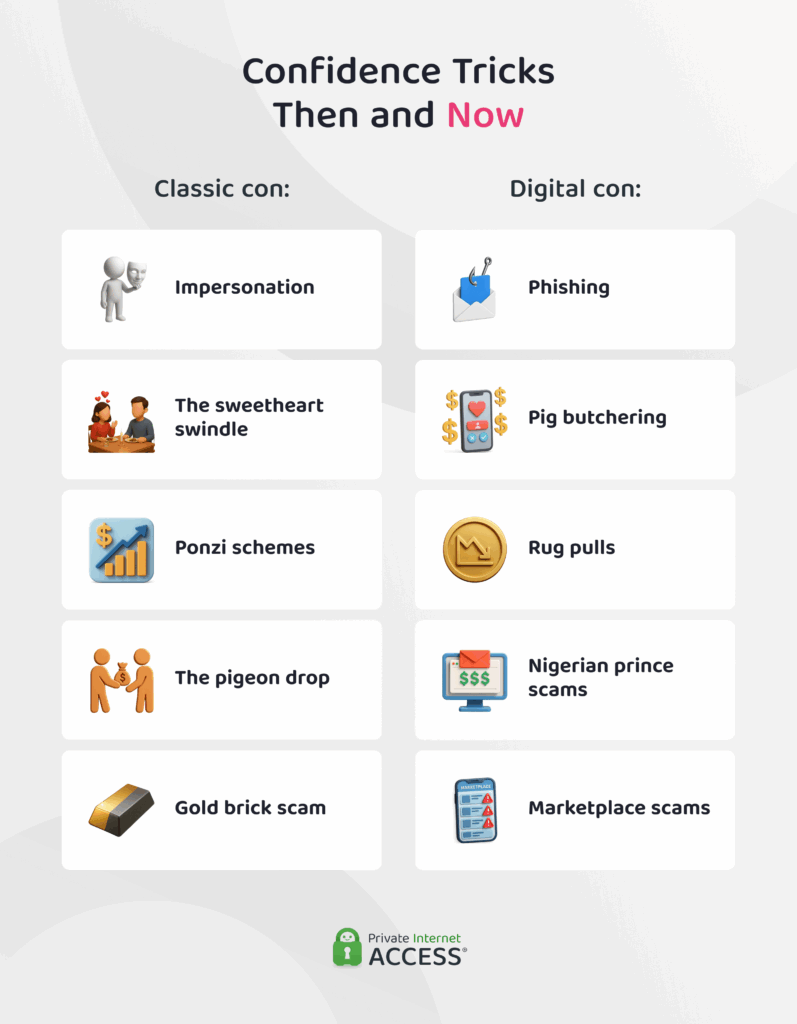
Other long-running cons that have stood the test of time include:
- The pigeon drop: A mark is persuaded to put up their own money to share in a larger sum that never materializes.
- Gold brick scams: The mark is sold a seemingly valuable item that turns out to be worthless.
- Blackmail setups: The mark is lured into a compromising situation and then threatened with exposure unless they pay up.
- Ponzi schemes: Early investors are paid using money from new ones, creating the illusion of a legitimate return.
What these cons have in common is that none of them have disappeared – they’ve simply evolved. With the World Wide Web (and the dark version) at their fingertips, con artists now have a much bigger pool of potential marks to reach.
Confidence Tricks in the Digital Age
Most classic confidence tricks have found a new home online, and the internet has also given rise to entirely new categories of scam. Let’s take a look at some of the most common confidence tricks you’re likely to encounter today.
Phishing Scams
Phishing is one of the most widespread online confidence tricks. Here, the scammer impersonates a trusted organization (e.g. a bank, a delivery company, or a government agency) to get you to hand over personal information or click a malicious link.
You might see this in fake bank alerts warning of suspicious account activity, delivery notifications asking you to pay a customs fee or confirm your address, and spoofed emails from well-known brands asking you to verify your login details.
These messages are engineered to look legitimate, often mirroring the branding and tone of the real organization they’re impersonating. The scammer succeeds when they persuade you to trust the source of the message and act before you stop to question it.
Impersonation Scams
Impersonation scams are exactly what they sound like: The con artist pretends to be someone you’d trust.
- Grandchild scams: A fraudster poses as a grandchild in distress and begs the victim not to tell anyone.
- Charity scams: Often timed around natural disasters or the holiday season, the con artist poses as a legitimate fundraiser.
- Tech support scams: Someone claims your device has a problem and requests remote access or payment to fix an issue that doesn’t exist.
- Sick child or family emergency hoaxes: Scammers manufacture urgent crises designed to bypass rational thinking entirely.
The target of these scams varies, but the mechanism is always the same. The con artist exploits your trust in a familiar or credible figure.
Investment and Inheritance Scams
Investment and inheritance scams are some of the most common confidence tricks online. The con artist promises the mark a large sum of money, then extracts fees or personal information before it can be released.
The most well-known example is the Nigerian prince scam (also called advance-fee fraud). In this setup, a supposed foreign dignitary, official, or wealthy individual asks for your help moving money, promising a generous cut in return.
Inheritance scams work in a similar way, with fraudsters posing as lawyers who represent a deceased stranger who has allegedly left you a large bequest. Like the Nigerian prince scam, the con artist continuously asks you to cover fees, but the promised payout never arrives.
A more modern variation involves fake investment mentors. These are often polished social media personalities who promise to teach you their methods for a fee, or invite you into exclusive investment opportunities that turn out to be fraudulent.
Romance Scams
Romance scams are probably the most emotionally damaging confidence tricks around. The con artist builds what feels like a genuine relationship before eventually fabricating a crisis and asking for money.
The most sophisticated version of this is known as pig butchering, where scammers spend weeks or months cultivating deep trust before steering the conversation toward a fake investment opportunity.
By the time the request comes, the emotional connection feels real enough to override any reasonable skepticism. This makes it much easier to understand how 17,910 complainants reported total losses of $672,009,052 to the Federal Bureau of Investigation in 2024 alone4.
The 2022 Netflix documentary The Tinder Swindler brought widespread attention to this kind of long con, exposing how fraudster Simon Leviev used a fabricated billionaire lifestyle to manipulate women into funding his next con.
Marketplace Scams
Some confidence tricksters take advantage of platforms like Facebook Marketplace, eBay, and Craigslist to extract money from marks on both sides of a transaction.
Fake sellers list items that don’t exist, collect payment upfront, and disappear. Fake buyers use fraudulent payment methods (e.g. stolen cards, counterfeit checks, fake transfer confirmations) to obtain goods without ever paying for them.
One of the most common tactics is the overpayment scam. A buyer accidentally sends more than the asking price and requests a refund for the difference. You send it back, their original payment gets reversed (because it was made with a stolen card or fake check), and you’re left out of pocket on both counts.
These scams are rising in popularity and are relatively effective, with 37% of people living in Great Britain having experienced scams while buying or selling on online marketplaces5.
Cryptocurrency Scams
Cryptocurrency has become a magnet for confidence tricks. And it’s easy to understand why. Transactions are largely irreversible, wallets can be anonymous, and the space moves fast enough that many investors don’t stop to ask the right questions.
Some of the most damaging crypto scams are rug pulls. Developers launch a new token, convince investors to buy in, and abruptly liquidate their holdings, leaving everyone else with tokens worth nothing.
Beyond rug pulls, crypto is also heavily used as the payment method of choice in other confidence tricks – including pig butchering scams and fake investment platforms – precisely because once the money is gone, there’s almost no way to get it back.
Warning Signs of a Confidence Trick
Most confidence tricks rely on the same architecture, which means they share red flags. That said, because they often appear one at a time, they can seem minor in isolation. Fortunately, knowing what to look for makes it much harder for a con artist to get a foothold:
- Requests for payments via unusual methods: Payments via gift cards, wire transfers, and cryptocurrency are all common asks in confidence tricks because they’re difficult or impossible to reverse once sent. A legitimate business or individual will rarely, if ever, insist on these.
- Requests for personal or login information: No genuine bank, company, or government agency will ask for your password, PIN, or full login credentials. If someone does, treat it as a serious warning sign.
- Pressure to act quickly: Phrases like “this offer expires today” or “you need to act now” are designed to stop you from thinking clearly or consulting someone else and should always raise suspicions.
- Requests to move to private platforms: A common early move is pushing the conversation to a private channel (e.g. WhatsApp, Telegram, or personal email) where there’s less oversight and fewer protections.
- Requests for secrecy: Con artists isolate their marks to prevent anyone from intervening. If someone asks you not to tell your family, friends, or bank about a transaction or opportunity, that’s a significant red flag.
- An offer that seems too good to be true: Unusually high returns, unexpected prizes, exclusive deals with no clear reason you’ve been selected are all warning signs. If something feels engineered to be irresistible, it probably is.
The best strategy is to trust your instincts. If something feels off, it most likely is.
What to Do If You Think You’re Being Targeted
Realizing you may be the mark in a confidence trick is unsettling, but it’s a blessing in disguise. The sooner you act, the better your chances are of limiting the damage. Here’s what to do:
1. Stop Responding
The first thing to do is cut off contact. Immediately. Don’t continue to engage by challenging the con artist, trying to recover money, or getting them to admit what they’re doing – it’s unlikely to work and it gives them the opportunity to keep manipulating you.
If the contact came through a specific platform, block the scam account. This also makes it harder for them to approach you again under a different identity.
2. Cancel Transactions or Transfers
If money has changed hands, contact your bank or payment provider immediately and explain that you’ve been the victim of a scam. Many institutions have fraud teams that can freeze or reverse transactions if you reach them quickly enough.
It’s much more difficult to recover funds if you’ve paid via cryptocurrency or wire transfer, but reporting it promptly still matters. Your provider may be able to flag the transaction and early reporting improves the chances of any wider investigation.
3. Secure Your Accounts
Where you’ve shared personal information, passwords, or login credentials during the interaction, you’ll need to secure your accounts.
Change the passwords for any affected accounts, and enable two-factor authentication if you haven’t already. If you shared financial information (e.g. card details or bank account numbers), contact your bank to flag this and discuss whether your accounts need to be frozen or reissued.
4. Report the Scam
Reporting what happened is extremely important. It helps authorities to build a clearer picture of how scammers are operating and can protect others from falling victim to the same con.
Report the incident to your national fraud or consumer protection authority (e.g. the FTC in the US or Action Fraud in the UK), as well as the platform where the contact was made. If the scam involves financial fraud, you should also notify your bank.
How to Protect Yourself From Confidence Tricks
There isn’t a single tool or habit that will make you immune to confidence tricks, but there are a few sensible precautions you can take to make you less of a target:
- Verify identities and offers: If you receive unexpected contact from a bank, company, or government agency, don’t respond directly. Look up their official contact details independently and reach out through their official channels instead.
- Limit the personal information you share online: Public social media profiles, forum posts, and data exposed in breaches all give con artists material to work with. The less information you make publicly available, the harder it is for a scammer to tailor their approach to you.
- Use cybersecurity tools to reduce your risk: Strong passwords stored in managers, authenticator apps, and VPNs all help limit your exposure to scammers. Many browsers and security suites will also flag suspicious websites and known phishing domains before you interact with them.
Confidence Tricks: FAQs
What is a confidence trick?
A confidence trick is a scam built on manufactured trust. The fraudster or con artist invests time in making their target (known as the mark) feel comfortable and convinced before exploiting them. By gaining a victim’s confidence first, they can extract money, personal data, or both.
How does a confidence trick work?
Confidence tricks usually follow a pattern: First, they find a vulnerable target. Then they establish their credibility and make small requests to build trust. Finally, they strike with a larger ask. The whole process is designed to get their mark’s trust so they can extract money or data from them.
What are common examples of confidence tricks?
Phishing emails, romance scams, fake investment opportunities, and online marketplace fraud are among the most widespread confidence tricks today. Longer-running cons like Ponzi schemes and advance-fee fraud are also still pretty common.
What are the warning signs of a confidence trick?
Urgency, secrecy, and unusual payment requests are the clearest signals that you might be being targeted for a confidence trick. So is being pushed off an official platform onto a private channel. Any situation where you feel pressured to act before you’ve had time to think should raise suspicions.
Why do confidence tricks work so well on people?
Confidence tricks are engineered to work well. Con artists study their marks carefully, identifying the emotional entry point they can exploit to get their targets to act. It’s important to know that the belief that you’re too smart to be fooled can actually make you more susceptible to these schemes, not less.
How can I protect myself from confidence trick scams?
Healthy skepticism is your best defence. Verify unexpected communications independently, research offers before committing, and be cautious about what you share online. Using a VPN can help. It encrypts your traffic and reduces your visible digital footprint, giving scammers less to work with from the outset.
References:
- Online Scams and Attacks in America Today – Pew Research Center
- Data breaches worldwide – statistics & facts – Statista
- Romance scam from the front lines of the $16 billion fraud crisis: 6 dead dogs, a missing $39,000, and a wronged widow – Fortune.com
- Federal Bureau of Investigation Internet Crime Report 2024
- Almost two fifths of Brits have experienced scams on online marketplaces – Experian
