What Is ECDSA? Everything You Need to Know
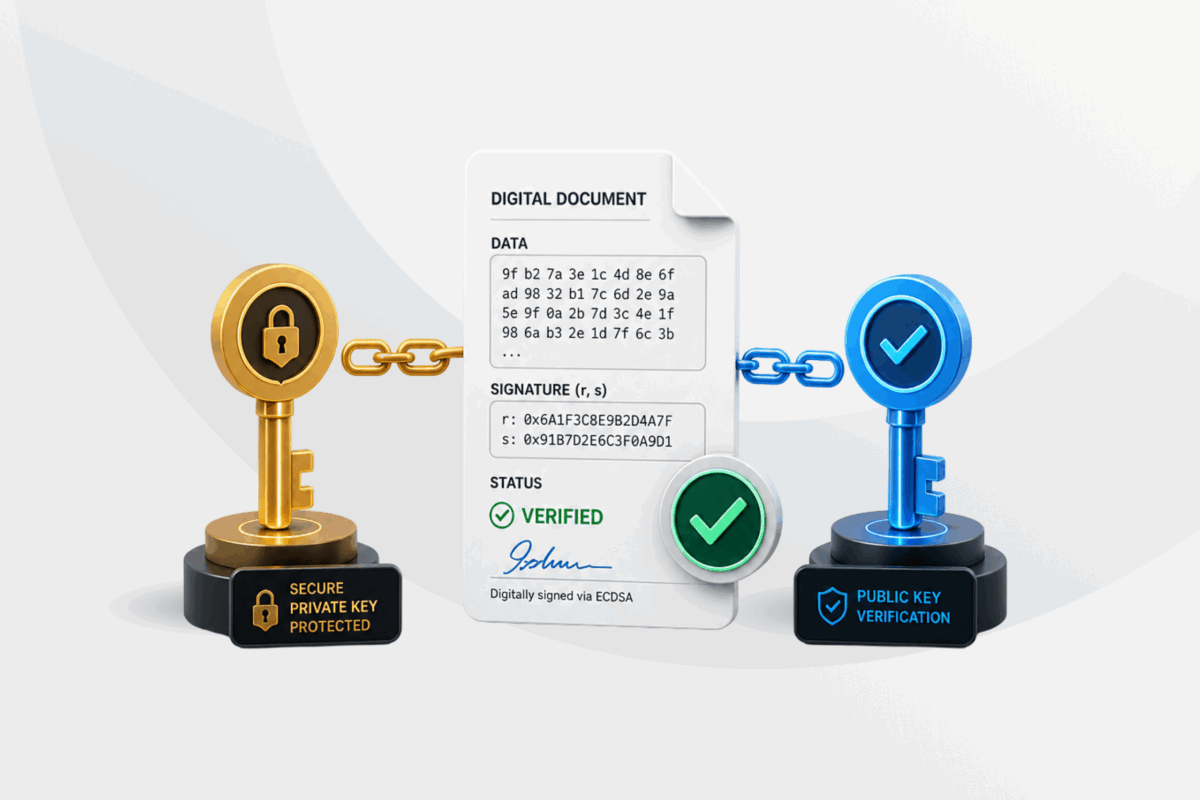
Every time your browser indicates that a site is using HTTPS, the site needs to prove it’s what it claims to be. Digital signatures do that job. They also let devices check that software updates come from a trusted source, and some blockchain networks use them to approve transactions.
Elliptic Curve Digital Signature Algorithm (ECDSA) is one of the methods behind these checks. This guide explains how ECDSA keys and signatures work and how they compare with other methods.
Understanding ECDSA
ECDSA is a cryptographic method that lets a person, device, or service create a digital signature using a private key that others can check with a matching public key. A successful check shows the signature came from the entity who held the private key.
A valid signature also shows that the data hasn’t changed since signing. Even a small change to the message causes the check to fail, which can alert the recipient to tampering or file corruption.
ECDSA doesn’t prove who owns a key on its own, though. A digital certificate or another trusted way of sharing the public key must link that key to a known website, person, or device. While ECDSA supports authenticity and data integrity, it doesn’t encrypt anything by itself.
What Is an ECDSA Key and How Is It Used?
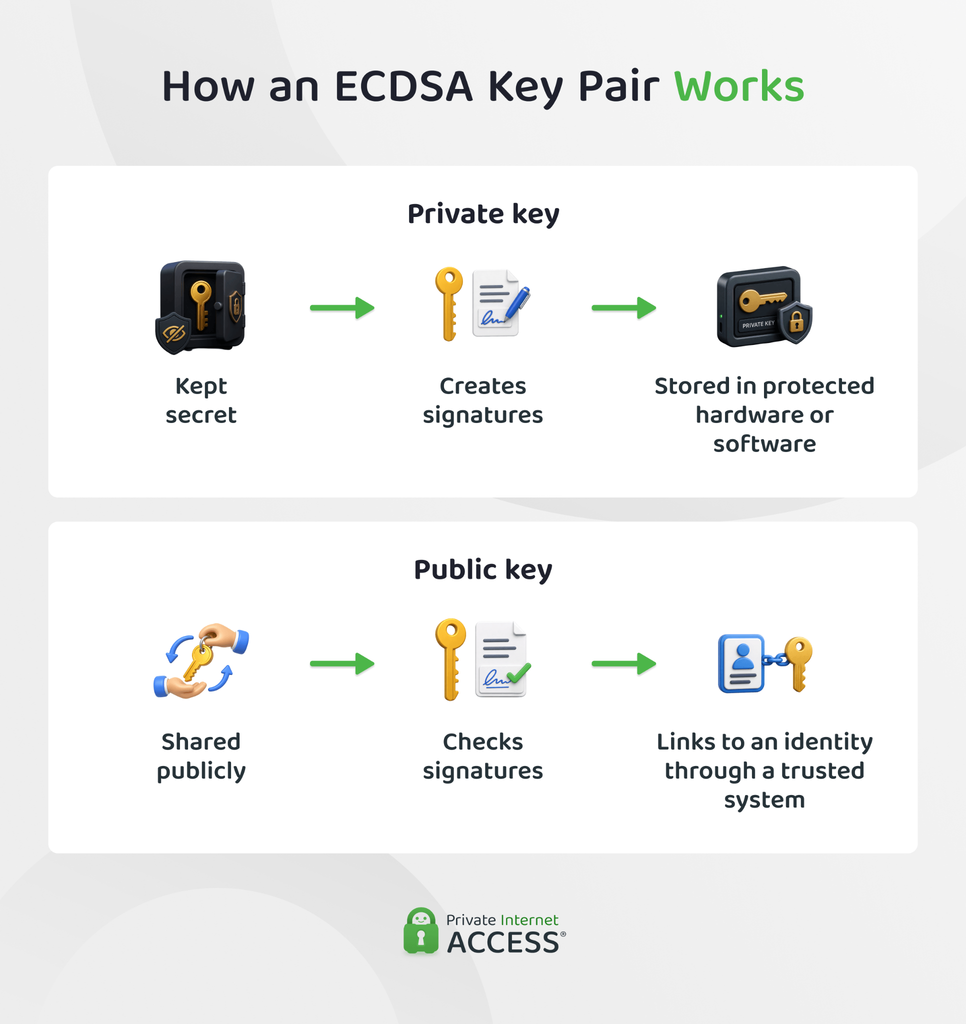
ECDSA uses a pair of linked keys. The private key creates digital signatures, while the public key checks them. The pair links mathematically but with secure curve settings, nobody can derive the private key from the public one.
Passkeys use the same asymmetric key model. The website or app you sign in to stores the public key, while an authenticator or credential manager protects the private key.
ECDSA Private Key
An ECDSA private key is a secret integer within the valid range of a specific elliptic curve, which provides the mathematical structure for key pairs. Proper key generation relies on cryptographically secure random number generators rather than manual selection.
Only the key owner should have access to the private key. A website may store it in a protected server key store, while a company might use a hardware security module for higher-risk signing tasks. Phones and laptops can also keep keys in hardware-backed security systems that limit direct access to the key itself.
Anyone who steals a private key may be able to create signatures that appear to come from its owner. For example, an attacker could sign a fake software update or pose as a server if the rest of the system still trusts that key.
An organization’s security policy may also require routine key rotation, which limits how long any one key stays in use and makes planned replacement easier. Rotation alone won’t fix an active compromise, though. You also have to revoke the old key or remove it from trusted systems.
ECDSA Public Key
The ECDSA public key lets other systems check signatures created with the matching private key. It doesn’t need to remain secret so the owner can share it with clients, users, or other services that need to verify signed data.
That sharing carries a catch. A trusted system must connect the key to an identity. For websites that use HTTPS, a certificate authority verifies the link between a public key and the owner’s identity, which may include a domain name among other identifiers, and issues a certificate confirming it. A company may instead place an approved key in a managed directory or device configuration.
Whoever receives the key must also trust how they got it. If an attacker swaps in their own key along the way, the signatures they produce will look valid. Certificates and other trusted distribution systems help prevent this by giving the recipient a reliable way to check which key belongs to the expected party.
How Does ECDSA Work?
ECDSA creates a digital signature that links a message to a specific private key. It first reduces the message to a short value called a message digest, then uses that digest to create the signature.
A recipient can check the signature with the corresponding public key. A successful check provides strong evidence that someone with access to the matching private key created the signature.
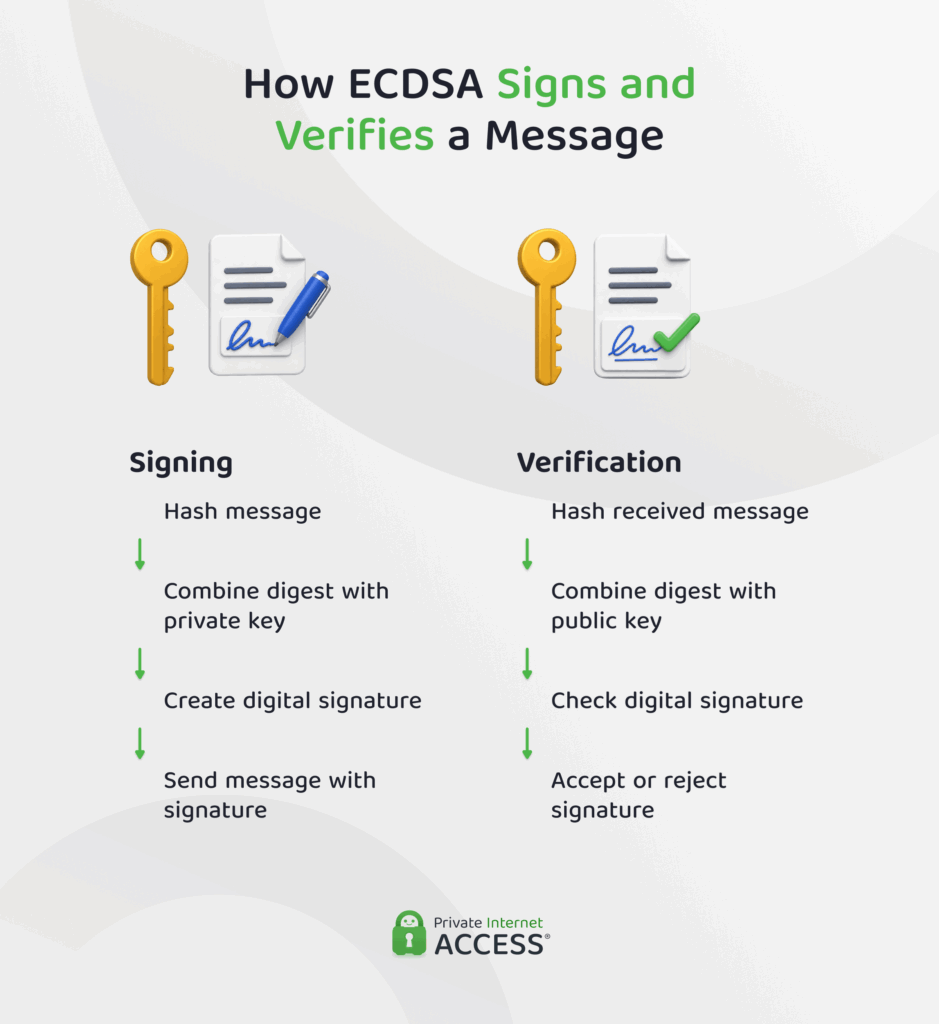
1. Hashing the Message
The signer first passes the message through a cryptographic hash function. This function converts data of any size into a fixed-length value called a message digest, or hash.
ECDSA uses this digest during the signing calculation instead of processing the entire message. A software update, for example, may contain millions of bytes, but its digest always has the length defined by the chosen hash function.
As a result, the main signing process works the same way whether the original data is a short text file or a large download. The hash function must still provide a security level that suits the ECDSA key, since a weak hash can reduce the strength of the final signature.
2. Creating the Signature
Once the digest is ready, the signer generates a temporary secret number called k. ECDSA needs a fresh and unpredictable value for every signature. Reusing k, or generating it with a weak source of randomness, can expose the private key. Then:
- The algorithm performs its calculations within an elliptic-curve system, using a defined set of mathematical rules and fixed values. Anyone who creates or verifies the signature must use the same system.
- One of the curve’s fixed values is the base point. ECDSA combines this point with k through an elliptic-curve calculation. Part of the result becomes r, the first number in the signature.
- A second calculation produces s, the second signature number. This step uses the message digest and the private key. It also includes r and k, which link the finished signature to both the message and the signer’s key.
- Together, r and s form the ECDSA signature. The signature doesn’t contain the private key or reveal k. The signer sends or stores these two values with the message so that another party can verify it.
3. Verifying the Signature
The verifier receives the message together with r and s. It begins by hashing the received message with the same hash function used during signing. This produces a new digest that represents the message in its current form.
Before continuing, the verifier checks whether r and s fall within the range allowed by the chosen elliptic curve. A value outside that range makes the signature invalid.
ECDSA then uses the new digest, the signature values, and the signer’s public key in another elliptic-curve calculation. This produces a point on the same curve. The algorithm creates a number from that point and compares it with r.
If the two values match, the verifier accepts the signature. A mismatch causes the verifier to reject it. Changing the message alters its digest, while using the wrong public key or different curve settings makes the check fail.
A valid signature applies to one specific combination of message and private key. It also depends on the public key, the hash function, and the elliptic-curve parameters used during signing.
Why the ECDSA Nonce Matters
ECDSA signatures require a unique, one-time random or pseudo-random value known as the nonce, or k, for every message signed.
Standard randomized ECDSA generates k with a secure source of random data. Each value must fall within the range set by the curve, and the generation process mustn’t make some values more likely than others.
Deterministic ECDSA takes a different approach. It derives k from the private key and the digest of the message through a set process. Therefore, signing the same message with the same key produces the same signature. The verifier doesn’t need to know which method created k because both methods produce standard ECDSA signatures.1
Deterministic generation reduces the risk caused by a poor source of random data during signing and doesn’t change the rest of the ECDSA process. If an implementation reuses k across different messages or makes it predictable, an attacker may be able to recover the private key.
ECDSA vs. RSA: What’s the Difference?
ECDSA and Rivest-Shamir-Adleman (RSA) can both create digital signatures, but they rely on different types of math. ECDSA uses elliptic curves, while RSA relies on the difficulty of breaking a large number into its prime factors.
While ECDSA only creates digital signatures, RSA handles both signatures and encryption through different RSA-based methods. Here’s how the two compare.
| Features | ECDSA | RSA |
| Main functions | Creates and verifies digital signatures only | Creates and verifies digital signatures; RSA OAEP can encrypt short values |
| Common key types | P-256 and P-384 curves | RSA-2048, RSA-3072, and RSA-4096 key sizes |
| Certificate size | Usually smaller at comparable security strength | Usually larger because RSA public keys and signatures contain more data |
| Key generation | Usually faster because the public key is derived from one private value | Usually slower because the system must generate suitable large prime numbers |
| Signing efficiency | Typically faster than RSA signing at comparable security strength | Often requires more processing, especially as the RSA key grows |
| Verification efficiency | Typically slower than RSA verification | Often fast when the public key uses a common small exponent |
| Storage and bandwidth | Smaller keys and signatures reduce storage and network overhead | Larger keys and signatures require more storage and network data |
| Adoption and compatibility | Broad support in modern software, though some older clients may reject ECDSA certificates | Broad modern support with stronger compatibility across many legacy systems |
| Quantum resistance | None: Shor’s algorithm breaks it | None: Shor’s algorithm breaks it |
ECDSA vs. RSA Key Size and Security
Raw key length alone doesn’t tell you which algorithm is safer. A 256-bit ECDSA key and a 256-bit RSA key don’t offer anything close to the same protection because the two systems use different mathematical problems.
Cryptographers compare them through security strength instead. This estimates how much work an attacker would need to break the algorithm with a conventional computer. Two keys can have different lengths while still aiming for the same security strength.
| Estimated security strength | ECDSA curve size | RSA key size |
| 112 bits | 224–255 bits | 2,048 bits |
| 128 bits | 256–383 bits | 3,072 bits |
| 192 bits | 384–511 bits | 7,680 bits |
| 256 bits | 512 bits or more | 15,360 bits |
This is why most people compare ECDSA P-256 with RSA-3072. Both aim for about 128 bits of classical security, even though the RSA key is much larger.2
Fewer bits don’t make ECDSA safer on their own. Elliptic-curve math reaches the same estimated security level in a more compact key.
ECDSA vs. RSA Performance
ECDSA generally needs less storage and less network data than RSA, but that doesn’t make it faster at every task. Performance changes depending on what the system is doing:
- Key generation: ECDSA creates a private value, then generates the public key from it. RSA must generate large prime numbers before it can build the key pair, which can take longer at larger key sizes.
- Signature creation: ECDSA often creates signatures faster than RSA at a similar security level. This can reduce the load on systems that sign large numbers of files or connection requests.
- Signature verification: RSA can verify signatures very quickly with common public-key settings. ECDSA may take longer during this step, depending on the curve and software in use.
- Network transfer: ECDSA sends less data because its keys and signatures are smaller. This can matter during a full TLS handshake, when the server sends its certificate chain.
- Storage: ECDSA takes up less space when a system stores many keys or signed records. The difference may also help small devices with limited memory.
Compatibility and Implementation
RSA has an advantage when a service must support older software because it has been in wide use for decades. ECDSA works across modern browsers and operating systems, but both sides must support the chosen curve.
For example, a client may accept ECDSA P-256 yet reject a less common curve, while some older devices may not accept ECDSA certificates at all.
Services that need broad compatibility can offer both certificate types. Modern clients receive the smaller ECDSA certificate, while older clients fall back to RSA. That keeps older devices working without losing ECDSA’s efficiency everywhere else.
Your infrastructure can narrow the choice too. A certificate provider or hardware security module may support only certain curves or RSA key sizes. ECDSA systems must also agree on the curve and signature format, while RSA must use a defined signature scheme such as RSA-PSS.
When Should You Use ECDSA Instead of RSA?
ECDSA is often a good choice when every client that has to verify your signatures supports the curve you pick, and smaller keys offer a clear benefit. It can suit modern websites that handle many secure connections, and it helps devices with limited storage or network capacity.
RSA may still make more sense when older system support matters more than smaller keys. It can also be the practical choice when current hardware or company rules already depend on RSA.
Neither algorithm wins outright. RSA’s compatibility with a wider range of older systems balances out ECDSA’s smaller keys and signatures. The right choice depends on the devices that must verify the signature and the rules the system must follow.
ECDSA vs. ECC and ECDH: What’s the Difference?
Elliptic-curve cryptography (ECC) is the broad category. The three algorithms below apply it to different tasks, so they aren’t competing options so much as different tools.
ECDSA vs. ECC
ECC covers all cryptographic techniques that use calculations based on elliptic curves. ECDSA is one specific ECC algorithm designed to create digital signatures.
That makes ECDSA part of ECC rather than an alternative to it. When software advertises ECC support, the label doesn’t reveal which algorithms or curves it supports. You may still need to check for a specific combination, such as ECDSA with the National Institute of Standards and Technology (NIST) P-256 curve.
ECDSA vs. ECDH
ECDSA proves that someone with a specific private key signed a piece of data. Elliptic Curve Diffie–Hellman (ECDH) does something else. It lets two parties create the same shared secret without sending that secret across the network.
Each party combines its own private key with the other party’s public key. Both calculations produce the same shared secret value. The system then passes that result through a key-derivation function to create keys for symmetric encryption.
That said, ECDH doesn’t prove who the other party is on its own. An attacker could stand between both sides and create separate shared secrets with each of them unless the protocol adds authentication.
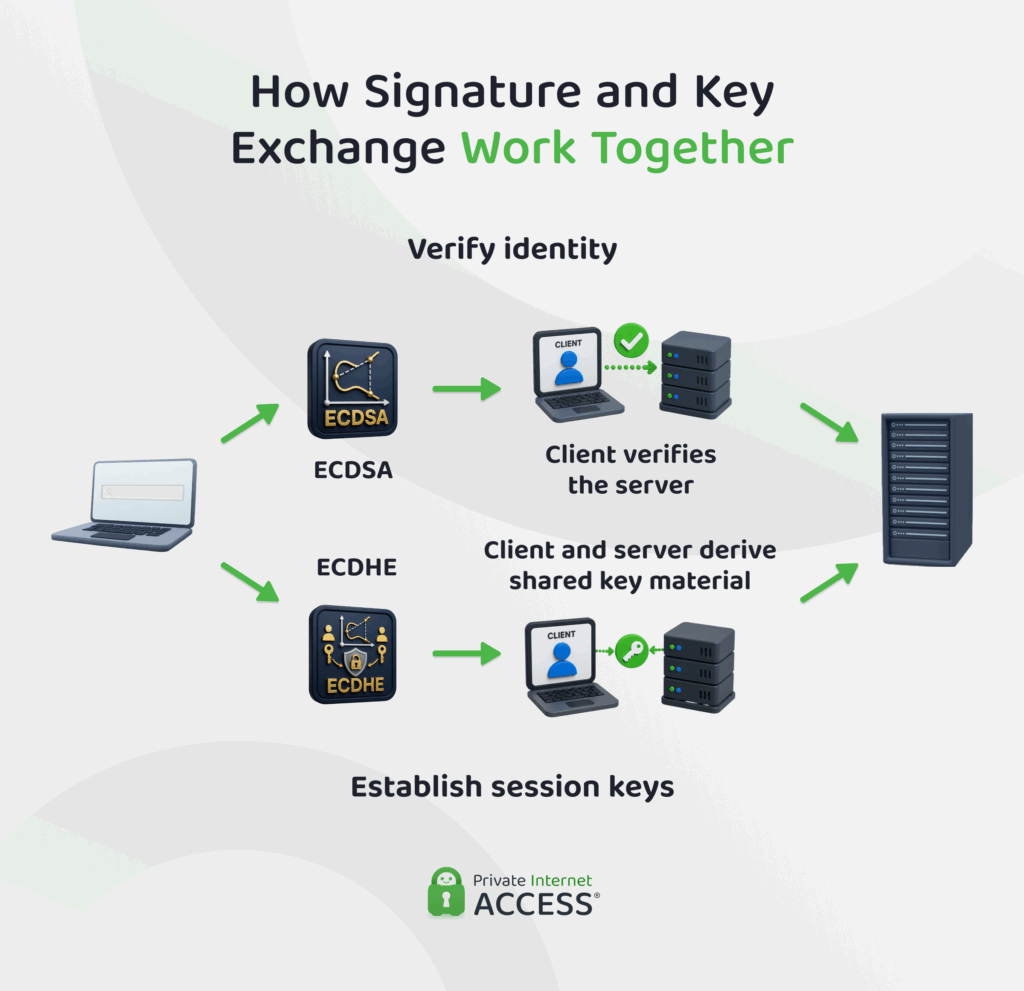
A secure connection can use both ECDSA and ECDH. For example, a Transport Layer Security (TLS) connection may use Elliptic Curve Diffie-Hellman Ephemeral (ECDHE), the temporary key form of ECDH, to establish session keys. ECDSA can authenticate the server during the same connection. Similarly, the IKEv2 protocol can use ECDH for key exchange as part of an IPsec VPN connection along with ECDSA for authentication.
ECDSA vs. EdDSA
ECDSA and Edwards-Curve Digital Signature Algorithm (EdDSA) both create digital signatures with elliptic-curve cryptography. They do the same job through different mathematical designs.
EdDSA has two main standardized forms: Ed25519 and Ed448.3 The former is the version you’re most likely to find in tools such as Secure Shell (SSH), while Ed448 uses a larger curve for a higher security level.
One key difference is how each method creates the temporary value needed for signing. EdDSA produces this value from the private key and the message through a fixed process. This makes EdDSA deterministic by design and avoids relying on fresh random data for each signature. ECDSA can also work this way, but it also supports deterministic signing.
The two methods aren’t interchangeable. An Ed25519 public key can’t verify an ECDSA signature and ECDSA software can’t use an EdDSA key unless it supports that exact method. The right choice usually depends on the protocol, available software, and any standards the system must follow. Neither method is automatically best for every use.
Comparing ECDSA, RSA, and DSA
ECDSA, RSA, and Digital Signature Algorithm (DSA) are all public-key algorithms that can create digital signatures. Each rests on a different mathematical problem, and each offers a different set of capabilities. Here’s how the stand under the Digital Signature Standard (DSS) released by the National Institute of Standards and Technology:
| Algorithm | Mathematical basis | What it does | Status under NIST FIPS 186-5 |
| ECDSA | Elliptic Curve Discrete Logarithm Problem | Creates and verifies digital signatures | Approved for new signatures with supported curves |
| RSA | Integer factorization problem | Supports digital signatures; separate RSA schemes can encrypt small values | Approved for new signatures with suitable key sizes |
| DSA | Discrete logarithms in a finite field | Creates and verifies digital signatures only | No longer approved for creating new signatures; limited to legacy verification |
DSA vs. RSA
DSA does one job, and that’s creating digital signatures. It can confirm that signed data matches a public key, but it doesn’t have a standard way to encrypt data.
RSA supports more than one type of operation through separate schemes. RSA-PSS, for instance, creates digital signatures, while RSA-OAEP can encrypt small pieces of data, such as symmetric encryption keys. Software must use the correct scheme for each task instead of applying the core RSA calculation by itself.
The algorithms also rely on different mathematical problems. DSA uses the difficulty of solving discrete logarithms within a fixed set of numbers governed by specific mathematical rules. RSA depends on the difficulty of finding the two large prime numbers behind its modulus.
DSA vs. ECDSA
ECDSA grew from the basic design of DSA, but it performs its calculations in a different mathematical setting. DSA uses modular arithmetic with large whole numbers, while ECDSA uses points on an elliptic curve.
That change lets ECDSA reach the same estimated security strength with much smaller parameters. For about 128-bit classical security, a traditional DSA setup uses a 3,072-bit prime parameter and a 256-bit subgroup size. ECDSA can target a similar level with the P-256 curve.
Where Is ECDSA Used?
ECDSA appears in systems that need to verify the entity that approved a message or file without exposing the private signing key. A few use cases include:
- TLS certificates: Websites can use ECDSA certificates to prove their identity during a secure connection, which normally uses Port 443. Other algorithms set up session keys and encrypt the data sent through the connection.4
- Cryptocurrency transactions: Some blockchain networks use ECDSA to confirm that a private-key holder approved a transaction. Bitcoin uses it with the secp256k1 curve for many transaction types.5
- SSH authentication: SSH can use ECDSA keys to verify a user connecting to a remote system. Servers can also use them to prove their identity to SSH clients.6
- Software and code signing: Developers can sign apps or updates with ECDSA so devices can check who released them. Android supports ECDSA keys for app signing.7
- DNS security: The Domain Name System (DNS) Security Extensions (DNSSEC) use digital signatures so that resolvers can spot forged or modified records coming from a signed zone.8
- Resource-constrained devices: ECDSA uses relatively small keys and signatures, making it useful for devices with limited storage, processing power, or bandwidth. This can be especially helpful when devices need to digitally sign messages while keeping the amount of data they send and store to a minimum.9
Common ECDSA Security Risks
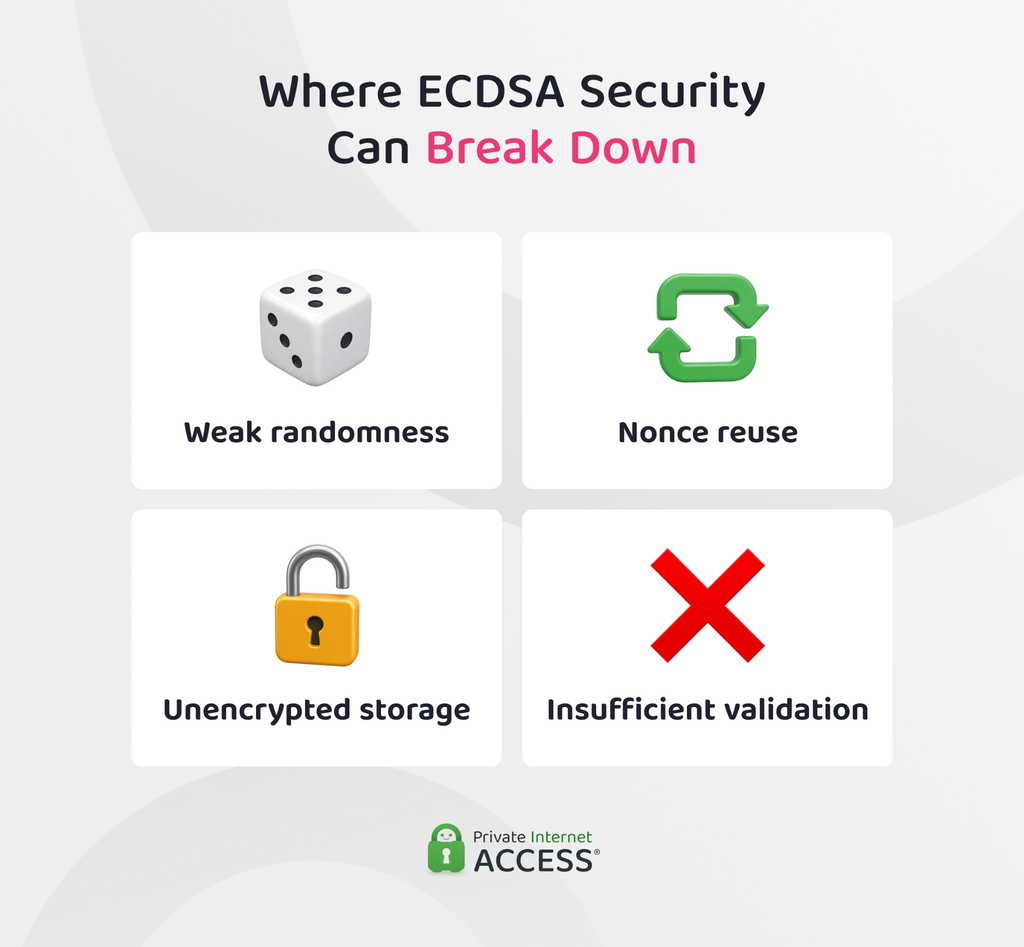
ECDSA remains secure when software follows its rules and protects the private key. Most real-world failures come from weak key generation or mistakes in the code that handles signatures, such as:
- Nonce reuse or predictability: Using the same nonce with one private key gives an attacker enough information to calculate that key. Biased or partly predictable nonces can cause the same result after an attacker studies enough signatures.
- Weak key generation: An ECDSA private key must come from a secure random source and fall within the range set by the curve. Poor randomness can make the key easier to guess or cause separate devices to generate the same value.
- Private key theft: Anyone who obtains the private key can create signatures that pass normal checks. These signatures may continue to appear valid until someone revokes the key or removes it from the systems that trust it.
- Side-channel and fault attacks: Attackers may study how long a device takes to sign data or measure changes in its power use. They can also disrupt a calculation and study the faulty result, which may reveal information about the private key.
- Invalid inputs and verification errors: Software may accept a public key that doesn’t belong to the expected curve or handle a malformed signature incorrectly. ECDSA also allows two related forms of the same valid signature, which can change a transaction or record identifier in systems that don’t require one standard form.
- Unsafe custom implementations: ECDSA depends on exact mathematical rules and strict input checks. A small error in the calculations can break verification, while a mistake in nonce handling can expose the private key.
How to Use ECDSA Safely
Safe ECDSA use depends more on the surrounding software and key controls than on the algorithm alone. Work through these practices when you build or deploy an ECDSA system:
- Use a maintained cryptographic library: Choose a trusted library or operating system security API that receives regular updates. Don’t write your own elliptic-curve calculations or signature checks.
- Choose supported curves and hash functions: Follow the requirements of the protocol or standard you use. Common pairings include P-256 with SHA-256 and P-384 with SHA-384.
- Use a secure nonce process: Let the cryptographic library generate each nonce with a secure random source or a tested deterministic method such as RFC 6979. Don’t supply custom nonce values.
- Limit access to private keys: Store high-value keys in a hardware security module (HSM) or another protected key store when possible. Only approved services should be able to request signatures and the key shouldn’t appear in logs or unprotected backups.
- Validate keys and signatures: Check that public keys belong to the expected curve and that signature values fall within the allowed range. Use the library’s standard decoding and validation functions instead of parsing signatures by hand.
- Use separate keys for separate purposes: Don’t reuse an ECDSA signing key for ECDH key agreement or an unrelated application. Separate key pairs limit the damage if someone compromises one system.
- Replace a key after suspected exposure: Generate a new key pair, then revoke the affected certificate or remove the old public key from trusted systems. Updating the key without removing trust in the old one leaves the original risk in place.
- Test compatibility before deployment: Check the exact curve and signature format against every required client. Test certificate chains and older device versions, then provide an RSA fallback where ECDSA support is uncertain.
Is ECDSA Quantum Safe?
ECDSA isn’t quantum safe. It remains secure against known practical attacks from conventional computers, but a large, fault-tolerant quantum computer could change that.
Such a machine could use Shor’s algorithm to solve the math behind ECDSA and recover a private key from its public key. This would let an attacker create forged signatures that pass normal checks. RSA and traditional DSA face the same long-term risk.
What Could Replace ECDSA?
Two current post-quantum options are ML-DSA and SLH-DSA. Both create digital signatures, but they rely on math that’s believed to resist attacks from large quantum computers.
- Module-Lattice-Based Digital Signature Algorithm (ML-DSA): This uses problems based on mathematical structures called lattices. It’s NIST’s primary standard for post-quantum digital signatures, published as FIPS 204.10
- Stateless Hash-Based Digital Signature Algorithm (SLH-DSA): SLH-DSA builds signatures from cryptographic hash functions instead.11 It provides an alternative based on a different security foundation in case future research finds a serious weakness in lattice-based methods.
Neither method is a larger or upgraded version of ECDSA. They use different keys and signature formats. Their data sizes are also larger, so replacing ECDSA may require changes to software, hardware, or security protocols.
FAQ
What is ECDSA?
ECDSA is a public-key algorithm that creates and verifies digital signatures with elliptic-curve cryptography. The signer uses a private key, while others check the signature with the matching public key. ECDSA helps detect changed data, but it doesn’t encrypt the content.
How does ECDSA work?
ECDSA first turns the message into a fixed-length digest with a cryptographic hash function. It then uses that digest, the private key, and a per-message secret value to create the signature. The recipient checks it with the public key and the same curve settings.
ECDSA vs. RSA: What’s the difference?
Both ECDSA and RSA can create digital signatures, but they rely on different mathematical problems. ECDSA reaches a similar classical security level with much smaller keys. P-256, for example, is roughly comparable to RSA-3072. Separate RSA schemes can also encrypt small values, while ECDSA only handles signatures.
What is an ECDSA key and how is it used?
An ECDSA key is one half of a linked public-private key pair. The private key creates signatures, while the public key verifies them. A certificate or another trusted system must link the public key to a person, device, or website.
Is ECDSA more secure or faster than RSA?
ECDSA isn’t more secure or faster than RSA. Secure versions of both can provide a similar level of classical protection, but ECDSA uses smaller keys and often signs data with less processing. RSA verification can be faster in common setups, so results depend on the software and hardware.
How do I decide between using ECDSA and RSA?
You should use ECDSA when all required clients support the chosen curve and smaller keys or signatures provide a clear benefit. It often suits modern systems that need lower storage or network overhead. RSA may remain the better choice when older clients or RSA-only hardware must stay supported.
Resources:
- RFC 6979: Deterministic Usage of the Digital Signature Algorithm (DSA) and Elliptic Curve Digital Signature Algorithm (ECDSA) – RFC Editor
- Comparing ECDSA vs RSA: A Simple Guide – SSL.com
- RFC 8032 EdDSA: Ed25519 and Ed448 – RFC Editor
- RFC 8446: The Transport Layer Security (TLS) Protocol Version 1.3 – RCF Editor
- Transactions — Bitcoin
- RFC 5656: Elliptic Curve Algorithm Integration in the Secure Shell Transport Layer – RCF Editor
- Android signing schemes, compliance and crypto agility – SignServer
- DNS Security Introduction and Requirements – RFC Editor
- RFC 5480: Elliptic Curve Cryptography Subject Public Key Information – RFC Editor
- NIST Releases First 3 Finalized Post-Quantum Encryption Standards – NIST
- FIPS 205, Stateless Hash-Based Digital Signature Standard – CSRC
