What Is Endpoint Detection and Response?
Traditional endpoint security tools like antivirus software and firewalls provide essential protection, but they’re not infallible.
Sophisticated attacks increasingly bypass these defenses and, once an attacker gains access to a single endpoint, they can move laterally across a network, escalate privileges, and exfiltrate data before traditional tools even register a threat.
Endpoint detection and response (EDR) addresses this by focusing on rapid detection and containment. Rather than relying solely on prevention, EDR continuously monitors endpoint activity, identifies suspicious behavior in real time, and responds automatically to minimize damage.
This guide explains what EDR is, how it works, why it’s become essential for defending against modern cyberattacks, as well as how it fits into tech stacks alongside other security tools.
What Is EDR in Cybersecurity?
Endpoint detection and response is an AI-powered security solution that continuously monitors, detects, and responds to threats on endpoint devices in real time.
Unlike traditional antivirus software, which was originally built to detect known malware (such as viruses, worms, and Trojans) using signature-based detection, EDR platforms work by collecting data from all connected endpoints (e.g. laptops, desktops, mobile devices, and servers).
While signature-based detection is effective against known threats, on its own it often fails to detect new or evolving malware, including zero-day exploits or fileless attacks. Modern antivirus tools may also use heuristic or behavioral techniques, but these are typically more limited than the continuous monitoring and analysis provided by EDR.
This is because it’s becoming more and more common for cyberattacks to bypass perimeter defenses and target individual devices directly. In fact, over 97 billion exploitation attempts were carried out in 20241, with attackers frequently targeting unprotected endpoints to gain initial access.
Once an attacker gains access to a single endpoint, they can move laterally across a network, escalate privileges, or steal sensitive data.
An EDR tool analyzes data using real-time analytics to identify patterns associated with known or suspected cyberthreats before deploying fixes to contain or eliminate those threats and minimize potential damage.
This is why EDR has become a foundational element of any competent cybersecurity strategy. Especially for organizations managing distributed workforces or large device ecosystems.
What Does EDR Do?
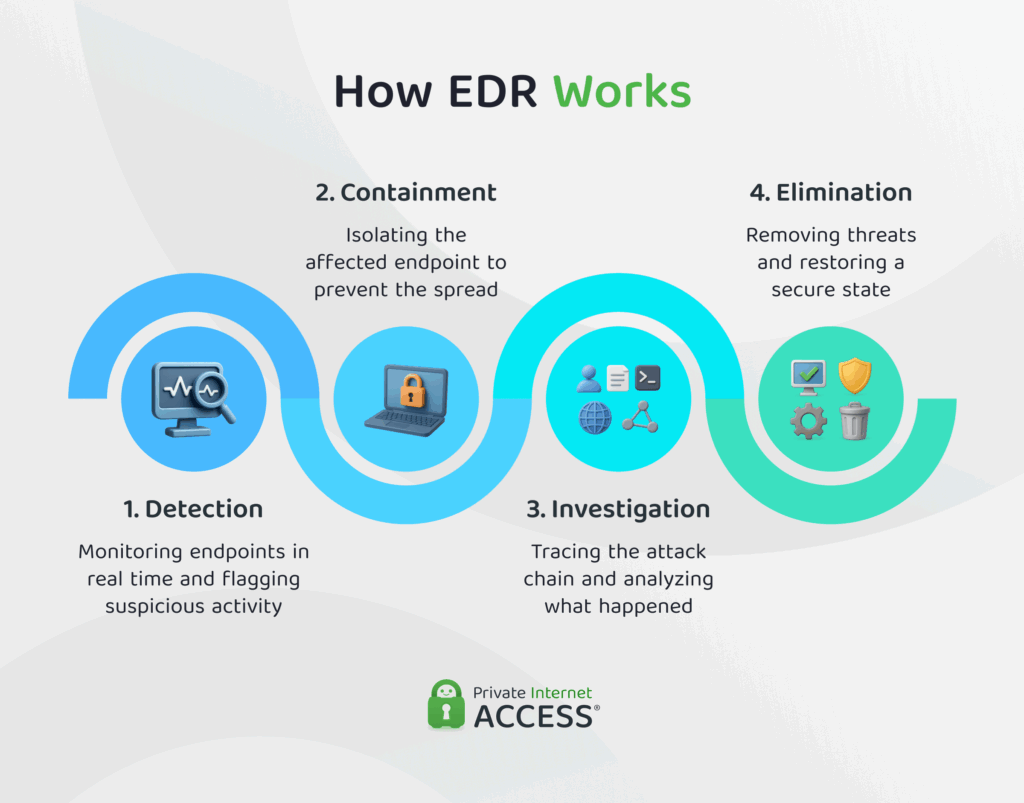
Endpoint detection and response gives you continuous visibility across all endpoints to detect, investigate, and neutralize threats that traditional defenses might miss. This is generally done across four stages:
- Detection: EDR tools monitor endpoint activity in real time, flagging suspicious behavior like unusual file modifications, unauthorized network connections, or privilege escalation attempts. Instead of waiting for a known signature match, it identifies anomalies that might suggest an attack is underway.
- Containment: Once a threat is detected, EDR can isolate the affected endpoint from the network to prevent its lateral movement across devices. This quarantine happens automatically, stopping attackers from spreading to other devices while the threat is assessed.
- Investigation: EDR platforms capture detailed forensic data about the attack, such as what was executed, when, and by whom. Security teams can then trace the full attack chain, from initial entry point to attempted exfiltration, without needing to comb through logs manually.
- Elimination: After identifying the threat, an EDR tool will deploy remediation actions like terminating malicious processes, deleting infected files, or rolling back unauthorized changes. The goal is to restore the endpoint to a secure state without requiring a full system wipe.
How EDR Works
These threat-detection tools capture security-relevant data across all endpoints, enabling security teams to search for indicators of compromise before an attack fully materializes, rather than waiting for an alert to trigger.
Endpoint Telemetry Collection
A lightweight agent installed on each endpoint handles the continuous gathering of security data.
This agent runs in the background, capturing detailed telemetry about endpoint behavior: which processes are running, what servers they’re connecting to, what files are being accessed, and how system resources are being used.
This data creates a baseline of normal activity for each device, making it easier to spot deviations that might indicate a threat. The telemetry also serves as a forensic record, allowing security teams to reconstruct attack sequences after an incident.
By logging granular details about user actions, application behavior, and network traffic, an EDR platform builds the contextual picture needed to distinguish legitimate activity from malicious behavior.
As the agent operates locally on the device, it can collect data and execute detection and response actions even when the endpoint isn’t connected to the internet. Once connectivity is restored, the agent syncs its findings with the central EDR platform, ensuring that security teams maintain visibility across distributed environments.
Threat Detection and Response
There are two methods for identifying threats. For known threats, EDR tools match endpoint activity against indicators of compromise (IOCs) like signatures, file hashes, malicious IP addresses, or behavioral patterns tied to documented attack techniques.
For unknown threats, it uses behavioral detection models to detect anomalies that don’t match any existing signature but exhibit suspicious characteristics (e.g. a process attempting to disable security controls or encrypt files en masse). These models are usually based on frameworks such as MITRE ATT&CK and indicators of attack (IOAs), which map real-world attacker behaviors and activity patterns.
Once a threat is detected, the system can automatically isolate the affected endpoint, terminate malicious processes, or alert security teams for manual review, depending on the severity and confidence level of the detection.
Reporting
Endpoint detection and response platforms have reporting capabilities that support operational decision-making and help to satisfy compliance requirements.
These reports give security teams and leadership visibility into threat activity and response effectiveness. They typically include metrics like mean time to detect and respond to threats, the number of incidents blocked or remediated, and trends in attack types targeting the organization.
They also track compliance with regulatory frameworks by documenting how security incidents were handled, what data was accessed, and how quickly threats were contained.
Data Storage
The telemetry and forensic data collected by EDR agents is typically stored in a centralized cloud-based repository or on-premises data center, depending on the organization’s infrastructure and compliance requirements.
Stored data can reveal how attackers tested defenses, established persistence, or moved laterally before launching a more visible attack. It also supports threat hunting initiatives, where analysts search for patterns that only become apparent when viewed across a longer timeline.
Why EDR Is Useful for Defending Against Cyberattacks
In 2024, the average cost of a breach for organizations that deployed EDR was $168,361 less than those that didn’t2. By reducing the window between compromise and remediation, EDR has the ability to limit attacker access and reduce financial damage.
Minimizes Security Blind Spots
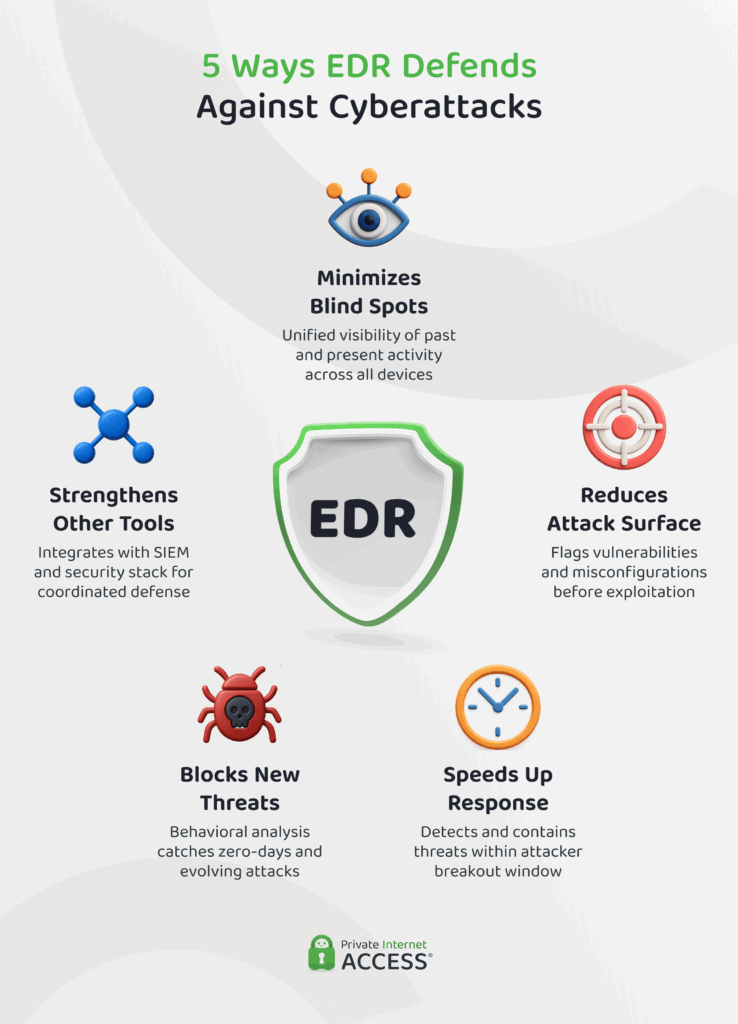
As EDR gives security teams unified visibility across all endpoints, it allows them to monitor current activity while also reviewing past events to identify threats that may have initially gone undetected.
Many modern EDR platforms include extended modules that provide access to detailed information like which vulnerabilities exist on specific devices, what patches are missing, which users have elevated privileges, and how endpoints are configured.
By consolidating this data in one platform, EDR eliminates the fragmented visibility that often allows attackers to exploit gaps between security tools. Security teams can track common vulnerabilities and exposures across the entire endpoint environment rather than discovering them piecemeal during an active incident.
Reduces Attack Surface
By identifying and flagging security weaknesses before attackers can exploit them, EDR reduces the attack surface.
Continuous monitoring reveals misconfigurations like overly permissive user access, unpatched software, or disabled security controls that create entry points for threats. When the system detects these vulnerabilities, it can alert security teams to remediate them or, in some cases, automatically enforce security policies to close the gap.
This proactive identification means organizations can address weak points in their defenses and identify which vulnerabilities pose the greatest risk based on actual device exposure and usage patterns.
Speeds Up Investigations and Response
EDR compresses the timeline between detection and remediation by automating containment actions and providing the forensic data needed to investigate incidents. When a threat is identified, the system can immediately isolate affected endpoints, terminate malicious processes, and prevent further spread while security teams assess the situation.
The platform also applies best practices automatically, like capturing memory dumps or preserving logs, so investigators have the evidence needed to determine root cause and next steps.
Considering that the average breakout time – or how long it takes an attacker to move laterally from an initially compromised host – is just 29 minutes3, the ability to detect and respond quickly is critical.
Blocks New Threats
Behavioral analysis functionality enables EDR to detect threats that don’t match known signatures or attack patterns.
Instead of relying solely on static indicators, the system monitors how processes behave, flagging actions like credential dumping, lateral movement attempts, or unusual data exfiltration regardless of the specific malware variant being used.
Deep threat monitoring surfaces suspicious behavior as it happens, allowing EDR to block attacks in their early stages. This is especially effective for threats that continually shift their code or tactics to evade signature-based detection.
Strengthens Other Security Measures
When EDR is integrated with broader security infrastructure, it enhances the overall threat detection and response capabilities.
When connected to a Security Information and Event Management (SIEM) system, for example, EDR feeds detailed endpoint data into centralized logging and analysis platforms. This integration allows correlation between endpoint activity and network-level events, making it easier to identify coordinated attacks that span multiple vectors.
EDR data can also inform firewall rules, identity and access management policies, and vulnerability scanning priorities. By sharing intelligence across security tools, it helps organizations move from siloed defenses to a coordinated security posture where each component reinforces another.
Challenges of EDR Implementation
While endpoint detection and response provides significant security benefits, organizations could face practical obstacles when deploying and maintaining these systems:
- Alert fatigue: EDR platforms can generate an overwhelming volume of alerts, especially during initial tuning. When security teams are flooded with notifications, critical threats can be overlooked or delayed while analysts work through the queue.
- Integration complexity: Incompatible APIs, data format mismatches, and a lack of standardized protocols can slow deployment and prevent organizations from achieving the unified visibility EDR promises.
- Resource constraints: Businesses may lack the budget or personnel to staff a dedicated security operations team needed to configure policies, investigate alerts, and respond to threats effectively.
- Limited scope: As EDR focuses exclusively on endpoints, it won’t detect threats that operate entirely at the network level or within cloud infrastructure. Organizations still need complementary tools to cover these gaps.
What to Consider When Choosing an EDR Solution
There are certain capabilities that set effective EDR solutions apart from those that may leave gaps in your defenses. Here are the must-have features to prioritize:
| Feature | What It Does | Why It Matters |
| Real-time threat detection | Monitors endpoint activity continuously and flags suspicious behavior as it occurs | Delays in detection give attackers more time to move laterally, escalate privileges, or exfiltrate data – real-time visibility compresses the window of opportunity |
| Automated response capabilities | Executes containment actions like isolating endpoints, terminating processes, or blocking connections without manual intervention | Ensures threats are contained immediately, even outside business hours |
| Behavioral analysis | Identifies threats based on how processes behave rather than relying solely on known signatures | Behavioral analysis catches novel threats and zero-day exploits that traditional methods miss |
| Offline protection | Continues monitoring and response when endpoints lose network connectivity | Without offline capabilities, endpoints become blind spots during the most vulnerable periods |
| Low performance impact | Operates without significantly slowing down endpoint devices | Lightweight agents ensure protection doesn’t come at the cost of usability |
| Integration with existing tools | Connects with SIEM, firewalls, identity management, and other security infrastructure | Integration enables correlation across data sources and coordinated response across your security stack |
EDR and Other Cybersecurity Tools
Endpoint detection and response functions most effectively as part of a layered security strategy. Understanding how it complements and differs from other cybersecurity tools can help you build defenses that cover multiple attack vectors rather than relying on a single solution.
EDR and EPP
While Endpoint Protection Platforms (EPP) acts as a first line of defense against common threats using signature-based detection, antivirus engines, and firewall rules to block known malware at the perimeter, EDR provides the visibility and forensic capabilities needed when sophisticated attacks evade prevention measures.
Many organizations deploy both: EPP to stop straightforward malware and EDR to catch advanced threats that slip through. Some modern platforms now combine both capabilities into unified endpoint security solutions.
EDR and XDR
Extended Detection and Response (XDR) expands EDR’s scope beyond endpoints to include network traffic, cloud workloads, email, and other data sources. Where EDR focuses exclusively on endpoint activity, XDR correlates threats across the entire IT environment, providing broader visibility into attack campaigns that span multiple vectors.
Sophisticated attacks often move between endpoints, network infrastructure, and cloud services, creating potential blindspots for EDR. In these instances, XDR aggregates telemetry from all these sources to enable security teams to trace the full attack chain rather than investigating isolated incidents on individual endpoints.
EDR and VPNs
While EDR monitors endpoint activity for threats, a VPN encrypts network traffic between the device and the internet. This means that even if an endpoint is compromised, data in transit remains protected from interception.
VPNs are especially valuable for preventing man-in-the-middle attacks or traffic snooping. By encrypting the connection, they reduce the risk that sensitive data can be captured while moving between endpoints and corporate resources.
This makes VPNs a practical first layer of defense for organizations that may not yet have the budget or expertise to deploy full EDR solutions.
Frequently Asked Questions About EDR
What is endpoint detection and response (EDR)?
Endpoint detection and response is a security solution that continuously monitors endpoint devices for suspicious activity, detects threats in real time, and responds automatically to contain or eliminate them.
How does EDR work to detect and respond to threats?
EDR uses lightweight agents installed on each endpoint to collect data about system activity. It then analyzes the data using behavioral algorithms and indicators of compromise to identify threats, before automatically isolating affected devices, terminating malicious processes, or alerting security teams.
What threats does EDR help prevent or contain?
These platforms detect various threats, including ransomware, malware, credential theft, lateral movement attempts, unauthorized privilege escalation, and data exfiltration. They’re particularly effective against advanced persistent threats and zero-day exploits that evade signature-based detection by identifying suspicious behavior patterns.
How is EDR different from antivirus or endpoint protection platforms?
Endpoint protection platforms focus on preventing threats from executing in the first place, using signature-based detection, behavioral analysis, and machine learning to block malware before it runs. Endpoint detection and response assumes some threats will bypass prevention and focuses on continuous monitoring, threat detection after compromise, and forensic investigation.
Can a VPN reduce endpoint risk, or does EDR still matter?
Both VPNs and EDR address different attack vectors and work together as part of layered security. A VPN encrypts network traffic to protect data in transit, reducing the risk of interception on untrusted networks. Endpoint detection and response monitors what happens on the endpoint itself. A VPN protects the connection while EDR protects the device.
References:
