Why Internet Key Exchange (IKE) Matters for VPN Security
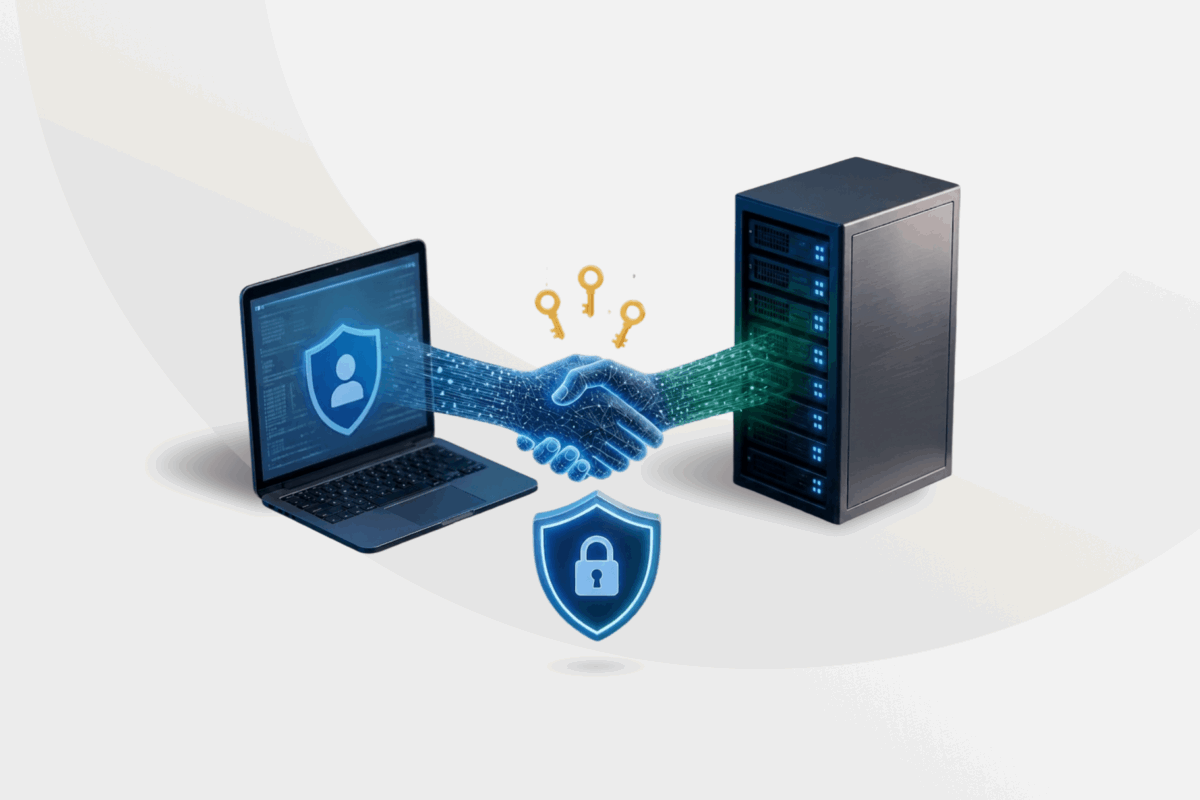
Every time you connect to a VPN, secure processes take place before the VPN encrypts any of your data. These behind-the-scenes processes authenticate the connection, negotiate security settings, and generate the encryption keys that keep your data private.
Internet Key Exchange (IKE) is the protocol responsible for making all this happen. Although most VPN users never see it in action, it plays a critical role in establishing secure VPN connections.
In this article, you’ll learn what IKE is, how it works, how it differs from IPSec, and what it means for VPN security and performance.
Table of Contents
What Is Internet Key Exchange?IKE vs. IPsec: What’s the Difference?
How Does IKE Work?
How Does IKEv2 Compare to IKEv1?
IKE Use Cases
Why IKE Matters for VPN Security and Performance
IKE Vulnerabilities and How to Prevent them
FAQ
What Is Internet Key Exchange?
Internet Key Exchange (IKE) is a key exchange and negotiation protocol that helps keep online communication secure. It is an essential part of IP security (IPsec) often used in Virtual Private Networks (VPNs) to set up a secure and encrypted communication channel between two devices over the internet.
Before your device sends any private information, IKE works behind the scenes to agree on the rules for encryption and authentication. It also takes care of establishing cryptographic keys in a safe way so that no one else can intercept or guess them. Think of it like a digital handshake that establishes trust and privacy before sharing sensitive data.
IKE vs. IPsec: What’s the Difference?
Although IKE and IPsec are often mentioned together, they perform different roles in securing a VPN connection.
IKE acts as the negotiation layer. It determines how to secure the VPN connection by agreeing on encryption methods, verifying the identity of the devices involved, and creating the keys needed for secure communication.
IPsec then uses those agreed-upon settings to protect the actual data going through the VPN tunnel. It handles the encryption and authentication of network traffic, ensuring that information remains private and unchanged as it travels between devices.
| IKE | IPsec |
| Establishes IPsec security associations | Encrypts and protects data in transit |
| Authenticates VPN peers | Secures IP packets |
| Negotiates security settings | Applies the agreed encryption and authentication methods |
| Manages encryption keys | Protects traffic throughout the VPN session |
How Does IKE Work?
When two peers (like a computer and a VPN server) want to communicate securely, they must first agree on how to protect the data. That includes things like which encryption algorithms to use, how to authenticate one another, and what keys will protect the traffic.
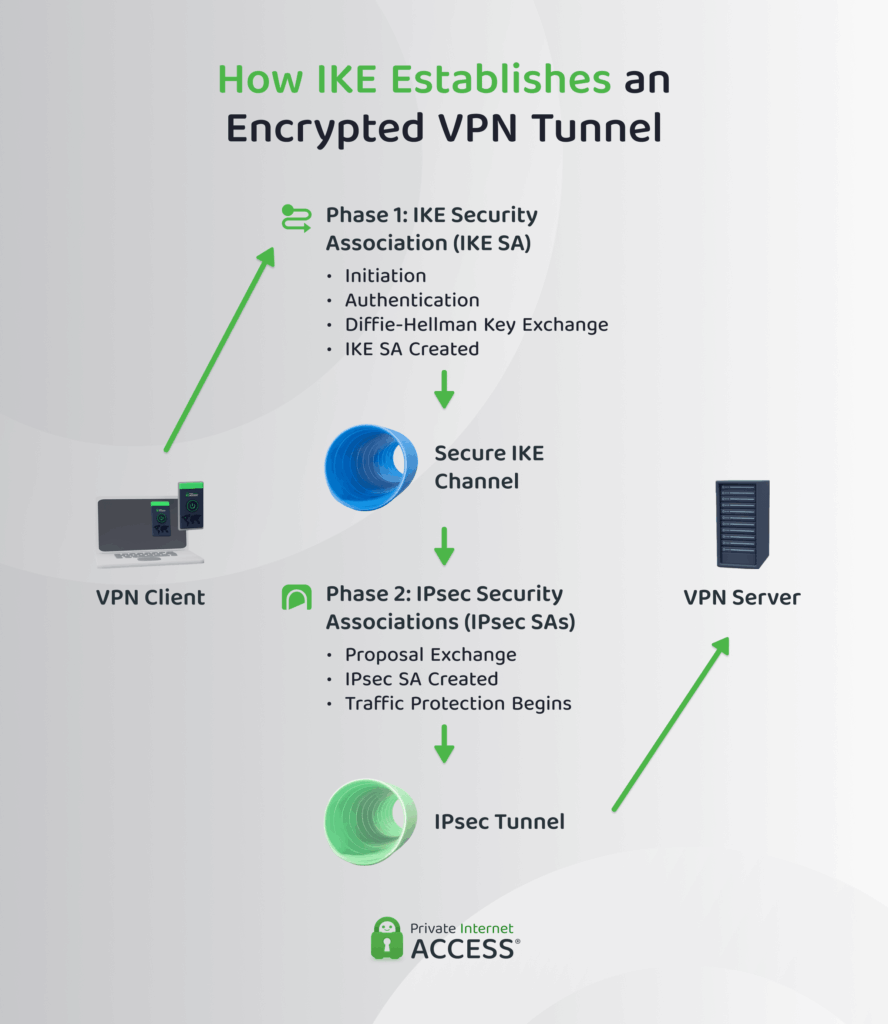
Internet Key Exchange (IKE) creates and regularly refreshes special encryption keys to protect the data traveling across networks. The protocol works in two main steps, called Phase 1 and Phase 2, which together ensure that secure connections are set up and maintained.
IKE Phase 1
Phase 1 is the foundation of IKE. Its purpose is to create a secure, authenticated channel so that the two peers (your device and the network) can safely negotiate the actual VPN tunnel in Phase 2.
Here’s how it works:
- Initiation: One peer (typically your device) sends a request to begin the process of negotiating security parameters. Together, both peers will set up a Security Association (SA) that defines how IPsec will secure the data. That means agreeing on methods for encryption, integrity checks, authentication methods, and key exchange methods (also called Diffie-Hellman group).
- Authentication: This extra security step prevents imposters from setting up fake tunnels. Each peer will need to prove its identity by providing a pre-shared key, digital certificates, or another established method.
- Diffie-Hellman key exchange: Diffie-Hellman is a cryptographic method that allows two devices to agree on a shared secret key that they can use to encrypt future communications. This happens without ever sending the key itself over the network, preventing attackers from intercepting the key.
- IKE Security Association (SA) is created: Both peers have verified each other’s identities, shared the secret key, and created a secure, encrypted channel. Now the IPsec VPN can safely send data between the devices.
Keep in mind that Phase 1 is about building a secure channel for the two peers to communicate. The tunnel for actual data traffic (IPsec) is now built in Phase 2.
IKE Phase 2
IKE Phase 2 is where the actual IPsec tunnel parameters are set up. While Phase 1 sets up a secure “control channel,” Phase 2 focuses on negotiating the actual VPN tunnel parameters.
Here’s how it works:
- Secure channel use: Phase 2 runs inside the secure channel that was already established in Phase 1. That means the secure channel encrypts and authenticates all negotiations to prevent eavesdropping or tampering.
- Proposal exchange: The peers exchange proposals that define how the IPsec tunnel should protect actual data traffic. This includes the encryption algorithm, integrity/authentication algorithm, Diffie-Hellman group, and lifetime of the tunnel.
- Establishing IPsec SAs: If both peers agree on compatible proposals, they create a pair of IPsec SAs that define how to encrypt, authenticate, and transmit packets.
- Traffic protection begins: Once the peers establish the IPsec SAs, the agreed-upon encryption and authentication settings protect the traffic. The two peers can now exchange data securely through the VPN tunnel.
Once both phases are complete, the VPN tunnel is ready and data can flow through it. IKE also supports features like key refresh, re-authentication, and handling dropped connections to ensure the tunnel stays both secure and stable over time.
How Does IKEv2 Compare to IKEv1?
Internet Key Exchange version 2 (IKEv2) is the updated version of the IKE protocol. It does the same core job as IKEv1, but its new design makes it faster, more secure, and more flexible.
In IKEv1, the negotiation process is more complex and it can take multiple rounds of messages to establish a tunnel. IKEv2 simplifies this process for a much cleaner exchange. This creates less encryption overhead and establishes VPN connections faster. It also lowers the chance of misconfigurations or negotiation failures.
IKEv2 strengthens VPN security by requiring the use of modern cryptographic standards like AES for encryption and SHA-2 for integrity checking. It also refines key management and supports perfect forward secrecy more consistently. Even if one key becomes compromised, past and future sessions remain secure.
Another one of IKEv2’s improvements is the incorporation of the Mobility and Multihoming Protocol (MOBIKE). This is especially important for mobile device users because it allows you to keep VPN connections stable when a device changes networks.
MOBIKE also supports multihoming, meaning a device with multiple network interfaces (like Wi-Fi and Ethernet) can maintain a single VPN session across them. That means if the Wi-Fi signal drops, the tunnel can continue over Ethernet without forcing you to reconnect.
IKEv1 vs. IKEv2: Differences At a Glance
| IKEv1 | IKEv2 |
| Slower setup (more message exchanges) | Faster setup (fewer steps) |
| Can drop if the network changes | Stays connected across network changes (better for mobile users) |
| Less efficient on modern networks | Optimized for speed and stability |
| Secure, but older design has limitations | Stronger security by default, more resilient against modern attacks |
| Best for legacy devices or systems that don’t support newer standards | Ideal for modern VPNs, mobile devices, and everyday internet security |
IKE Use Cases
The main use of IKE is to create and manage secure connections over the internet. It’s most often used in corporate networks to securely exchange company data between offices. Remote workers can also access company systems and resources with more protection.
Most IKE use cases will fall into one of three categories:
VPNs
IKE forms part of the VPN protocol that sets up the secure “tunnels” VPNs use to protect data. When you connect to a VPN, IKE negotiates the encryption methods and generates secret keys that help prevent others from reading or altering your online activity. This automatic key management means you don’t have to configure complicated security settings, making VPNs easy to manage for both personal and business use.
Site-to-Site Communication
Businesses often need to connect multiple offices, data centers, or cloud environments. IKE establishes encrypted tunnels between entire networks, not only individual devices. It helps sensitive company data travel more securely across the public internet.
Mobile Device Security
IKEv2 can handle mobility through MOBIKE. It allows VPN connections to stay active even when a device switches networks, such as moving from public Wi-Fi to cellular data. Without it, changing networks could drop the VPN and interrupt secure communication during a video call or instant messaging session.
Why IKE Matters for VPN Security and Performance
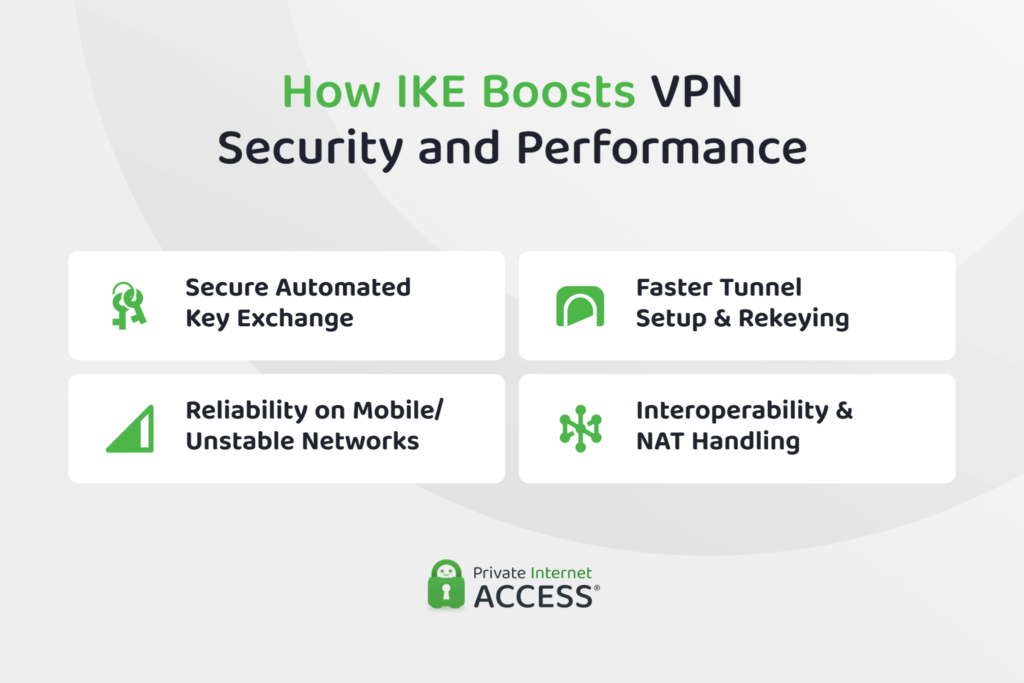
IKE plays a central role in maintaining VPN connections. It not only helps safeguard sensitive data, but also ensures VPN connections are fast, resilient, and dependable. Here are some of the main ways that IKE improves VPN performance:
- Secure automated key exchange: IKE negotiates encryption keys between the VPN endpoints, rather than relying on manually configured or long-term static keys. Because keys are temporary, previous and future sessions remain secure even if one session key becomes compromised.
- Faster tunnel setup and rekeying: IKE sets up the VPN tunnel and refreshes encryption keys automatically. Fewer negotiation messages (especially with IKEv2) mean the VPN connects faster and IKE can refresh keys mid-session without dropping the tunnel.
- Reliability on mobile/unstable networks: IKEv2 includes MOBIKE (Mobility and Multihoming) and other mechanisms to maintain VPN connectivity when network conditions change. This means users can switch networks without disrupting the connection.
- Interoperability and NAT handling: IKE supports Network Address Translation (NAT) traversal and widely accepted standards, allowing VPNs to function across different devices and networks. That means VPNs behind NATs or firewalls can still connect reliably when configured with IKE NAT traversal.
IKE Vulnerabilities and How to Prevent them
Like any network protocol, IKE has its vulnerabilities, particularly in certain implementations or configurations.
IKE vulnerabilities usually fall into one of three categories: protocol misuse, implementation flaws, or operational exposures. Here’s a detailed overview of the more common vulnerabilities found in IKE and what you can do to mitigate risk:
Denial of Service (DoS) Attacks
⚠️ The risk: IKE requires multiple handshake messages, which users can exploit to flood a VPN gateway, causing resource exhaustion.
✅ The solution: Enable IKEv2’s built-in anti-DoS cookie mechanisms, rate-limiting, and anti-replay protections.
Man-in-the-Middle (MITM) Attacks
⚠️ The risk: If authentication is weak, an attacker could intercept and manipulate IKE negotiation.
✅ The solution: Proper certificate-based authentication and strong cryptographic algorithms reduce this risk.
Replay Attacks
⚠️ The risk: Attackers may capture and replay packets to disrupt VPN communications. IKE protects its own negotiation messages from replay, while IPsec handles replay attacks against encrypted VPN traffic.
✅ The solution: Ensure IPsec’s anti-replay protection remains enabled, and keep VPN software up to date to address implementation flaws.
Weak or Deprecated Cryptography
⚠️ The risk: Older IKE implementations support weak algorithms that attackers can exploit to decrypt traffic or break the key exchange.
✅ The solution: Always configure modern algorithms (AES, SHA-2, DH groups 14+).
Vulnerabilities in IKE Implementations
⚠️ The risk: Software bugs in IKE daemons may lead to buffer overflows, memory corruption, and remote code execution.
✅ The solution: Keep VPN devices and software updated with security patches.
NAT Traversal (NAT-T) Weaknesses
⚠️ The risk: Some NAT-T implementations could leak internal IP addresses or fail to properly encrypt traffic.
✅ The solution: Use up-to-date VPN software with security patches, enable NAT-T only where required, and verify it’s correctly configured on both VPN endpoints.
MOBIKE/IPv6 Considerations
⚠️ The risk: While IKEv2’s MOBIKE improves mobility, flawed implementations could allow attackers to hijack sessions or force rekeying in unsafe ways.
✅ The solution: Keep all VPN appliances, servers, and clients patched to the latest versions. Verify that your IKEv2 implementation supports MOBIKE over IPv6.
FAQ
What is the Internet Key Exchange protocol?
The IKE protocol is a standard used to establish secure connections between devices over the Internet. It automates the exchange of cryptographic keys and the negotiation of security settings, helping to keep data private and more tamper-proof. VPNs use IKE to create and maintain encrypted tunnels between networks or devices.
How does Internet Key Exchange work in VPNs?
IKE works by negotiating and establishing a secure VPN tunnel between two devices or networks. It first authenticates the devices and then dynamically generates encryption keys to protect the data transmitted through the tunnel. Once IKE establishes the secure connection, it can also handle periodic key updates to maintain strong security.
Which VPN tunnel type uses Internet Key Exchange?
IPsec VPN tunnels use IKE to establish secure communication between devices or networks. IKE handles the negotiation of encryption keys and security parameters for both site-to-site and remote-access IPsec VPNs. Without IKE, IPsec tunnels would require manual key configuration, making them less secure and harder to manage.
What are the differences between IKEv1 and IKEv2?
IKEv2 is an updated version of IKEv1 that offers improved security, efficiency, and reliability. Unlike IKEv1, IKEv2 supports faster connection setup, simplified message exchange, and built-in features like NAT traversal and MOBIKE for mobile devices. Additionally, IKEv2 is more reliable against certain attacks and easier to manage, making it the preferred choice for modern VPNs.
Why is Internet Key Exchange important for VPN security?
IKE is important for VPN security because it automates the secure exchange of encryption keys, helping to prevent unauthorized access to transmitted data. It facilitates data integrity and confidentiality by negotiating strong security parameters for the VPN tunnel. Additionally, IKE supports features like periodic key updates and mobility, maintaining a secure connection even as network conditions change.
