Managed DNS: A Complete Guide

How quickly your web pages load directly impacts how much your visitors will enjoy your website and how likely they are to stick around.
A lot of factors can affect this time, but DNS is one that’s often overlooked – sometimes at significant cost. Page abandonment rates increase quickly alongside page load times. Large portions of users drop off where the wait to see what’s on your site is longer than three seconds.
Using a managed DNS service can significantly improve your website’s performance with little effort from you. This guide explains what managed DNS is, how it works, its benefits and drawbacks, and what to look for when choosing a provider.
What Is Managed DNS?
A managed Domain Name System (DNS) is a DNS service that’s not handled by your own digital infrastructure, but by a server that’s controlled and maintained by a third party. Let’s break that down a bit.
You can think of DNS as the internet’s GPS. When you type a website address like “example.com” into your browser, DNS translates that human-readable domain name into a machine-readable IP address (e.g. 192.0.2.1) that devices use to locate and connect to the website’s server.
Unless it already knows the IP address of a domain, your device will begin executing a multi-step lookup process until it reaches the authoritative DNS server or server that holds the actual DNS records for that name.
Managed DNS puts this entire process in the hands of a specialized provider. Instead of the client running its own DNS infrastructure, a managed DNS provider handles the servers, configuration, maintenance, and security protocols.
As the client or client organization, you still control your DNS records (i.e. determining which domain names point to which IP addresses), but the provider manages the technical infrastructure that makes it all work.
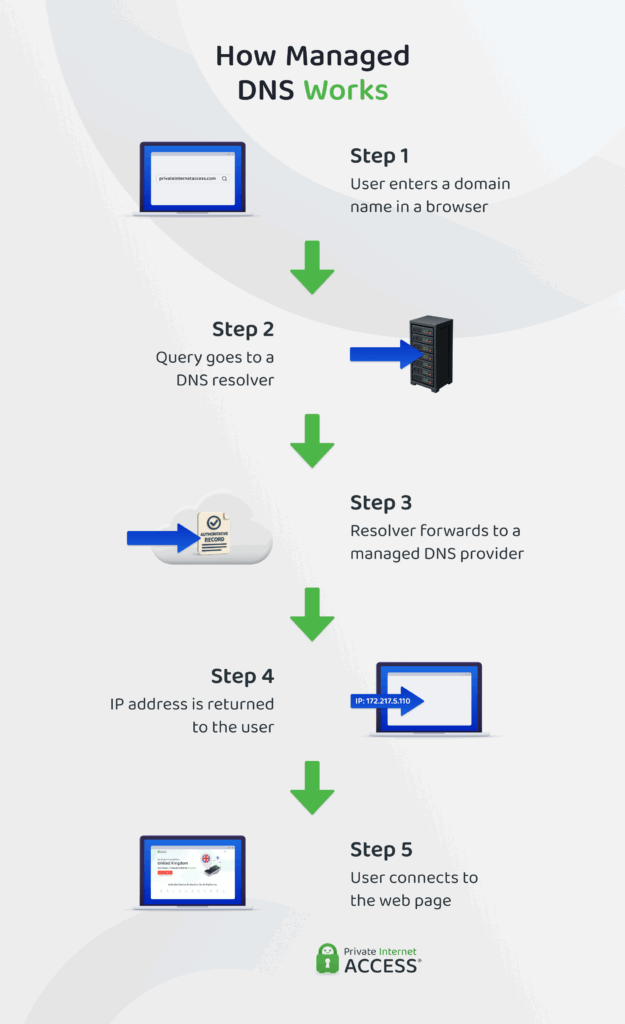
How Managed DNS Works
If you’re managing your own DNS and a user types your website’s domain name into their address bar, your servers handle the incoming query and store, update, and secure the DNS records for your domain.
With managed DNS, a third-party provider takes over these responsibilities. The provider stores the DNS records for your organization’s domains and hostnames on their DNS servers.
Companies like Cloudflare, Amazon Web Services (Route 53), Google Cloud DNS, and others operate as managed DNS providers. They do all the technical heavy lifting, including server configuration, ongoing maintenance, software updates, and security protocols.
Most managed DNS providers operate globally distributed networks of servers positioned in data centers around the world. This geographic distribution helps ensure faster response times regardless of where users are located.
While the provider manages the infrastructure, you can still add, modify, or delete your DNS records through the provider’s web-based platform or via application programming interfaces (APIs), giving you flexibility in how you manage your domains.
Why Do We Need Managed DNS?
Managed DNS helps organizations achieve faster, more reliable, and more secure domain resolution. For businesses that depend on their online presence, these improvements can directly impact customer experience and revenue.
Imagine how this might affect an e-commerce store during a major sales event. A single DNS server might not be able to convert the high volume of domain name queries into an IP address. That can lead to errors and timeouts, as well as frustrated customers and lost sales.
With managed DNS, the scenario plays out a little differently. When there’s a query spike, the DNS service provider’s globally distributed network can distribute the requests across multiple servers. If one experiences an issue, traffic is automatically routed to another.
This ensures DNS queries get quick responses. Customers are able to load pages and proceed to checkout with minimal interruption, which allows the business to focus its resources on handling the sale rather than the DNS infrastructure.
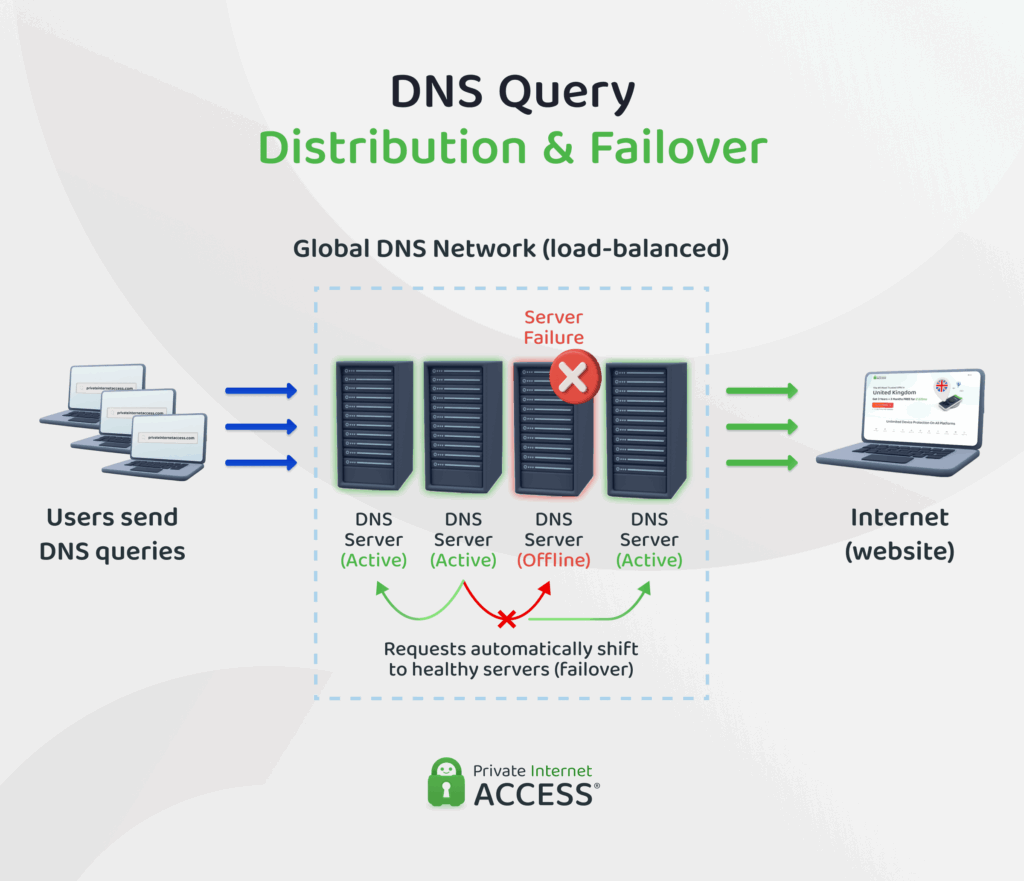
Common DNS Management Services
Managed DNS providers typically offer a range of services designed to improve website performance, reliability, and security. Here are the most common features you’ll find in their offerings:
- DNS lookup tools: Utilities for testing and verifying DNS configurations.
- DNS resolution: Translating domain names into IP addresses for users trying to access your services.
- DNS hosting: Storing and serving your DNS records from the provider’s infrastructure.
- Global Points of Presence (PoPs): Server locations distributed worldwide for better geographic coverage.
- Traffic management and load balancing: Distributing incoming requests across multiple servers to prevent overload.
- Failover protection: Automatically redirecting traffic to backup servers if primary systems go down.
- Anycast routing: Directing user queries to the nearest available server for faster response times.
- Disaster recovery: Maintaining redundant systems to restore DNS services after major outages.
- DNS Security Extensions (DNSSEC): Adding cryptographic signatures to DNS records to prevent tampering and spoofing.
- API access: Allowing automated management of DNS records through programming interfaces.
- Record management: Tools for creating, updating, and deleting DNS records through user-friendly interfaces
- Dynamic DNS: Automatically updating DNS records when IP addresses change.
- Analytics and monitoring: Tracking query volumes, response times, and system health in real-time.
- Troubleshooting tools: Diagnostic features to identify and resolve DNS issues quickly.
- Encryption protocols: Securing DNS queries to protect user privacy.
Benefits of Managed DNS Services
Maximize Uptime and Resilience
Managed DNS providers build redundancy into their infrastructure by default. Because they have servers in multiple data centers in different places, a single server or location outage doesn’t affect other servers or locations. When one has an issue, traffic is automatically routed to another.
This redundancy means your DNS remains available even during hardware failures, network issues, or localized outages. Most providers offer Service Level Agreements (SLAs) guaranteeing uptime percentages of 99.99% or higher, giving you confidence that users can always resolve your domain names and access your services.
Faster Response Times
The geographic distribution of servers also plays a role in DNS performance. Worldwide server locations mean that user queries are answered by the nearest available server rather than traveling across continents. This reduces latency for millisecond response times.
Faster DNS resolution means websites and applications load more quickly to directly improve the user experience.
Accelerated Propagation Times
When you update DNS records (e.g. by changing an IP address or adding a new subdomain), those changes need to propagate across the internet. Managed DNS providers can apply and distribute updates across their authoritative servers very quickly. Their globally distributed infrastructure pushes changes to all servers simultaneously.
However, how quickly users see those changes also depends on DNS caching by resolvers, ISPs, and local devices, which are outside the provider’s control. These cached records remain in place until their TTL (time to live) expires, which can delay when updates take full effect.
Increased Efficiencies
Managed DNS eliminates the time a tech team would need to spend on DNS infrastructure tasks. The provider’s automation handles routine maintenance, so there’s no need to monitor server health, apply security patches, troubleshoot resolution issues, or optimize configurations yourself.
This extends to scaling, too. Adding new domains or handling increased query volumes requires minimal effort on your part, often just a few clicks in the provider’s interface.
Simplified Management
Building and maintaining DNS infrastructure requires specialized knowledge, dedicated staff, and ongoing attention. Managed DNS eliminates the need for site owners to carry out complex functions themselves.
The provider handles the technical complexity while giving the site owner straightforward tools to manage their records.
Regulatory Compliance
Operators in many industries need to adhere to regulations that require specific data handling practices, uptime guarantees, or security measures. Managed DNS providers often maintain compliance certifications for the standards these entities need to meet.
By using managed DNS, businesses can inherit aspects of their provider’s compliance posture to meet regulatory requirements more easily.
Cost-Effectiveness
There’s no need for upfront capital expenditure on servers or infrastructure, or spending on ongoing costs like power, cooling, data center space, and salaries. This usually makes the monthly cost of managed DNS lower than running equivalent infrastructure in-house.
Advanced Security Features
Managed DNS providers often invest heavily in security features that would be complex and expensive to implement independently. This includes DDoS mitigation to absorb malicious traffic before it overwhelms your systems, DNSSEC to authenticate responses and prevent spoofing, and rate limiting to block suspicious query patterns.
Many providers also offer threat intelligence, monitoring for unusual activity, and automated responses to attacks.
Disadvantages of Using Managed DNS Solutions
While there are lots of perks that come with using managed DNS, there are also a few trade-offs to consider:
- Reduced control: Organizations are limited to the customization options their provider offers, which may not meet highly specialized requirements. They may also become dependent on their provider’s infrastructure and expertise – which means technical issues can be passed on.
- Latency: If the provider’s nearest server is geographically distant from users, speeds may not be optimal, though this is less common with well-distributed networks.
- Security: Although many providers do implement strong protections, storing DNS records with a third party requires high levels of trust that they will safeguard that data and prevent unauthorized access.
- Vendor lock-in: Moving DNS configurations to a different service requires careful planning to avoid downtime, which may discourage switching even if the service is unsatisfactory.
- Compliance: Privacy-conscious organizations may have concerns about compliance requirements or how providers handle DNS query data, particularly when operating in jurisdictions with strict data protection regulations.
Features to Look for in Managed DNS Services
When choosing a managed DNS provider, focus on the factors that directly impact performance, reliability, and security. These include global network coverage, uptime guarantees, response times, built-in protections like DDoS mitigation and DNSSEC, and how easily you can manage your records.
Rather than evaluating these in isolation, it’s best to compare providers across a consistent set of criteria:
How to Evaluate a Managed DNS Provider
Not all managed DNS providers offer the same level of service. Before making a decision about which one to go with, you should assess each one against these criteria:
| What to look for | |
| Network scope | Number of PoPs and geographic coverage across continents |
| Uptime SLA | Guaranteed uptime percentage (aim for 99.99% or higher) and compensation terms for downtime |
| Redundancy | Multiple data centers, anycast routing for automatic failover, and backup systems |
| Performance metrics | Average query response times and latency benchmarks for important geographic regions |
| Security capabilities | DDoS protection capacity, DNSSEC support, and additional threat mitigation features |
| Compliance certifications | Relevant industry certifications (SOC 2, ISO 27001, HIPAA, GDPR) with recent audit dates |
| Scalability | Traffic handling capacity and whether scaling happens automatically or requires manual intervention |
| Support quality | Availability of 24/7 technical support, response time commitments, and expertise |
| Pricing structure | Transparent pricing model and total projected costs based on expected usage |
| Return on investment (ROI) | Cost savings from reduced downtime, improved performance, and eliminated infrastructure expenses versus subscription fees |
Managed DNS Frequently Asked Questions
What are managed DNS services?
Managed DNS services are third-party solutions that handle DNS infrastructure on behalf of organizations. The provider operates the DNS servers, manages configurations, applies security updates, and ensures uptime, while the client retains control over their DNS records through web interfaces or APIs.
How do managed DNS solutions work?
Managed DNS providers store an organization’s DNS records on their globally distributed servers. They handle all technical operations (e.g. server maintenance, security, and traffic routing) while clients manage their records through the provider’s platform or API.
What are the benefits of using a managed DNS provider?
Key benefits of using a managed DNS provider include improved uptime through redundant infrastructure, faster DNS resolution via globally distributed servers, enhanced security features, simplified management, automatic scaling, and compliance certifications that help meet regulatory requirements.
How do managed DNS services improve website performance and uptime?
These services improve performance by routing queries to the nearest server, reducing latency and speeding up website loading times. For uptime, providers use redundant infrastructure across multiple data centers with automatic failover.
What’s the difference between managed DNS and self-hosted DNS?
Where managed DNS involves a third-party provider handling the DNS infrastructure, maintenance, and security, self-hosted DNS requires organizations to run their own servers and manage all technical aspects themselves.
Can managed DNS services be used with a VPN?
Yes. Managed DNS still works when visitors use a VPN. A VPN can change the user’s connection path and apparent location, though, so if you use geo-based routing, they may be directed to a server near the VPN location rather than their physical one. This can be an issue when you’re trying to personalize content to a user’s physical location.
