Privacy Engineering: Principles, Frameworks, and Best Practices
When software collects user data, privacy risks usually come down to poor system design, not malicious intent. Extra form fields get saved, background logs hold onto location coordinates, and third-party tools collect data in the background.
Privacy engineering fixes these issues at the architecture level. It applies practical engineering methods to find data risks early and build protections directly into code.
This guide covers what privacy engineering is, how it works across the software lifecycle, how it differs from security, and how to build it into your development process.
Table of Contents
What Is Privacy Engineering?Why Privacy Engineering Matters
Core Privacy Engineering Principles
Privacy Engineering vs. Cybersecurity
What Is a Privacy Engineering Framework?
The NIST Approach to Privacy Engineering
How Privacy Engineering Works Across the Data Lifecycle
How to Implement Privacy Engineering by Design
Privacy Engineering in Practice
Where VPNs Fit Into Privacy Engineering
Privacy Engineering FAQ
What Is Privacy Engineering?
Privacy engineering is a branch of systems engineering concerned with identifying and addressing privacy risks created by products that process personal data. It converts high-level organizational commitments, such as collecting only necessary records or honoring deletion requests, into concrete requirements that designers and developers can implement and test.
The work is both technical and cross-functional. A privacy engineer may map how data moves through an application, review a proposed feature, define retention logic, evaluate a de-identification method, or check whether a user control matches backend behavior. That requires close collaboration with software developers, security teams, product managers, legal counsel, compliance specialists, and UX designers.
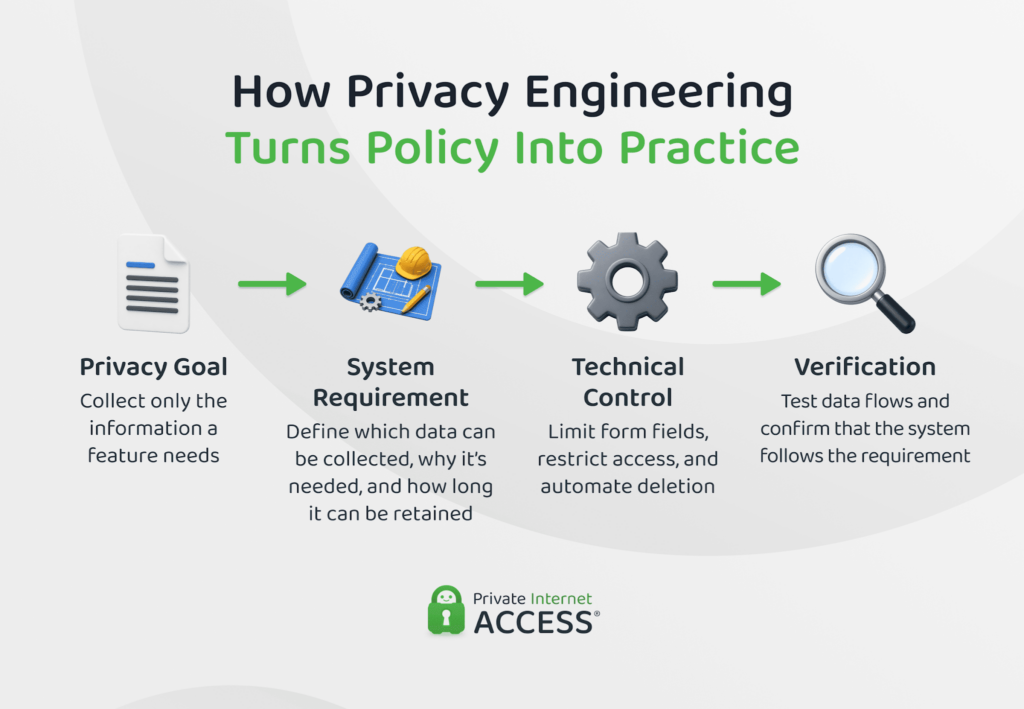
Rather than acting as a legal check or a notice-writing exercise, privacy engineering focuses on execution. While a policy might promise account deletion upon request, engineering determines which databases, logs, backups, and third-party services the deletion affects, what triggers it, and how to confirm the records are permanently gone.
Why Privacy Engineering Matters
Modern applications process user details at a scale and speed that makes manual privacy management impossible. A single feature might route data through mobile apps, application programming interfaces (APIs), analytics pipelines, cloud storage, and external vendors. If privacy questions arise only at the end of development, changing those data flows later becomes difficult and expensive.
Addressing privacy early allows teams to question whether specific attributes are necessary in the first place. They can establish retention limits, restrict downstream access, and build meaningful user controls long before software decisions become deeply embedded in the codebase.
Article 25 of the General Data Protection Regulation (GDPR) requires data controllers to implement appropriate technical and organizational measures designed to put data-protection principles into practice.1 Building privacy into early development supports these regulatory obligations and helps organizations reduce unnecessary exposure.
Core Privacy Engineering Principles
While no single universal standard dictates every privacy engineering principle, established regulatory rules and technical guidance consistently point toward several core ideas.
Collect Less and Use It Deliberately
Data minimization begins by asking whether each collected field is strictly necessary for a defined purpose. Purpose limitation then stops an organization from using that data for unrelated purposes. Together, these principles shape form fields, analytics events, application logs, machine-learning inputs, and access permissions.
Make Privacy the Starting Position
Privacy by default ensures that individuals don’t have to navigate complex settings to avoid unnecessary processing. A product should launch collecting only what its core function requires. Optional features can request additional inputs as needed, explaining the choice at that specific moment.
Make Data Practices Understandable
Transparency is effective when user interfaces, public policies, and technical execution align seamlessly. People should be able to form accurate expectations about how a system handles their details. Achieving this requires clear front-end explanations backed by technical verification on the server side.
Keep Personal Records Accurate
Privacy risk extends beyond unauthorized exposure or misuse. Inaccurate, incomplete, or outdated records can lead an application to make flawed decisions about an individual. Organizations should provide straightforward mechanisms to update personal details and ensure those corrections propagate through connected services.
Give People Practical Control
User-facing controls need working technical processes behind them. An account-deletion button fails its purpose if it merely hides a profile from view while leaving active database records untouched. Access, correction, export, consent modifications, and deletion requests must reach all relevant systems and return reliable outcomes.
Protect Information Throughout Its Lifecycle
Privacy safeguards must cover every phase of the data lifecycle. This includes initial intake, processing, sharing, storage, and final disposal.
Privacy Engineering vs. Cybersecurity
Privacy engineering and cybersecurity frequently overlap, but they focus on distinct questions. Cybersecurity concentrates on protecting systems and infrastructure from unauthorized access, alteration, disruption, or destruction. Privacy engineering evaluates the risks that stem from authorized, intended data processing.
| Area | Privacy Engineering | Cybersecurity |
| Primary concern | How data processing may create problems for individuals | External threats to systems, services, and infrastructure |
| Typical question | Should the organization collect or use this information this way? | How can teams reduce unauthorized access or disruption? |
| Example risk | Using accurate customer data for an unexpected secondary purpose | An attacker stealing customer databases |
| Example response | Limit collection, separate purposes, and provide user controls | Use authentication, encryption, monitoring, and patching |
A database can be strongly secured against external breaches and still create severe privacy issues if it retains excessive information indefinitely or supports processing that users would not reasonably expect.
Conversely, weak security can compromise privacy by exposing sensitive records to unauthorized actors. Both disciplines must work in tandem without treating one as a replacement for the other.
What Is a Privacy Engineering Framework?
A privacy engineering framework provides a structured, repeatable model for identifying privacy risks and putting safeguards into practice. It establishes common vocabulary, organizes target outcomes, assigns team responsibilities, guides control selection, and tracks progress over time.
To understand how these tools fit together, it helps to distinguish four key concepts:
- Principles: High-level goals, such as minimizing data collection.
- Frameworks: Comprehensive structures that organize the work required to meet those goals.
- Methodologies: Defined analytical processes used to assess specific designs or architectures.
- Controls: Technical or organizational measures implemented within a software environment.
Frameworks serve as flexible guidelines rather than automatic compliance engines. An organization must tailor them to fit its products, infrastructure, user base, legal duties, and risk tolerance. Their true value lies in making privacy decisions consistent, deliberate, and traceable.
The NIST Approach to Privacy Engineering
The National Institute of Standards and Technology (NIST) treats privacy engineering as an outcome-oriented discipline within systems engineering.
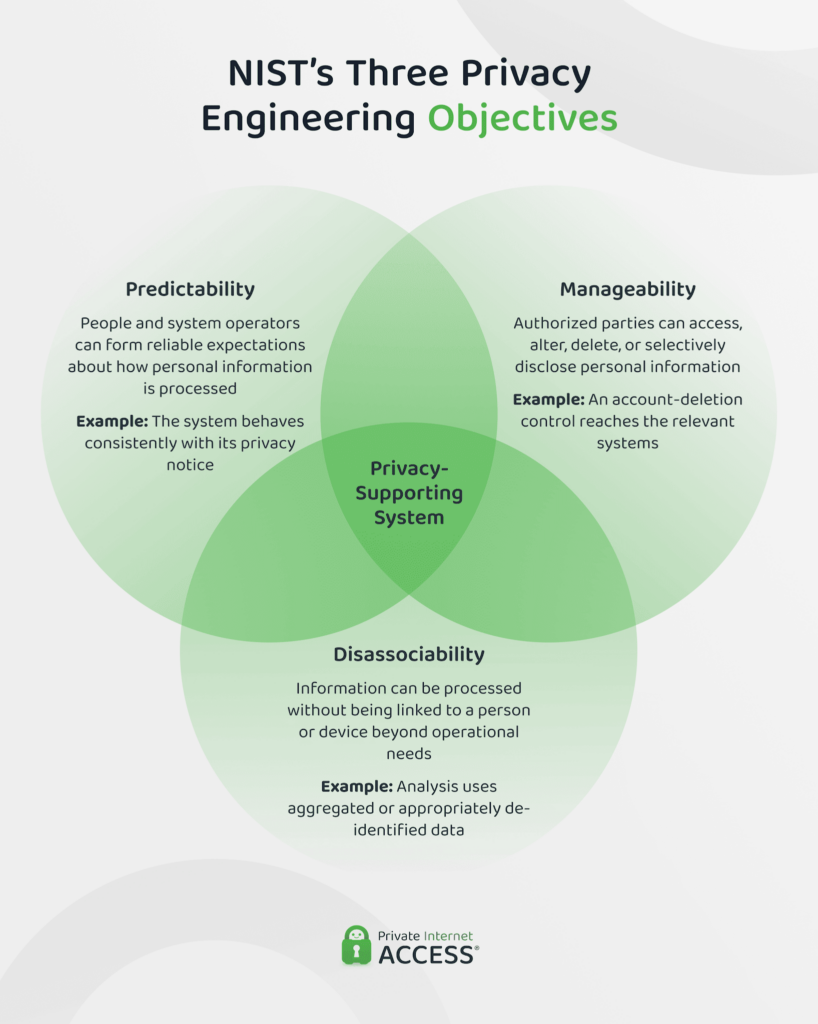
In NISTIR 8062, NIST outlines three core objectives that help software teams translate policy expectations into system capabilities:2
- Predictability: The system operates in a way that allows individuals, owners, and operators to form accurate assumptions about how the system processes personal data. Notices contribute to predictability, but underlying technical behavior must match those claims.
- Manageability: The architecture provides granular administration over personal records. Key capabilities include precise modification, selective disclosure, and targeted deletion, turning abstract ideas about user control into functional software mechanisms.
- Disassociability: The system can process data or events without linking them directly to specific individuals or devices beyond operational needs. Techniques like aggregation, pseudonymization, and privacy-preserving analytics support this objective.
How Privacy Engineering Works Across the Data Lifecycle
A product’s privacy profile evolves as records move through its infrastructure. Reviewing the entire lifecycle surfaces vulnerabilities that a basic collection-focused audit would miss.
| Stage | Key Question | Practical Action |
| Collection | Does the feature require every requested field? | Remove unnecessary inputs or make non-essential fields optional. |
| Storage | Where do records live, and for how long? | Apply strict access permissions and set up automated retention schedules. |
| Use | Does data processing align with the stated purpose? | Separate permissions and internal workflows for distinct activities. |
| Sharing | Which internal services or external vendors receive data? | Restrict network transfers and disclose only required parameters. |
| User Requests | Can individuals exercise their choices and legal rights? | Connect user interface controls directly to database management tasks. |
| Disposal | Does deletion completely remove records? | Test purge jobs across active databases, caches, and backup systems. |
How to Implement Privacy Engineering by Design
Privacy engineering operates best when integrated directly into standard product development cycles rather than running as a disconnected review process.
- Map the Data: Identify what personal attributes enter the application, where they originate, how they traverse internal networks, who holds access, and when to purge them. Map analytics pipelines, background jobs, logs, and third-party vendor connections.
- Define Clear Purpose: Connect every data field and processing step to a concrete product requirement. Vague justifications like “future feature development” make it impossible to evaluate necessity or set appropriate retention limits.
- Analyze Potential Impact: Evaluate potential problems beyond standard security breaches. Consider unwanted re-identification, loss of autonomy, discrimination, exclusion, economic loss, or automated decisions based on outdated inputs.
- Draft Testable Requirements: Convert generic directives into specific, verifiable software behaviors. Replace vague statements like “delete data promptly” with precise conditions, including the exact trigger event, affected database tables, target execution window, edge-case exceptions, and confirmation logs.
- Select Proportionate Safeguards: Address risks by adjusting underlying system architecture rather than adding surface-level tools. Techniques include minimizing initial collection, processing calculations locally on client devices, decoupling user identifiers, enforcing short retention windows, or setting restrictive defaults.
- Verify Technical Execution: Test user controls, network transmissions, database permissions, automated purge scripts, and public-facing claims. Evaluate software behavior under normal operational conditions and simulated edge-case failures.
- Monitor Ongoing Changes: Recognize that new software updates, API integrations, dataset additions, or machine-learning integrations can alter system risk over time. Reassess assumptions whenever architecture changes rather than relying solely on periodic audits.
Privacy Engineering in Practice
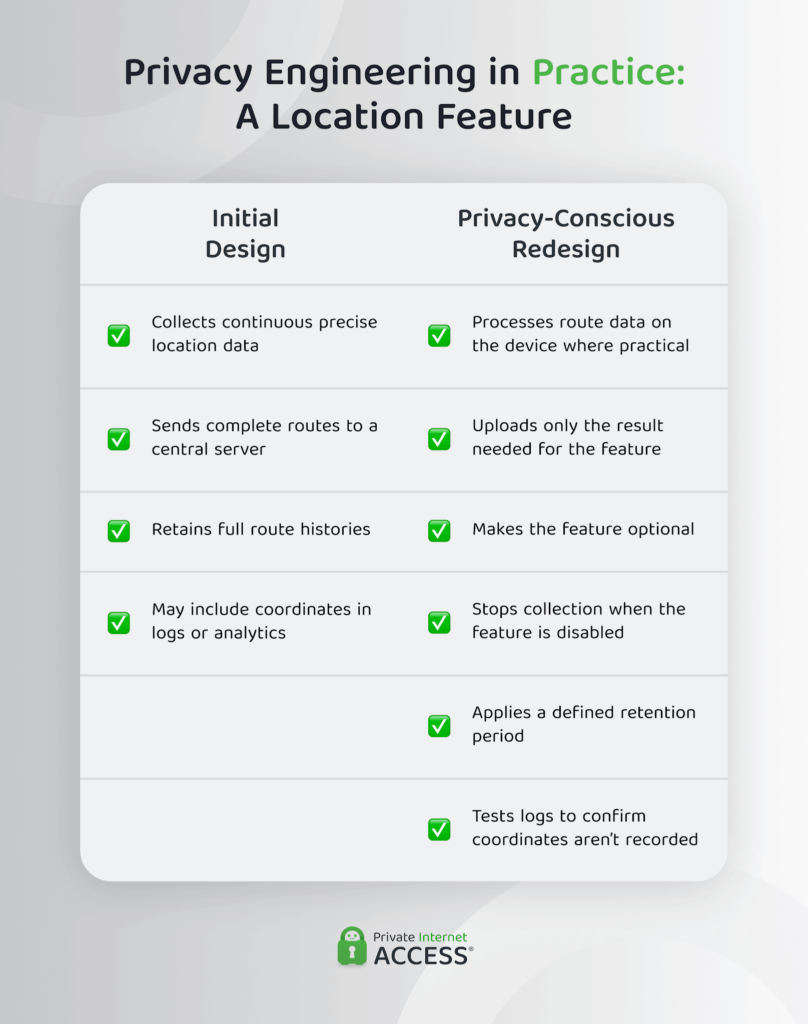
Let’s use a fitness app as an example. The product team develops a feature that produces route summaries for outdoor workouts.
- Initial Design: The application sends continuous, high-precision global positioning system (GPS) coordinates to a central database and retains full location histories indefinitely. This can create a huge dataset of personal data, which can expose a user’s daily habits and location in the event of a data leak.
- Privacy Engineering Intervention: After analyzing the feature’s core purpose, engineers determine that distance calculations can run locally on the smartphone. The application only needs to upload the final workout summary to the server.
The team makes route tracking optional, halts location polling when a user turns it off, prevents raw GPS coordinates from reaching analytics logs, and applies an automated retention policy to saved summaries. This transforms an abstract privacy objective into concrete, testable software constraints.
Additional Examples of Privacy Engineering Tasks
- Data Subject Requests: Building automated pipelines that propagate deletion, correction, and export commands across primary databases, secondary caches, and vendor APIs.
- Automated Lifecycle Enforcement: Writing database scripts that purge or anonymize records automatically once their retention window closes.
- User Interface Alignment: Verifying that front-end toggle switches and opt-out buttons accurately reflect server-side data flows and avoid dark patterns that push users toward intrusive choices.
- Control Verification: Developing automated integration tests to confirm that privacy safeguards function as expected across software releases.
- Vendor Data Boundary Management: Restricting external software development kits (SDKs) and API integrations so third parties receive only the attributes needed for their specific service.
Where VPNs Fit Into Privacy Engineering
A Virtual Private Network (VPN) serves as one specialized technical control within a broader privacy architecture. It encrypts network traffic between a user device and the VPN server, concealing the device’s origin IP address behind the server’s IP address. This helps protect against local network eavesdropping and external location tracking at the transport layer.
Since a VPN operates at the network layer, it doesn’t affect what an application collects, why a company processes data, how long records remain on server databases, or whether internal deletion scripts function properly. System designers still need privacy engineering to manage data collection, access control, transparency, and lifecycle retention across their applications.
Privacy Engineering FAQ
What is privacy engineering?
Privacy engineering is the discipline of translating privacy principles and legal rules into practical design choices, software requirements, and technical safeguards for systems that process personal data.
What are the core principles of privacy engineering?
The key principles of privacy engineering include data minimization, purpose limitation, privacy by default, transparency, record accuracy, user control, complete lifecycle protection, and verifiable accountability.
What is a privacy engineering framework?
A privacy engineering framework is an organized structure that helps organizations identify privacy risks, assign responsibilities, implement technical controls, and measure how effectively their systems protect user data.
How does privacy engineering differ from cybersecurity?
While cybersecurity and privacy engineering may overlap, they serve different purposes. Cybersecurity protects systems and data from unauthorized access, disruption, or attacks. Privacy engineering focuses on the risks created by authorized data processing, ensuring that legitimate system operations do not cause unintended problems for individuals.
What is the NIST approach to privacy engineering?
NIST’s three main objectives for privacy engineering are predictability, manageability, and disassociability. It also provides a privacy framework and privacy risk assessment methodology (PRAM) to help organizations structure their risk management activities.
How can organizations implement privacy engineering by design?
Companies can implement privacy engineering by design by mapping data flows across their applications, defining explicit justifications for each collected attribute, evaluating privacy risks, and drafting verifiable software requirements. They can then select appropriate technical controls, test backend behaviors under real-world conditions, and reassess system designs as products evolve.
References:
