The Search Engine Privacy Index: What Every Search Engine Really Knows About You
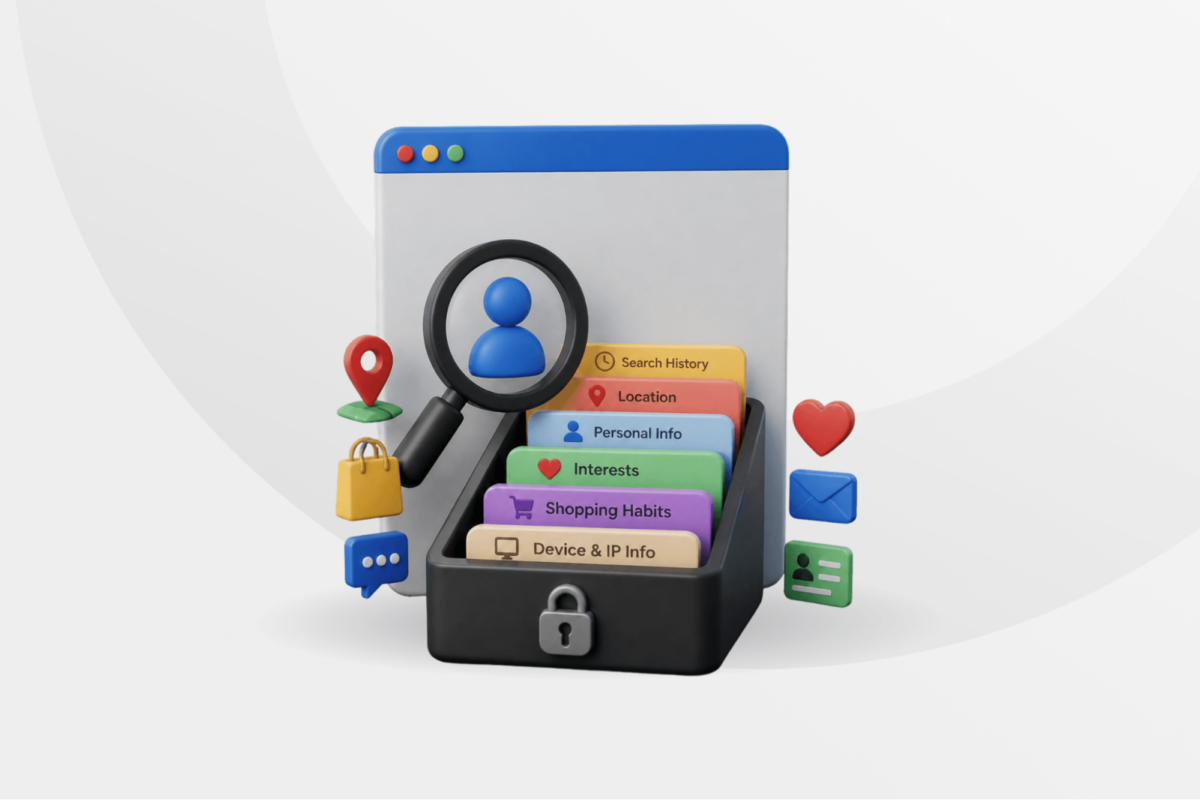
Despite Google’s continued dominance in search, users today have more choices than ever. Mainstream engines, privacy-focused alternatives, decentralized platforms, and even AI chatbots can all provide an answer you seek.
No matter what type of engine you use, every search leaves a digital trail. The key difference lies in how much information is collected, who can access it, and how long it is retained.
Interest in privacy-focused engines has particularly grown in recent years. After Google’s AI-heavy search changes in May 2026, DuckDuckGo reported a sharp rise in app installs across the U.S., peaking at 30.5% daily growth.
That shift led us at Private Internet Access to review the privacy policies and public documentation of 24 search engines, comparing how they collect, retain, and share user data.
Research Limitations
As with any study based on publicly available documentation, this research has a few limitations. The findings represent a snapshot based on the date each provider was reviewed. The search engines and AI assistants mentioned may update their privacy policies, features, or default settings after this article is published.
Our research also relies primarily on providers’ privacy policies, help documentation, and product announcements. Without conducting technical audits of each service, we cannot independently verify every privacy claim.
For the AI assistants, features such as prompt training and opt-out options may differ by subscription plan, region, or product version. Our findings reflect the configuration available at the time of review.
Table of Contents
Methodology: How We Measured PrivacyWhat Your Search Engine Really Knows
Understanding Privacy Claims
Pick the Right Level of Privacy for You
Privacy Is a Spectrum, Not a Switch
Methodology: How We Measured Privacy
To compare search engines consistently, we evaluated each of them against the same set of privacy features (such as IP logging, user profiling, tracking cookies, and third-party data sharing).
For each feature, we reviewed the search engine’s own privacy policy, help documentation, and product announcements before verifying the information against at least one independent source.
If the documentation explicitly confirmed that a feature or practice applied, we marked it as “Yes.” If it explicitly stated that the feature or practice did not apply, we marked it as “No.”
When a feature was not mentioned in any of the documentation we reviewed, we classified it as “Unknown.” If the documentation described the feature with exceptions or conditions, we marked it as “Limited” and explained the relevant caveats where applicable.
To compare search engines consistently, we evaluated each of them against 12 privacy features covering how they process searches, what data they collect and retain, how transparent they are about their practices, and the privacy tools and options they offer.
We used the same core privacy criteria (where applicable) to evaluate AI assistants, along with additional AI-specific features, such as whether user prompts are used for model training by default and how users can opt out.
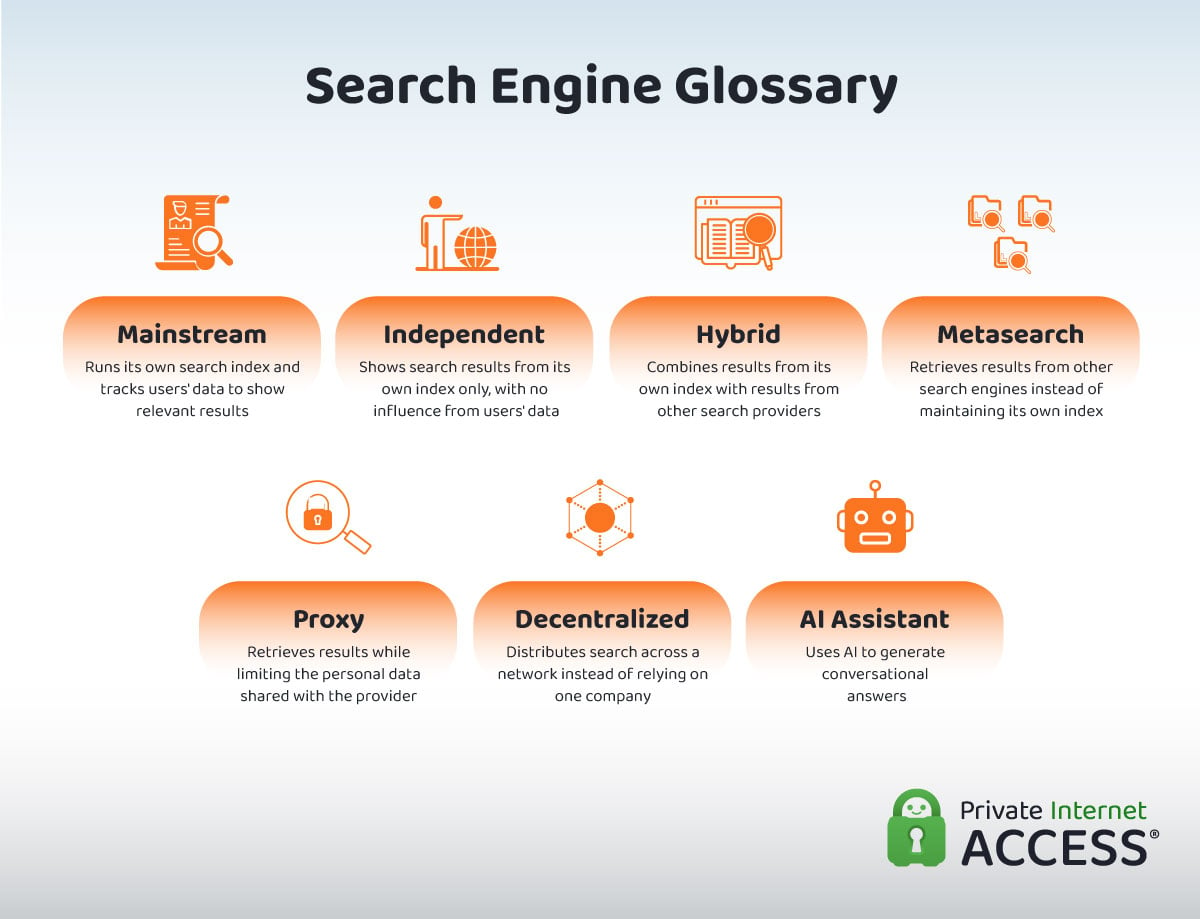
Our research covers 24 search engines grouped into five categories:
- Mainstream Search Engines: Google, Bing, Yahoo, Yandex, and Baidu.
- Search Engines That Run Their Own Index: Brave Search, Mojeek, and Kagi.
- Search Engines That Use Third-Party Indexes: DuckDuckGo, Startpage, Qwant, Ecosia, MetaGer, Swisscows, and SearXNG.
- Decentralized Search Engines: YaCy and Presearch.
- AI-Powered Search Assistants: ChatGPT, Google Gemini, Claude, Perplexity, Microsoft Copilot, Grok, and DeepSeek.
What Your Search Engine Really Knows
While some search engines collect extensive information about users and their searches, others are designed to minimize data collection or reduce reliance on mainstream search providers.
The following sections explore our findings on each category and what they mean for your privacy while browsing.
Mainstream Search Engines
Most internet users today gravitate toward mainstream search engines like Google, Bing, and Yahoo, despite privacy not being the primary focus of these services.
According to their privacy policies, the search engines in this category may collect information such as search activity, IP addresses, browser and device information, cookies, and other usage data. They may also share certain data with third parties, including service providers, affiliates, and advertisers. If required, they may also disclose data with legal authorities.
Combined, these data points enable search engines to build detailed user profiles over time. Profiling becomes deeper and more consistent when you are signed in, because the search engine can associate your activity with your account.
Search engines may use behavioral or contextual advertising. Behavioral advertising personalizes ads based on information about the user, such as their browsing activity or search history. Contextual advertising, on the other hand, displays ads based only on the content of the current search query.
Depending on the engine, this profile may also incorporate information from other services within the same ecosystem, such as Google’s Gmail, YouTube, and Maps, or other account-linked services.
The main trade-off of user tracking and profiling is reduced privacy in exchange for greater convenience. By collecting and analyzing user data, mainstream search engines can deliver more relevant search results, provide location-specific information, and show advertisements that are more likely to match a user’s interests.
However, if you want to prioritize privacy, there are several alternative search engines available.
Privacy-Focused Search Engines
Most privacy-focused search engines share the same core principles: not logging your IP address, not storing your search history, and not building advertising profiles based on your searches.
They differ mainly in how they retrieve search results. Understanding these differences can help you choose the search engine that best fits your privacy preferences.
The Borrowers: Those That Use Third-Party Indexes
Rather than maintaining their own search index, these services retrieve results from third-party search providers, such as Google or Bing, and present them through their own interface. They typically remove or minimize the amount of identifying information shared with those providers.
For example, when you type a query into Startpage, your search is forwarded to Google or Bing after identifying information like your IP address has been removed. Google receives the search terms but not information that can directly identify you or build a profile based on your searches.
According to its privacy policy, Startpage doesn’t store IP addresses, record search history, or create user profiles. It also offers Anonymous View, a built-in proxy that lets users visit search results without revealing their IP address to the destination website.
Run by the German non-profit SUMA-EV, MetaGer claims it doesn’t store any data that could identify users. It also forces all traffic through encrypted connections, reducing exposure to your local network or your Internet service provider from viewing the content of your queries.
Similarly, Swisscows states that it doesn’t create user profiles or use tracking cookies. Based in Switzerland, it also masks the last segment of users’ IP addresses before processing searches.
SearXNG is an open-source metasearch engine that can be self-hosted, meaning users can install and run it on their own server instead of relying on a public service. It’s designed without tracking, allowing users to run their own private search instance while maintaining more control over how search queries are processed.
The Independents: Those That Run Their Own Index
Primary index search engines maintain their own databases of web pages instead of borrowing results from another engine. When they also avoid IP address logging and profiling, your searches are not forwarded to other engines and are less likely to be tied back to you or your location.
One example of this model is Brave Search. According to its privacy policy, Brave Search doesn’t retain information about users, their devices, or their search queries in a way that can identify them or build user profiles. It temporarily uses your IP address to process searches, but states that it is deleted within seconds.
Another privacy-focused search engine that runs its own index is Mojeek. It claims in its privacy policy that it doesn’t profile users or store IP addresses, replacing them with two-letter country codes.
Mojeek does retain limited operational information (such as the time of a visit and the page requested) to help run and maintain the service. However, it states that these logs aren’t used to identify or track individual users.
By default, Mojeek doesn’t place cookies on your device. It uses cookies only with your explicit consent, such as to save personal preferences. You can also view the contents of any Mojeek cookies and delete them at any time.
The Five Eyes is an intelligence-sharing alliance between Australia, Canada, New Zealand, the United Kingdom, and the United States. A search engine based in one of these countries may be subject to data laws and intelligence-sharing rules that can increase the chance of user data being shared across jurisdictions.
The Hybrids: Those That Rely on Both Indexes
DuckDuckGo is another privacy-focused search engine that relies on third-party search indexes. However, rather than simply forwarding queries to a single search provider, it compiles results from multiple sources, including Bing and its own web crawler, DuckDuckBot.
Its privacy policy states that it doesn’t store your search history or keep user profiles tied to search or browsing behavior. While it does use advertisements, they are contextual rather than behaviorally targeted, allowing the company to generate revenue without relying on personal user information.
Qwant and Ecosia also rely on third-party search indexes to provide results, but both have made efforts to become more independent from major search providers. In 2025, the two companies partnered to develop Staan, a shared European search index that now handles an increasing share of French and German queries.
Kagi is a paid search engine that uses a hybrid approach, combining its own search index with results from third-party search providers. According to its privacy policy, Kagi’s subscription-based business model eliminates the need to collect or monetize users’ search data through advertising or profiling.
For additional privacy, you can create a Kagi account with a pseudonymous email address, pay with cryptocurrency, and access the service through Tor.
The Decentralized: Those That Distribute Search Across a Network
The search engines discussed above are operated by a single company. Unlike them, decentralized search engines like YaCy and Presearch don’t rely on one organization to crawl, index, and serve search results.
Instead, they spread these tasks across a network of independent nodes (computers run by different participants). Rather than depending on a single company to maintain the service, multiple participants help keep the network running.
YaCy is a decentralized peer-to-peer search engine that you can run on your own device. Participating peers crawl and index web pages, then share this information across the network, creating a distributed search index without relying on a central server.
The engine is open-source and claims it doesn’t collect personal data or use cookies. Because YaCy doesn’t rely on a central server, the network never stores search histories in a central database.
Unlike YaCy, Presearch is a blockchain-based metasearch engine that uses a decentralized network of community-operated nodes to process queries. These nodes don’t collectively build a distributed search index. Instead, they retrieve search results from other search engines.
The platform also rewards eligible users and node operators with PRE cryptocurrency tokens for participating in the network. According to Presearch’s privacy policy, it doesn’t build user profiles or store search histories. It also allows users to customize which search sources are used to generate search results.
Decentralized search engines prioritize transparency and reduce reliance on a single company to process search queries. However, they often have a steeper learning curve than mainstream search engines and may require additional setup to take full advantage of their features.
AI-Powered Search Assistants
AI technology has transformed web search, shifting it from typing keywords into a search box to using conversational prompts. Millions of people now ask AI assistants like ChatGPT, Gemini, Perplexity, or Grok the questions they used to type into traditional search engines. However, these tools introduce a new set of privacy considerations that users should be aware of.
A 2025 Stanford study found that six major AI developers in the United States (Amazon, Anthropic, Google, Meta, Microsoft, and OpenAI) used all users’ chat inputs by default to train and improve their models at the time of the study.A 2025 Stanford study found that six major AI developers in the United States (Amazon, Anthropic, Google, Meta, Microsoft, and OpenAI) used all users’ chat inputs by default to train and improve their models at the time of the study.1
Since the study was published, a couple of things have changed. Anthropic has changed its approach and allows Claude users to decide whether their chats can be used for model improvement. Meanwhile, Grok doesn’t use private conversations for model training by default, but xAI may use public X posts from non-EU users to improve its models.
All other AI assistants in this category use prompts for model training by default. Although users can usually opt out of model training, the setting is often buried within multiple menus and is not widely known. As a result, many users may unknowingly allow their conversations to be used to improve AI models.
Among the major AI assistants, DuckDuckGo’s DuckAI stands out for its privacy-focused approach. The service works as a gateway to AI models from providers such as OpenAI, Anthropic, and Meta. It doesn’t use user prompts for AI training and removes users’ IP addresses before forwarding requests to the selected AI provider.
Improve Your Privacy When Using AI Assistants
- Opt Out of AI Training
Disable the option to have your chats used for model training. - Review Data Retention Policy
Check how long chats and uploaded files are stored. - Avoid Entering Sensitive Information
Treat chatbot conversations as if they could be reviewed by the provider.
Understanding Privacy Claims
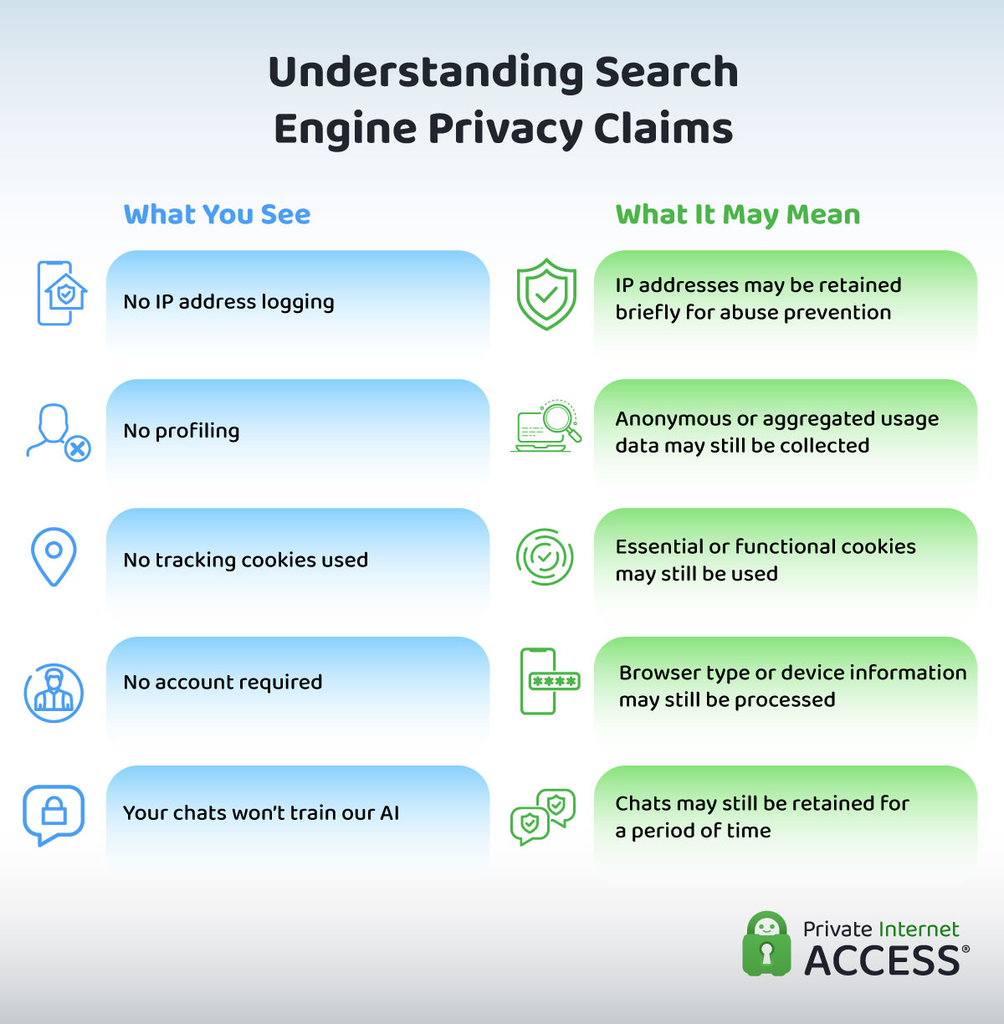
Privacy-focused search engines frequently use phrasing such as “no tracking” or “no profiling” to describe their services. While these claims are largely true, they sometimes omit certain details and qualifications. A search engine may claim not to track users, but that does not necessarily mean it collects no data.
For example, some of the privacy-focused search engines discussed in this article retain IP addresses only for a few seconds to help prevent abuse. Others avoid storing IP addresses altogether but retain non-identifying information, such as country codes.
Similarly, a claim of no user profiling doesn’t necessarily mean that a search engine collects no data about your searches or browsing habits. Rather, it means that any data it collects is not used to build a profile that identifies you as an individual.
Many privacy-focused search engines still collect anonymous or aggregated information for purposes such as improving search quality, measuring performance, or detecting abuse.
Search engines also often state that they use no cookies. In many cases, however, this refers specifically to tracking cookies that monitor users across websites. Essential or functional cookies may still be used to remember user preferences and support basic website functionality.
Where an engine is based can also affect how your data is handled, but it should not be treated as a guarantee of privacy. Providers based in jurisdictions with strong privacy laws, such as the EU’s GDPR or Swiss law, are generally subject to stricter data protection rules.
However, an engine’s privacy ultimately depends on the company’s own practices rather than its location alone. Even under stronger privacy regulations, an EU- or Swiss-based search engine may collect more user data than a competitor that is designed to minimize data collection.
Even with these qualifications, the privacy-focused engines discussed here are generally designed to collect less user data than mainstream search engines, making them a better fit for privacy-conscious users.
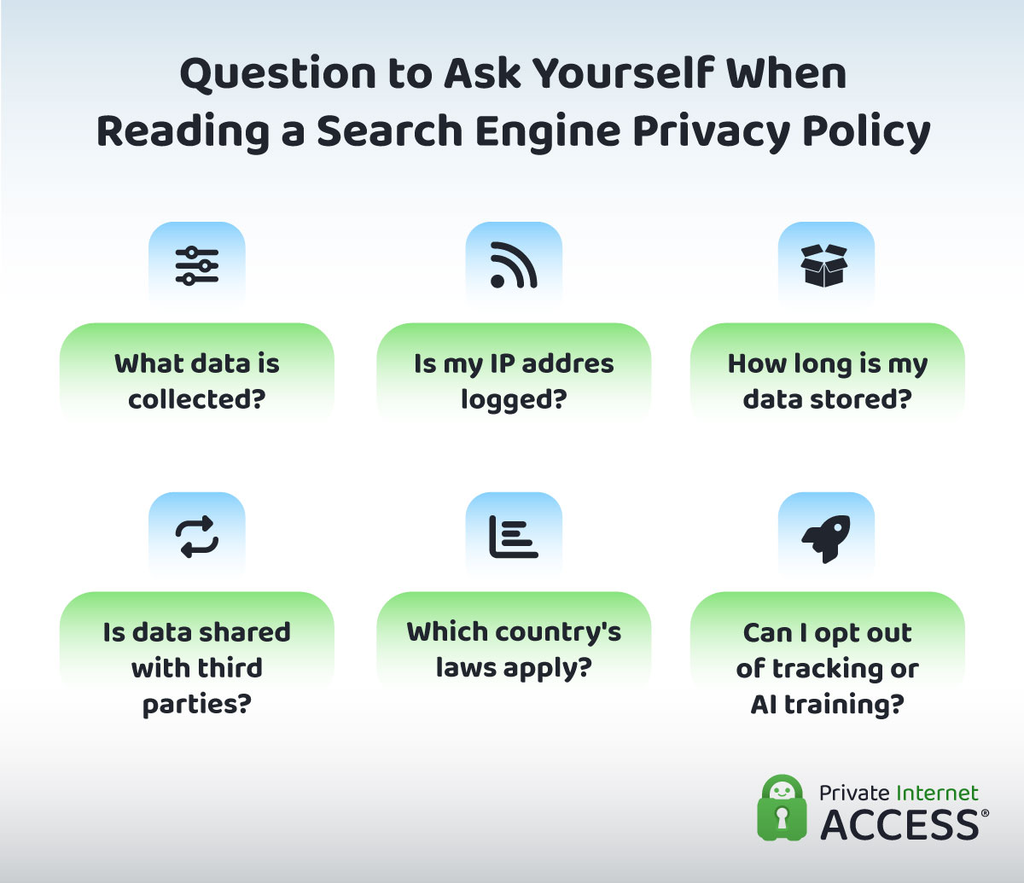
A search engine’s privacy policy provides a more complete picture of its data practices than its marketing claims. Reading it can help you understand what information is collected, why it’s collected, and how it’s used.
Pick the Right Level of Privacy for You
A search engine that relies on a third-party index typically forwards your query to a mainstream engine like Google or Bing, while removing your IP address and other identifying information. This allows you to keep the familiarity and quality of the search results while reducing the amount of personal data shared.
An important consideration is that the proxy search engine is not the only engine involved. The search engine that provides the results still remains part of the search process.
If you don’t want your query to reach a mainstream search engine at all, choose a privacy-focused search engine that uses its own index. These engines crawl and index the web themselves, eliminating the need for a third-party engine.
Alternatively, if you prefer more control over how your searches are handled, you should pick a decentralized or self-hosted search engine. These services reduce reliance on a single company by distributing the search infrastructure or letting you run your own search instance.
The trade-off is that, depending on the level of privacy you want to achieve, you might have to make some sacrifices in terms of convenience, including:
- Smaller Search Indexes: They may have a smaller index than mainstream search engines, making highly specific or newly published content more difficult to find.
- More Technical Setup: They may require more technical knowledge and setup, making them better suited to experienced users than the average searcher.
- Less Personalization: They offer less personalized search results because they collect little or no information about you and cannot tailor results based on your previous activity or location.
- Fewer Convenient Features: They may not offer the same level of integration with services such as email, maps, shopping, or AI assistants that are available within larger ecosystems.
- Less Intuitive Design: They may organize search results differently from mainstream search engines, making them feel less intuitive for users accustomed to mainstream engines like Google or Bing.
Privacy Is a Spectrum, Not a Switch
Our research shows that no search engine is universally the most private. Privacy exists on a spectrum, ranging from mainstream search engines to privacy-focused proxies, independent search indexes, and AI assistants that introduce a new set of privacy trade-offs.
Ultimately, the right choice depends on your priorities. You may value convenience, independence from Big Tech, stronger anonymity, or simply greater control over how your searches and AI prompts are used. Understanding these differences can help you choose a search engine that aligns with your privacy expectations.
References:
