Cybersecurity Compliance Standards (Regulations): All You Need to Know
Cybersecurity compliance standards vary by industry, data, and location. Some guidelines are optional, while others are legal obligations.
In this article, you’ll learn the difference between cybersecurity and network security standards, frameworks, and regulations. By the end, you’ll understand which ones apply to your organization and which are required in your industry, helping you make informed decisions about your security controls.
What Are Cybersecurity Compliance Standards?
Cybersecurity compliance standards are rules that define how organizations protect their digital systems and data. Standards often appear together with frameworks and regulations, but it’s helpful to understand the differences between all of these.
Cybersecurity Standards
Standards define baseline security and privacy requirements for organizations. They set specific criteria for security controls, risk management mechanisms, backup solutions, and data storage policies.
Cybersecurity Frameworks
Frameworks outline how organizations can organize and manage cybersecurity efforts. They function more as operational guidance than strict rules that help you identify risks, test defenses, apply controls, and track your systems.
Cybersecurity Regulations
Regulations are legally enforceable laws. They apply to entities that handle personally identifiable information (PII) and other regulated data. Failure to comply can result in penalties, such as fines, audits, or operational restrictions.
What Are Network Security Compliance Standards?
Network security compliance standards define security requirements for communication channels. These standards cover a narrower area than cybersecurity standards, including:
- Wired and wireless networks
- Internet connections
- Local area networks (LANs)
- Remote system access
- Data exchange between systems
Following network security standards reduces the risk of hackers accessing your network and intercepting or tampering with sensitive data.
Aspects of Cybersecurity and Network Security Compliance
Compliance with cybersecurity and network security standards includes multiple elements:
- Legal requirements: Authority-issued laws that specify how organizations must collect, store, use, and share PII and other sensitive data.
- Policies and procedures: Company-wide instructions that define secure behavior, such as rules for password handling, device usage, and VPN use.
- Risk management: The process of identifying what could go wrong, evaluating how likely and damaging those risks could be, and taking steps to reduce the chances or impact of security incidents.
- Authentication: Identity checks that prevent unauthenticated users from accessing your digital environment or data.
- Access control: Security measures that determine who can access systems, data, or resources and what actions they are allowed to perform based on roles, permissions, or responsibilities.
- Data encryption: Protection of network traffic, location, and data in transit through VPN encryption or a similar service.
- Intrusion prevention: Firewalls and monitoring tools that inspect network activity, block malicious traffic, and contain threats before they spread across systems.
- Incident response: Plans for detecting security events, containing damage, and restoring normal operations.
- Documentation: Records of policies, access reviews, security testing, and clear explanations of every security incident.
- Security reviews and audits: Continuous checks and periodic audits that evaluate your security measures and potential weaknesses.
- Cybersecurity training: Awareness campaigns and practical training about key cybersecurity practices and requirements.
Benefits of Cybersecurity Compliance Standards
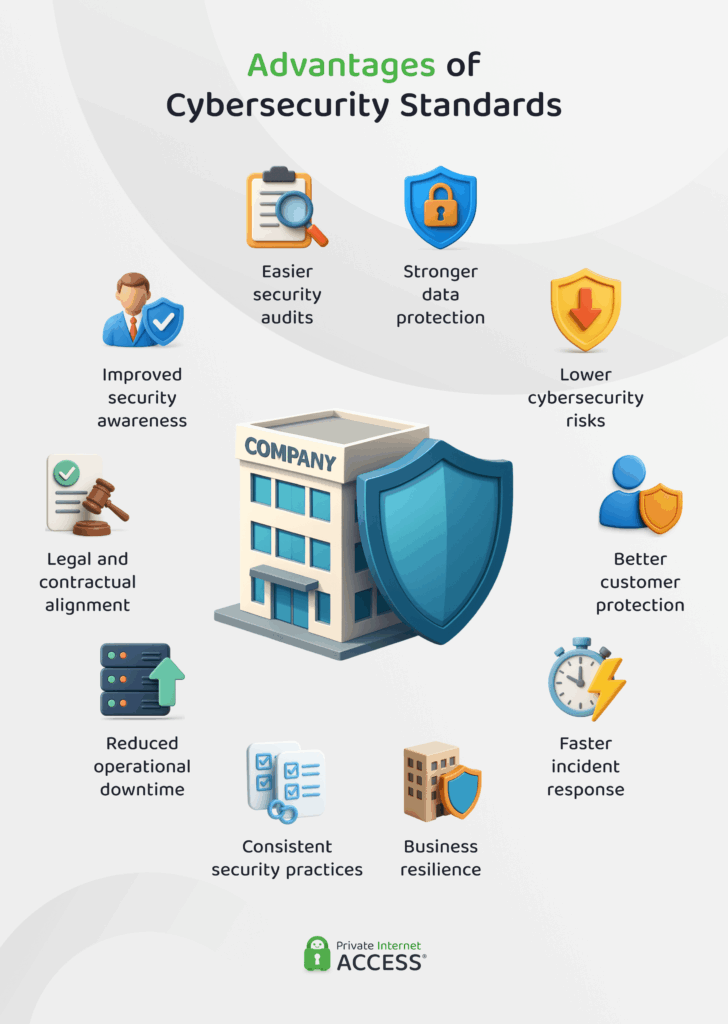
Security standards shape how your organization can protect itself and recover from digital threats. This translates into a wide range of benefits:
- Stronger data protection: Security standards force you to patch weak points that attackers can use to access your systems.
- Easier security audits: Clear documentation, standardized controls, and continuous monitoring make compliance reviews and external audits more manageable.
- Better customer protection: Compliance standards encourage stronger safeguards for customer data, helping reduce accidental exposure, unauthorized sharing, and misuse of sensitive information.
- Lower cybersecurity risk: Security standards help organizations identify vulnerabilities, strengthen defenses, and reduce opportunities for cyberattacks, unauthorized access, and data breaches.
- Stronger business resilience: Standardized security practices improve operational continuity and help organizations recover more effectively from outages, cyber incidents, or disruptions.
- Faster incident response: Established response procedures and defined security responsibilities help teams detect threats earlier, contain damage faster, and restore systems more efficiently.
- Legal and contractual alignment: Compliance with cybersecurity regulations and industry requirements can help organizations meet legal obligations, avoid penalties, and satisfy customer or vendor security expectations.
- Reduced operational downtime: Stronger safeguards, monitoring practices, and recovery procedures can help minimize service interruptions and keep critical systems available.
- More consistent security practices: Standardized procedures help teams apply security controls more consistently across devices, departments, cloud services, and remote environments.
- Improved security awareness: Ongoing cybersecurity training and compliance procedures help employees recognize threats, follow safer practices, and reduce human error.
Top 15 Cybersecurity Compliance Standards, Frameworks, and Regulations
ISO/IEC 27000
The ISO/IEC 27000 series is a family of international information security standards that tells you how to run a secure information security management system (ISMS). The ISO 27000 series contains dozens of guidance standards that describe voluntary security practices. You can complete an external audit to get ISO/IEC 27001 certification to prove that your organization operates a secure ISMS.
Here are the key rules and guidelines this framework contains:
- ISO/IEC 27001: Formal ISMS requirements (that you can certify against), including secure processes, risk management, controls, ownership, and monitoring.
- ISO/IEC 27018: PII protection in public cloud services, including security responsibilities of your cloud providers and their business customers.
- ISO/IEC 27031: Guidance on keeping IT systems running and recovering them during disruptions, such as outages, cyber incidents, or disasters.
- ISO/IEC 27037: Practices for identifying, collecting, acquiring, and preserving digital evidence for legal cases.
- ISO/IEC 27040: Rules for security across storage systems and backups.
- ISO/IEC 27402: Guidance on security and privacy for connected devices, such as IoT sensors, smart equipment, and monitoring software.
SOC 2
Service Organization Control 2 (SOC 2) is an auditing and attestation framework that demonstrates that your company protects customer data sufficiently. SOC 2 and ISO 27001 have about 80% overlapping security criteria1 and almost identical controls.
To obtain a SOC 2 attestation report, a company undergoes an audit by a licensed CPA firm. It tests your controls against the Trust Services Criteria for security, availability, processing integrity, confidentiality, and privacy.
- Type I report: Evaluates the design and implementation of your policies, processes, and safeguards at a specific point in time.
- Type II report: Evaluates whether those same controls work in practice over a defined period (usually 3-12 months).
PCI DSS
The Payment Card Industry Data Security Standard (PCI DSS) defines how you should store, process, and transmit payment card data. It’s a necessity for e-commerce businesses, retailers, and merchants. Failing to comply with these cybersecurity industry standards will prevent you from being able to accept bank card transactions.
- Network security systems: Outlines how firewalls and system configurations should protect payment environments from unauthorized network access.
- Cardholder data protection: Encryption and key management protect card data in transit and at rest so unauthorized parties cannot read it.
- Vulnerability management: Patch management, malware protection, and regular updates reduce known security weaknesses.
- Access control measures: Unique user accounts and role-based permissions limit employee access to only the resources required for their job responsibilities.
- Regular testing: Continuous monitoring, log reviews, and security testing help identify misconfigurations and verify that controls are working as intended.
- Information security policy: Written rules define responsibilities, acceptable use, and required practices for anyone handling card data.
NIST Framework
The National Institute of Standards and Technology (NIST) is a US government agency that publishes cybersecurity standards, such as the NIST Cybersecurity Framework and the SP 800 series. Many NIST guidelines are voluntary for private organizations. However, agencies and government contractors may be required by contracts or federal regulations to implement specific NIST standards and controls.
- NIST SP 800-37: A step-by-step process to help you identify critical systems, choose the right security protections for them, and check that those protections work.
- NIST SP 800-53: Catalog of security and privacy rules that explain how people, processes, and systems should protect sensitive data inside federal organizations.
- NIST SP 800-171: Rules for companies outside the government that handle Controlled Unclassified Information (sensitive government-related information).
- NIST SP 1800 series: Practical guides that show how to apply NIST security rules using common technologies in your organization.
- NIST CSF 2.0: A security framework that divides security into 6 areas (identify, govern, protect, detect, respond, and recover) so you can manage risk in a structured way.
CMMC
Cybersecurity Maturity Model Certification (CMMC) is a US Department of Defense (DoD) security program for its contractors. If you work for the DoD, their regulations will require you to protect two main data types: Controlled Unclassified Information and Federal Contract Information (information created for or provided under a federal contract).
CMMC largely overlaps with the NIST SP 800-171 framework and uses three levels with stricter requirements and checks as risk goes up.
- Level 1: Basic safeguards for handling federal contract information that you can confirm by assessing yourself.
- Level 2: Over 110 controls that align with NIST SP 800-171, requiring either a self-assessment or third-party audit by an outside organization.
- Level 3: More than 134 controls against more persistent threats that the US Department of Defense confirms every 3 years.
FISMA
The Federal Information Security Modernization Act (FISMA) is a US law that enforces security requirements for companies that process federal information.
This security law uses NIST SP 800-37 and SP 800-53 as baselines for risk management and controls. Unlike NIST, FISMA is mandatory for federal agencies and for outside companies that operate their systems.
COBIT
Control Objectives for Information and Related Technology (COBIT) is a voluntary framework that helps you run your IT systems safely. It exists because many companies run critical systems differently across teams, leaving security and accountability gaps. COBIT helps define what needs protection and how teams should manage it in practice.
- Governance and management: Governance defines what you should protect and how thoroughly, while management explains how to run those security processes daily.
- Control objectives: Outline outcomes for each process, such as preventing unapproved changes to production systems.
- Process descriptions: Describe how teams can keep the processes unified (such as change management, incident response, and backup recovery).
- End-to-end coverage: Define the controls and governance practices organizations should apply across systems, teams, services, and third-party vendors.
- Process ownership: Assigns an accountable owner with clear responsibilities for each process.
CIS Controls
Center for Internet Security (CIS) controls are priority actions that help reduce security vulnerabilities. This is a voluntary best practice framework that outlines which safeguards organizations should deploy, configure, and monitor to give hackers fewer opportunities.
- Enterprise asset inventory: Accountability for every device, software, and cloud resource, so attackers cannot use unknown assets as an entry point.
- Data protection: Security measures for critical services and databases.
- Access control: Sign-in checks and permission controls for business-critical systems, so only approved users can access them.
- Configuration management: Hardened configuration that removes common attack paths.
- Vulnerability assessment: Regular scanning and timely patches that reduce exposure to known exploits.
- Audit log management: Centralized logs that help you detect suspicious activity and investigate intrusions.
COSO
The Committee of Sponsoring Organizations of the Treadway Commission (COSO) is a business framework that helps you reduce security mistakes. It mandates policies and checks that keep work consistent and auditable.
- Operational controls: Rules that keep daily activities predictable, such as approval chains, separation of duties, and access limits.
- Reporting controls: Controls that improve the accuracy and completeness of your reporting tools.
- Compliance controls: Checks that help the company follow applicable data security and privacy laws.
- Informational flow: Controls that ensure people receive accurate and sufficient information on time.
- Board oversight: Ongoing reviews by higher-level stakeholders to confirm that your controls work as expected.
NERC CIP
The North American Electric Reliability Corporation Critical Infrastructure Protection (NERC CIP) is a set of security rules applied to organizations that operate high-voltage electric systems. NERC CIP requires you to protect critical digital assets that could compromise the entire grid.
- CIP 003: Forces clear ownership, documented policies, and management-level security controls.
- CIP 004: Enables personnel training, access authorization, and ongoing security awareness.
- CIP 005: Requires network segmentation and controlled electronic access around critical assets.
- CIP 006: Mandates physical protection plans for facilities, including limited access to equipment.
- CIP 008: Focuses on incident response planning and timely reporting of security events.
- CIP 013: Outlines supply chain risk management requirements for third-party products and services.
IEEE 802.11
IEEE 802.11 is a technical standard that defines how devices work and stay protected on a Wi-Fi network. This standard sets the rules for how devices join a wireless network and exchange data without colliding.
Modern network security protocols build on these standards to authenticate devices and protect wireless traffic.
- 802.11n (Wi-Fi 4): Allows routers and devices to send the same data stream across multiple antennas at once, making the data flow and connection more stable.
- 802.11ac (Wi-Fi 5): Operates in a cleaner frequency range with fewer competing devices, allowing much faster data transfer than Wi-Fi 4 at shorter distances.
- 802.11ax (Wi-Fi 6): Schedules when each device sends data, maintaining higher speeds when more devices connect simultaneously.
GDPR
The General Data Protection Regulation (GDPR) is a data privacy law that applies to organizations that handle the PII of European Union residents. It defines how and why you collect, store, and use sensitive data.
- Lawfulness: You should have a legal reason and a clear purpose to collect and use personal data.
- Accountability: Document what data you collect, where it moves, who can access it, and what vendors do with it.
- Security measures: Protect your data with robust controls, including encryption, access controls, and authentication.
- Privacy measures: Collect the minimal data required and anonymize it when possible to help prevent it being linked back to real people.
- Deletion: Regularly archive or delete the personal data you no longer need.
- Breach notifications: Report breaches to regulators within required deadlines and notify people whose information is at high risk.
HIPAA
The Health Insurance Portability and Accountability Act is a US health privacy law governing how to manage patient health information (PHI). These standards apply to healthcare organizations, medical billing companies (clearinghouses), health plans and insurance providers, and business associates that process PHI.
- Privacy rules: Set how you can use and share PHI inside and outside a healthcare organization.
- Administrative safeguards: Define organizational policies and procedures that protect patient data.
- Physical safeguards: Protection for physical environments where you store patient data, such as server rooms and workstations.
- Technical safeguards: Security tools for the electronic patient data inside your systems, such as logins, access controls, encryption, and data logging.
RAMP Family
The Risk and Authorization Management Program (RAMP) is a family of government-approved programs for cloud security. Cloud providers must typically comply with these programs before hosting sensitive government data. Programs in this family reuse most of the requirements from the NIST framework, particularly NIST SP 800-53.
- FedRAMP: Cybersecurity standards for federal agencies and cloud providers that want to work with them.
- StateRAMP: State-based and other local government programs for cloud vendors in the public sector.
- TX RAMP: Cloud approval program for cloud service providers used by Texas public sector organizations.
HITRUST
HITRUST is a certification program that proves your organization protects sensitive data through documented, tested, and audited controls. It bundles overlapping compliance requirements, such as NIST, ISO 27001, and HIPAA, into one control set.
HITRUST is popular in healthcare and other data-heavy industries. It’s very difficult to implement because it requires strict discipline across all organizational elements. That’s why many companies scope HITRUST to a specific product, platform, or environment as a pilot.
Key Cybersecurity Compliance Standards by Industry
Many of the cybersecurity requirements are industry-wide, but some privacy-focused sectors must comply with more of them. This table should help you understand which cybersecurity industry standards to follow.
| Standard | Healthcare | Finance | Government | Insurance | Energy | Retail | Manufacturing |
| ISO 27000 Series | ✅ | ✅ | ✅ | ✅ | ✅ | ✅ | ✅ |
| SOC 2 | ✅ | ✅ | ✅ | ✅ | ✅ | ✅ | ✅ |
| PCI DSS | ✅ | ✅ | ✅ | ✅ | ✅ | ✅ | ✅ |
| NIST | ✅ | ✅ | ✅ | ✅ | ✅ | ✅ | ✅ |
| CMMC | ❌ | ❌ | ❌ | ✅ | ❌ | ❌ | ✅ |
| FISMA | ❌ | ❌ | ✅ | ❌ | ❌ | ❌ | ❌ |
| COBIT | ✅ | ✅ | ✅ | ✅ | ✅ | ✅ | ✅ |
| CIS Controls | ✅ | ✅ | ✅ | ✅ | ✅ | ✅ | ✅ |
| COSO | ✅ | ✅ | ✅ | ✅ | ✅ | ✅ | ✅ |
| NERC CIP | ❌ | ❌ | ❌ | ❌ | ✅ | ❌ | ❌ |
| GDPR | ✅ | ✅ | ✅ | ✅ | ✅ | ✅ | ✅ |
| HIPAA | ✅ | ❌ | ❌ | ✅ | ❌ | ❌ | ❌ |
| FedRAMP (RAMP family) | ❌ | ❌ | ✅ | ❌ | ❌ | ❌ | ❌ |
| HITRUST | ✅ | ❌ | ❌ | ✅ | ❌ | ❌ | ❌ |
FAQs
What are cybersecurity compliance standards?
Cybersecurity compliance standards define the minimum security controls you must follow to protect sensitive systems and data. Security standards often include cybersecurity frameworks (practical guidelines) and regulations (mandatory processes).
What are the main cybersecurity industry standards?
The main cybersecurity industry standards include ISO/IEC 27001, SOC 2, NIST, PCI DSS, HIPAA, and GDPR. They help ensure compliance and sufficient security and privacy across industries. Other standards (FISMA, COBIT, RAMP programs, and local regulations) are typically aligned with these key standards.
What are common network security compliance standards?
Some of the most widely recognized network security compliance standards are PCI DSS, NIST CSF, and ISO/IEC 27001. These frameworks help organizations protect sensitive data, secure their networks, manage cybersecurity risks, and meet industry or regulatory requirements. They commonly cover areas such as access controls, network monitoring, encryption, incident response, and risk management.
How do organizations meet cybersecurity compliance requirements?
Organizations meet cybersecurity compliance requirements by identifying risks, implementing security controls, defining policies and responsibilities, and training employees. Continuous monitoring and regular reviews help ensure compliance as systems and threats evolve.
What are the emerging network security compliance trends?
Emerging network security trends focus on automation and stricter access controls. Zero Trust policies require continuous verification of users, devices, and access requests. Secure SD-WAN and SASE combine routing, firewalling, and access control into a single security system. Many companies adopt AI security tools that detect threats faster and respond automatically.
Can VPNs help businesses maintain network security compliance?
Yes. VPNs encrypt data in transit, helping protect communications between employees, devices, and corporate networks. While a VPN alone does not ensure compliance, it can support security requirements in frameworks and regulations such as HIPAA, PCI DSS, GDPR, and SOC 2 as part of a broader cybersecurity strategy.
Reference:
