Fast‑Flux Attacks: How They Work and How to Stop Them
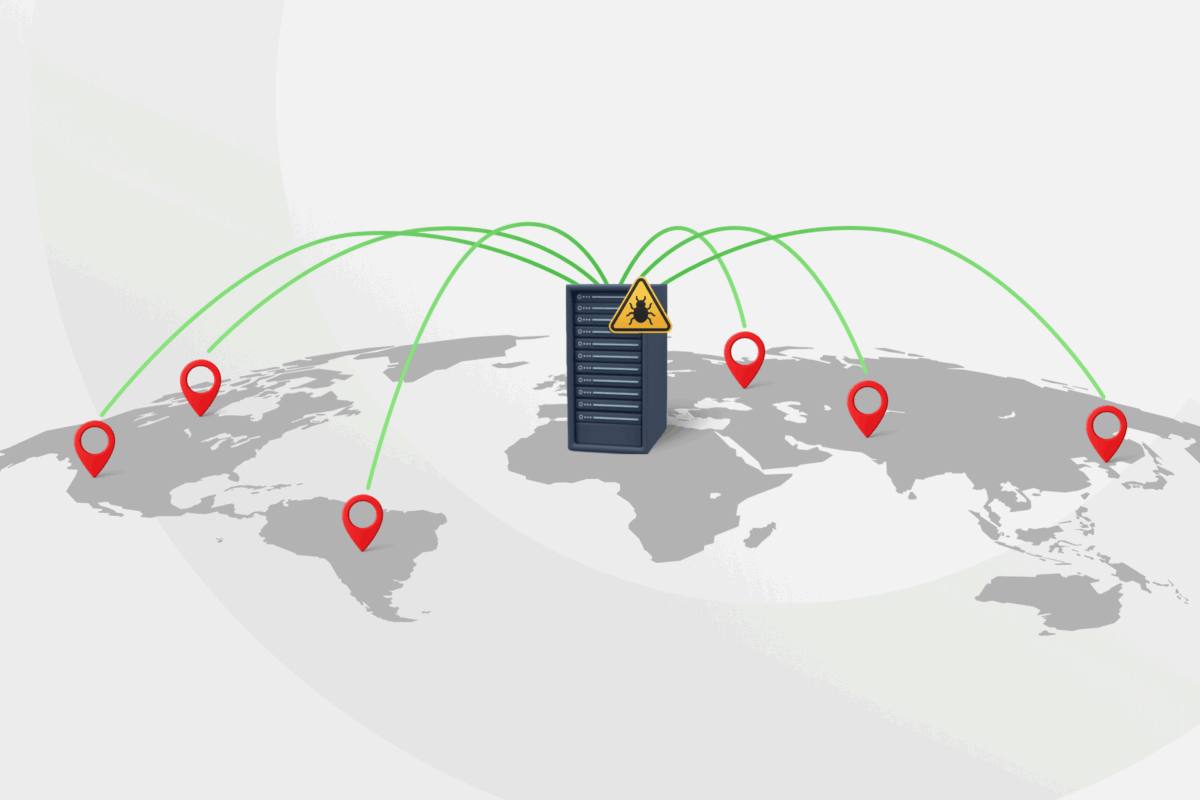
Malicious websites disguised as legitimate ones are nothing new. But what you might not know is that these websites can be built on highly resilient networks that make them extremely hard to take down. These are known as fast-flux networks and they put everyday internet users like you at risk.
In this post, we’ll tell you everything you need to know about fast-flux networks including what they are, how they work, and how you can protect yourself from these cyberattacks.
Table of Contents
What Is a Fast-Flux Network?How Does Fast Flux Work?
What Are the Types of Fast-Flux Networks?
What Do Attackers Use Fast‑Flux Networks For?
How to Detect and Stop Fast-Flux Attacks
FAQ
What Is a Fast-Flux Network?
Fast Flux Defined
A fast-flux network is a technique used by cybercriminals to hide the true location of malicious domains. It involves associating multiple IP addresses – sometimes hundreds or even thousands – with a single domain and changing those IP addresses rapidly to avoid detection.Fast flux lets attackers hide the origin of their attacks, maintain their web infrastructure, and evade IP-based blocking. This threat is significant enough that CISA, the NSA, the FBI, and cybersecurity agencies from Australia, Canada, and New Zealand jointly warned about it in an April 2025 advisory.1
Attackers need to keep their websites online to carry out their operations. Fast-flux makes it harder to take down these domains because the website’s address points to different hosts (usually compromised routers or modems) all the time. Those hosts act as temporary fronts or relays that get swapped out every few minutes. Since they change so quickly, they can’t be easily blocked or shut down. Basically, the target keeps moving so takedowns and simple IP blacklists are much less effective.
Think of it like a street criminal using a burner phone: because the number and device are swapped or discarded after each contact, it’s harder for police to link calls back to the real person. Similarly, fast flux keeps changing which IPs a domain points to so you can’t easily find the true server and shut it down.
How Does Fast-Flux Work?
Fast flux works by exploiting weaknesses in the Domain Name System (DNS). Normally, a legitimate domain points to a fixed set of IP addresses. But in fast-flux, the domain points to a large pool of (often compromised) machines that act as front‑end proxies, forwarding requests to the real hidden server.
This setup helps attackers hide their true location and keep their malicious website online longer by frequently changing the DNS A records to hide the real server location.
Fast‑flux networks are commonly used for phishing sites, malware distribution, and botnet command‑and‑control. Many of these malicious domains are created using a technique called typosquatting, where attackers create slight variations or misspellings of well-known websites.
When you arrive at the website, it looks like you’ve reached a legitimate bank, retailer, or service. But in reality, the site is run by cybercriminals and is set up to steal whatever information you enter, such as login credentials, payment details, or personal data.
What Are the Types of Fast-Flux Networks?
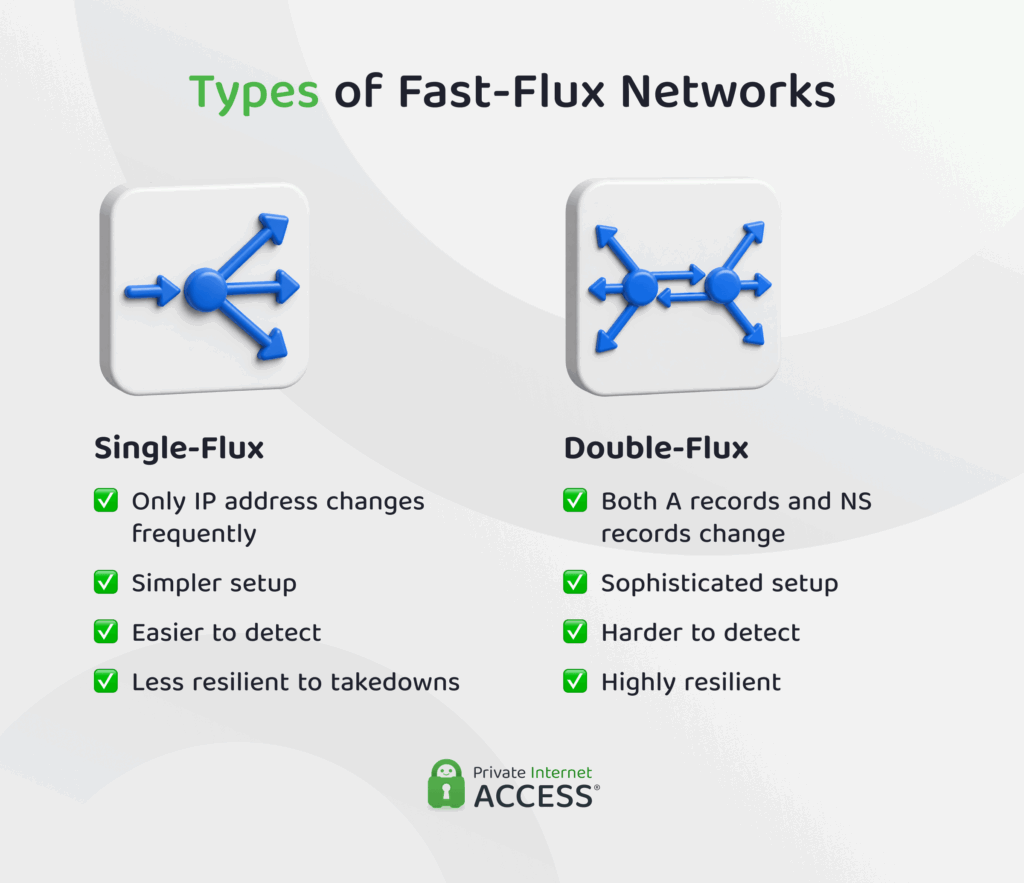
There are two main types of fast-flux networks: single-flux and double-flux. While both types work in similar ways, they differ in the level of DNS manipulation and difficulty in shutting the network down.
Single-flux network
A single-flux network is a type of fast-flux setup where only the IP addresses linked to a domain’s A records change. The name servers (NS records) that actually translate the domain name into an IP address change rarely, if at all.
Although the rotation of IPs hides the real server, single-flux is easier to block than double-flux because you can still target the NS records to disrupt the network.
Double-flux network
A double-flux network is a more advanced type of fast-flux setup where both the A records and the NS records change frequently. That makes it harder to block or trace because there isn’t a single, stable directory entry you can target to shut the network down.
In single‑flux, you can often target the unchanging NS records or a small set of IPs. But in double‑flux, both the IP and name servers keep changing, so taking down one set only affects the attacker for a short time before they switch to new servers or IPs.1
What Do Attackers Use Fast‑Flux Networks For?
Fast flux is most commonly used to mask phishing pages that steal logins and payment details. But this technique is also used in other malicious campaigns like malware distribution or command‑and‑control (C2).
Malware Distribution
Attackers use fast flux to make a malicious website hard to trace. Instead of hosting the bad site on one fixed server, they point the domain to many different hosts in a network so it never sits behind a single IP for too long.
When someone clicks a malicious link, the host either hands over a fake installer, redirects the visitor to the real server, or runs a quick probe that looks for browser weaknesses (known as an “exploit kit”). That small downloader (known as a “dropper”) then pulls in the full malware from a hidden location.
C2
C2 is how attackers remotely send instructions to compromised computers (or “hosts”) and get stolen data back. Fast flux helps them run C2 more reliably and hide where those instructions come from.
By constantly rotating the IP addresses and server names for a single malicious domain, a fast‑flux setup makes it much harder for you to locate and disable the real infrastructure. That means attackers can keep the C2 endpoint available even when some infected machines are cleaned or some IPs are blocked.
How to Detect and Stop Fast-Flux Attacks
If you land on a website hosted on a fast-flux network, you could fall victim to privacy risks like stolen passwords and malware infection. In severe cases, you could experience financial loss if important login or credit card details are stolen.
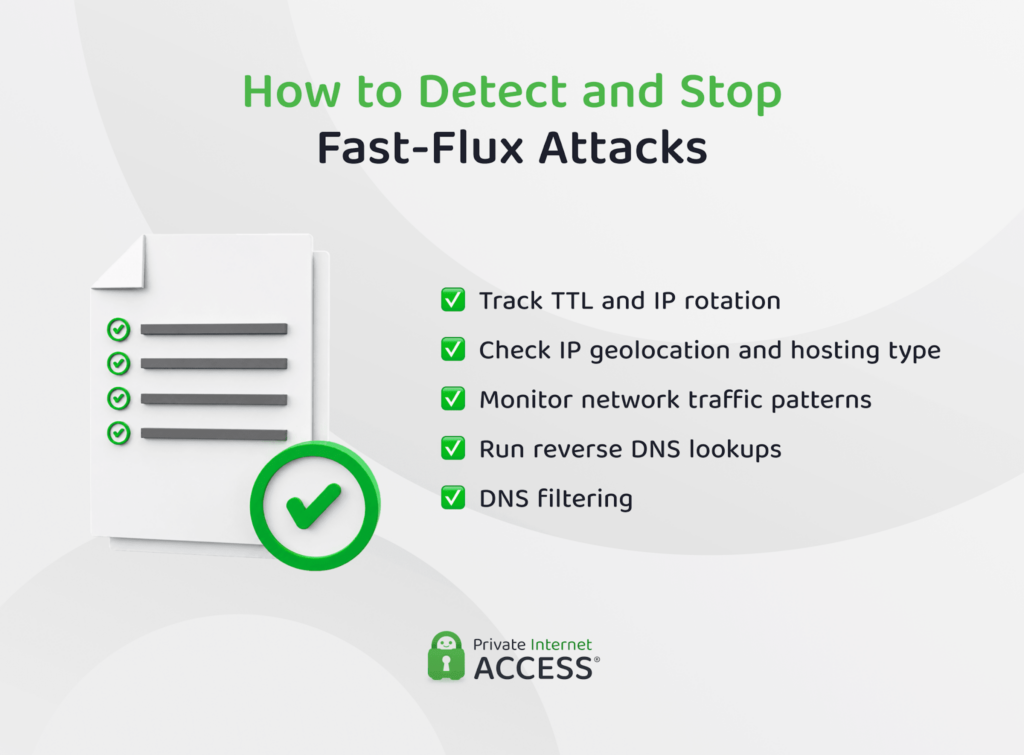
Learning to recognize the signs of a fast-flux attack can help you avoid unsafe sites and make smarter decisions about what to click or trust online. If you suspect a website is unsafe, here’s how to spot fast-flux behavior and what to do about it.
- Track DNS TTL and IP rotation: Fast-flux domains typically use very short TTLs – sometimes just seconds – to force constant DNS updates. Query the domain repeatedly: if it resolves to many different IPs in a short window and keeps returning unusually low TTLs, that’s a strong sign of fast flux.
- Check IP geolocation and hosting type: If the IPs are spread across many countries or regions and belong mostly to residential or consumer ISPs rather than data centers, that’s unusual for a legitimate site and a strong indicator of fast flux.
- Monitor network traffic patterns: Fast-flux traffic tends to involve frequent, short-lived connections to many different IPs for the same domain, often from residential networks rather than hosting providers. Watching for this pattern in network flow data can flag fast-flux activity before you even check DNS records.
- Run reverse DNS lookups: A lack of connection between the IPs and the main domain is a common sign of fast-flux. If reverse lookups map the IPs to unrelated or random hostnames instead of consistent server domains, they likely belong to compromised machines.
- DNS filtering: Some cybersecurity tools, like Virtual Private Networks (VPNs), offer DNS filtering as a first line of defense against malicious websites. When enabled, your DNS requests are directed to the VPN’s DNS servers and any domain that matches a known ad/malware site is effectively blocked, stopping malicious downloads before they finish.
FAQ
What is fast flux?
Fast flux is a technique used by cybercriminals to make malicious websites harder to take down. It works by rapidly changing the IP addresses associated with a domain name, often using a large network of compromised computers. This constant rotation hides the real location of the servers and keeps the malicious service online despite attempts to block it.
What is fast-flux DNS and how does it work?
Fast‑flux DNS is a trick cybercriminals use to keep malicious websites and services online. They constantly swap a website’s IP address, sometimes using hundreds or thousands of infected computers for short periods. That constant switching makes the malicious site hard to block or shut down.
What is a fast-flux attack and what threats does it pose?
A fast‑flux attack uses many compromised computers that rapidly rotate which IP address a malicious domain points to, so a harmful site stays online and is hard to remove. It enables resilient phishing, malware distribution, and stealthy command‑and‑control, making blocks and takedowns ineffective and investigations much harder.
How can I detect if a domain is using fast-flux techniques?
You can detect fast-flux techniques by looking at the domain’s DNS behavior over time. If it returns many A records, has very low TTLs, and its IP addresses change frequently between queries, that’s a red flag. Check whether those IPs are scattered across many countries and ASNs or sit in consumer/residential ranges, which suggests a pool of compromised hosts.
How do security teams mitigate or disrupt fast-flux botnets?
Security teams combat fast‑flux botnets by blocking or sinkholing malicious domains, monitoring DNS for rapidly changing IPs, and sharing threat intelligence with ISPs and partners. They also identify and clean infected machines to reduce the pool of compromised hosts.
References:
