Private Internet Access Transparency Report Q1 2026

Transparency reports exist to hold privacy companies accountable. Every quarter, we publish this data to show exactly how many legal requests we receive from authorities and what happens when they ask for user data.
Between January and March 2026, our legal team received 19 requests from domestic and international authorities.
As in every previous quarter, none of these requests resulted in the disclosure of user data. PIA’s infrastructure is strictly engineered not to log user activity. We can’t hand over information that we simply don’t possess. Below is a breakdown of the requests we received, updates from our Bug Bounty program, and a look at the wider privacy landscape in Q1.
PIA’s Q1 2026 Transparency Report
We categorize our requests so you can see exactly where the legal pressure is coming from.
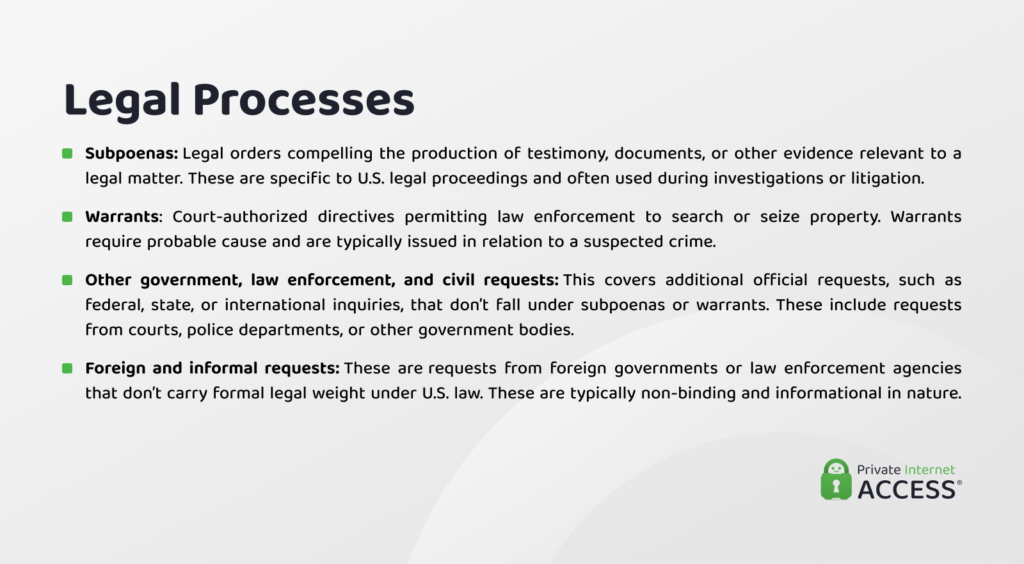
Here’s a breakdown of the notices our legal department received between January 1 and March 31:
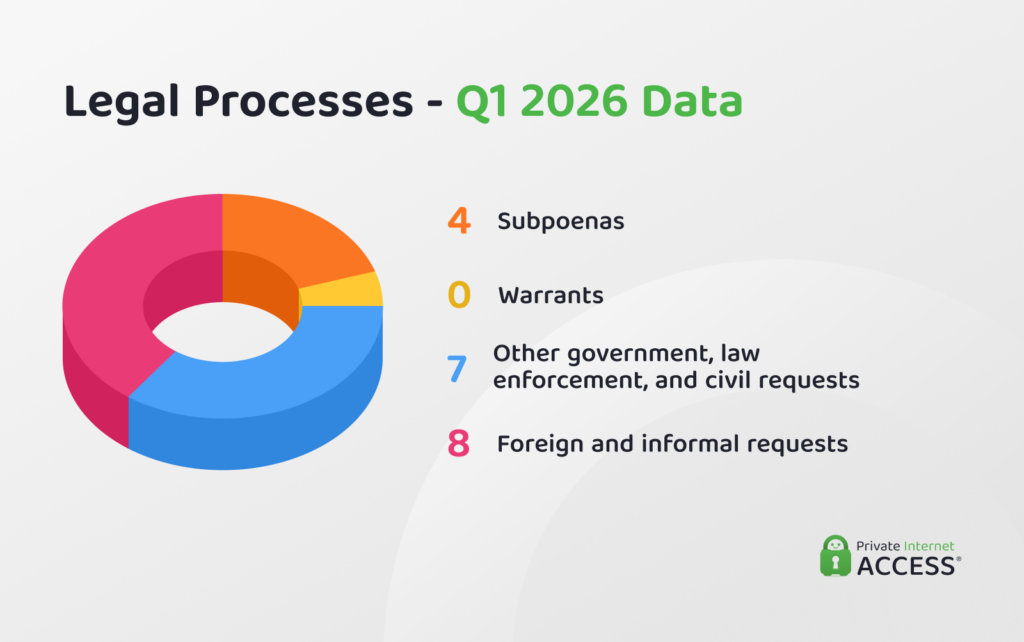
Logs produced: 0
Key Takeaways:
- Volume: Legal demands for user data remained steady, dropping slightly to 19 total requests compared to our previous reporting periods.
- Outcome: 100% of requests yielded zero data. Our RAM-only servers wipe on reboot, leaving no digital trail to retrieve.
Q1 Bug Bounty Activity
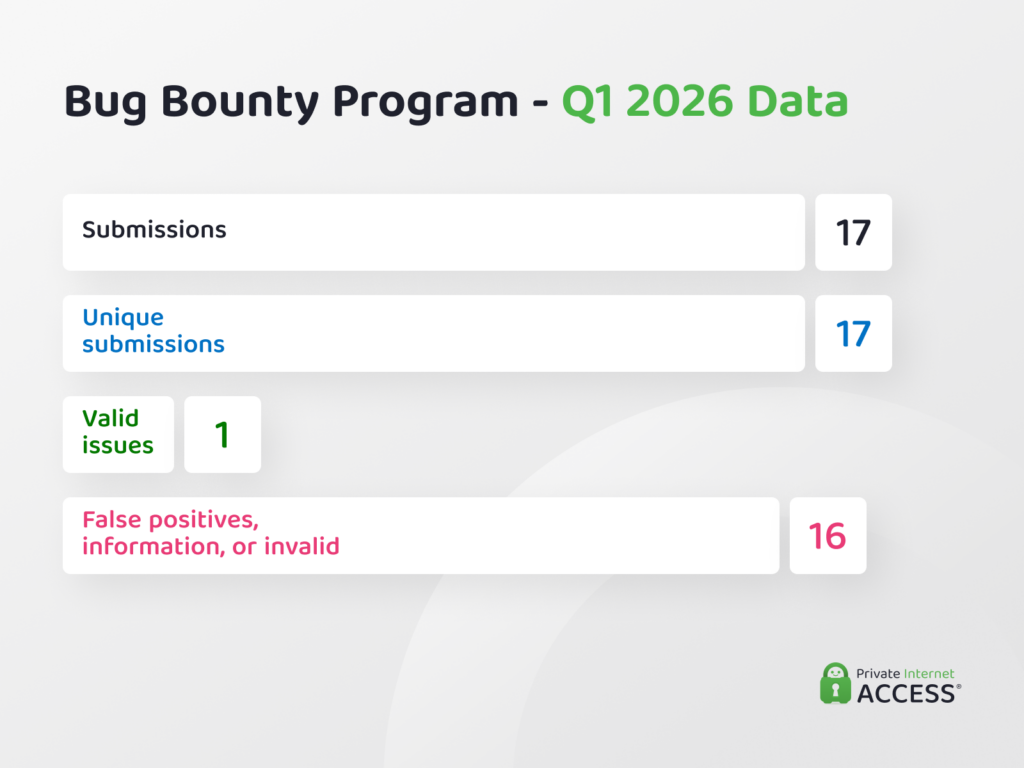
Our ongoing Bug Bounty program invites independent cybersecurity researchers to stress-test our infrastructure. Exposing our systems to outside scrutiny is how we validate our defenses and keep our users secure.
- Total Submissions: 17
- Unique Submissions: 17
- Valid Issues: 1
- Invalid Issues (False positives, informational, etc.): 16
In Q1, we confirmed and promptly addressed a single valid vulnerability. The remaining 16 reports were closed as informational or out of scope. Crucially, no user privacy or service integrity was compromised.
Privacy in the Wild: Global Security Trends (Q1 2026)
We believe digital privacy is a fundamental right, which is why we closely monitor how that right is challenged across the wider internet. The first three months of 2026 proved that the scale and speed of cyber threats are escalating, fueled by new technologies and careless data management.
GenAI Drives Near-Record Cyber Attacks
In February, cybersecurity researchers reported that global weekly cyber attacks hovered near record highs. A major driver of this sustained volume is the widespread adoption of Generative AI by threat actors. Attackers are leveraging Large Language Models (LLMs) to accelerate reconnaissance, generate highly convincing phishing campaigns, and write malicious code, lowering the barrier to entry for cybercrime.
149 Million Records Exposed by a Simple Misconfiguration
In January, researchers discovered a massive, publicly accessible database containing 149 million records, totaling nearly 100GB of sensitive information. The root cause was not a sophisticated zero-day hack, but a simple misconfigured cloud environment. The breach served as a stark reminder that even the most advanced cloud platforms are only as secure as the permissions their administrators set.
Millions Impacted by Vendor and Third-Party Breaches
Organizations are increasingly being breached not through their “front door,” but through their partners. Early in 2026, a major dating app conglomerate reported a breach exposing 10 million user records, which analysts believe stemmed from third-party access vulnerabilities. Similarly, the telecommunications provider Brightspeed suffered a ransomware attack impacting over a million users. These incidents highlight how interconnected our digital supply chains are, and how easily your data can leak when you trust it to third-party ecosystems.
Healthcare IT Under Siege
The healthcare sector faced relentless targeting in Q1. In New Zealand, the ManageMyHealth platform suffered a massive breach affecting over 120,000 users, leading to government-ordered reviews. Meanwhile, the U.S. medical tech giant Stryker faced a severe cyberattack that resulted in corporate devices being wiped in real-time. Attackers know that healthcare data is highly sensitive and operations are time-critical, making these institutions prime targets for extortion.
