What Is Credential Stuffing?
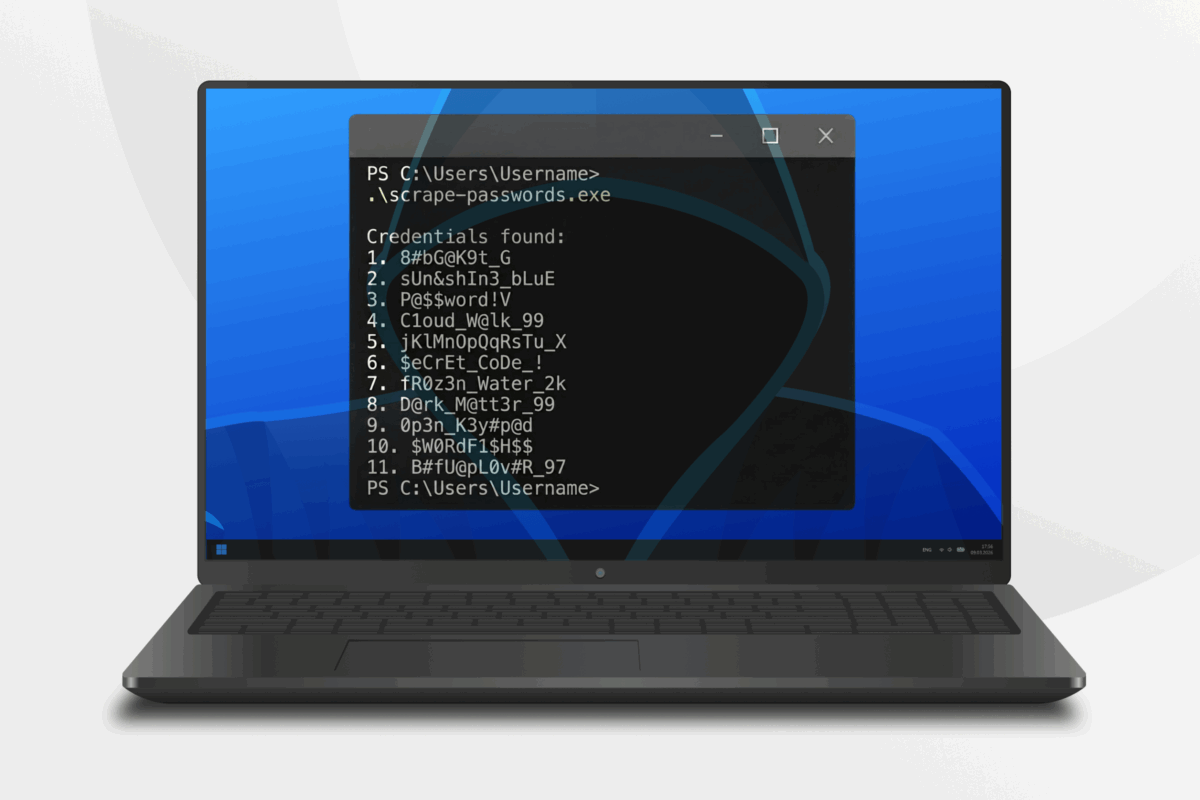
Credential stuffing is an automated cyberattack where hackers use stolen login credentials to gain unauthorized access across multiple sites. The attack succeeds because people commonly use the same username and password combinations for different accounts. What gets stolen from a forum breach today becomes tomorrow’s banking security incident.
In this article, we’ll break down how credential stuffing attacks unfold, examine the defenses that actually work, and explore the tools available to protect both individual accounts and organizational systems.
Credential Stuffing Meaning and Effects
Credential stuffing poses a serious threat to both individuals and organizations — and its effects can be far-reaching.
Attackers exploit a common security weakness: password reuse. When users apply the same credentials across multiple websites and services, a breach at one site creates vulnerabilities everywhere else those credentials were reused.
Once they’ve obtained user credentials – usually by purchasing them for pennies per thousand on the dark web – cybercriminals can quickly begin targeting various websites to try and gain access to your accounts.
In 2025, nearly one-quarter (22%) of all cyber breaches analyzed by Verizon in their Data Breach Investigations Report started with compromised credentials. What’s more, credential stuffing accounted for 19% of all authentication attempts.1
What Are Effects of Credential Stuffing?
Financial harm is the most obvious consequence of credential stuffing attacks. For individuals, cybercriminals might make unauthorized purchases or fraudulent transactions via compromised accounts. They may also drain stored payment methods, redeem loyalty points, or make purchases that leave victims dealing with chargebacks and disputed charges.
Beyond financial loss, individuals may also lose access to their own accounts when attackers change passwords or security settings. The stolen personal information (e.g. names, addresses, payment details) can also be used for identity theft or sold to other criminals, extending the damage well beyond the initial breach.
Credential stuffing doesn’t just affect individuals – businesses usually have to absorb costs from fraudulent transactions through refunds and chargebacks. In addition to this, they often have to spend on incident response, internal investigations, and customer communications or reputational damage control.
The long-term effects can be severe. Customers often lose trust in platforms that fail to secure their accounts to prevent unauthorized access by cybercriminals, leading to user attrition and difficulties acquiring new customers down the line.
How a Credential Stuffing Attack Works
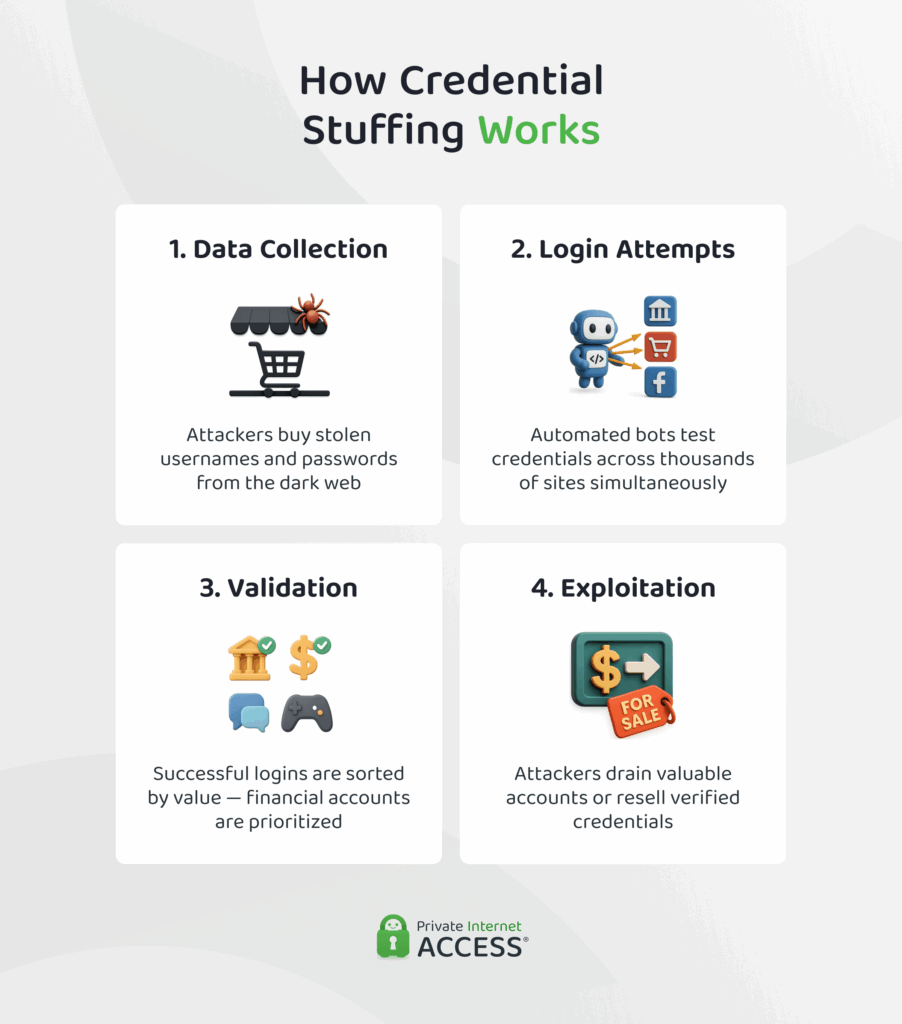
Credential stuffing attacks follow a predictable pattern. Attackers move through four distinct stages, from acquiring stolen credentials to exploiting compromised accounts. Understanding how these attacks unfold can help you spot potential vulnerabilities and build better defenses.
Data Collection
Attackers start by acquiring stolen credentials, typically from data breaches that expose millions of usernames and passwords. These credentials are compiled into combo lists, or large databases that feature pairs of emails or usernames with their corresponding passwords.
Cybercriminals often purchase these lists on dark web marketplaces with minimal financial investment. The data usually originates from breaches executed against forums, gaming platforms, streaming services, or any site where users created accounts.
Login Attempts
Combo lists enable cybercriminals to deploy automated tools and botnets to test the stolen credentials across thousands of websites. These scripts systematically attempt logins at scale, trying each username and password pair against banking sites, e-commerce platforms, social media accounts, and other services.
Attackers distribute their login attempts across multiple IP addresses using proxy networks to make the traffic appear legitimate and make it harder for targeted platforms to detect and block the attack.
Validation
When a credential pair gives cybercriminals access to a platform, they verify the login by confirming the account is active and assessing its potential value.
First, cybercriminals check what type of account they’ve accessed; for example, whether it’s linked to financial services, contains stored payment information, or provides access to premium features.
They then categorize these validated accounts based on their worth, separating high-value targets like banking or corporate accounts from lower-value entertainment or forum logins for different exploitation strategies.
Exploitation
Once attackers identify valuable accounts, they move to exploit them, using valid credentials to access personal data, financial accounts, or other systems. Attackers may make unauthorized purchases, transfer funds, or extract sensitive information for identity theft.
High-value credentials are often resold to other cybercriminals on dark web marketplaces, where corporate logins and financial account access command premium prices. Some attackers maintain long-term access to compromised accounts, using them repeatedly for fraud over extended periods.
How to Tell If You’ve Been the Victim of Credential Stuffing
Recognizing the signs of credential stuffing early allows you to take immediate action to secure your accounts and limit damage. While some indicators are obvious, others require closer attention to account activity and security notifications.
Common signs you’ve been targeted or compromised include:
- Unexpected login notifications: Alerts about successful logins from locations, devices, or IP addresses you don’t recognize, particularly from different countries or cities.
- Failed login alerts: Repeated notifications about unsuccessful login attempts, especially if they occur in quick succession or from multiple locations simultaneously.
- Unauthorized account changes: Modifications to your email address, phone number, security questions, or payment methods that you didn’t make.
- Unexplained transactions: Purchases, transfers, or redemptions of loyalty points that you didn’t authorize appearing in your account history.
- Suspicious emails from services: Password reset requests, two-factor authentication codes, or account verification messages you didn’t initiate.
- Account lockouts: Being locked out of your own account due to excessive failed login attempts or security measures triggered by suspicious activity.
- New linked accounts or devices: Unfamiliar devices, apps, or third-party services appearing in your account’s connected devices or authorized applications list.
How to Prevent Credential Stuffing
Preventing credential stuffing requires a multi-layered approach. Both individuals and organizations can implement specific defenses to reduce their vulnerability to these attacks, ranging from basic password hygiene to advanced technical controls.
For Individuals
Simple security practices significantly reduce the likelihood of falling victim to credential stuffing attacks. Below are proactive steps you can take to secure your credentials and avoid unauthorized account access, financial losses, and identity theft.
Unique Passwords
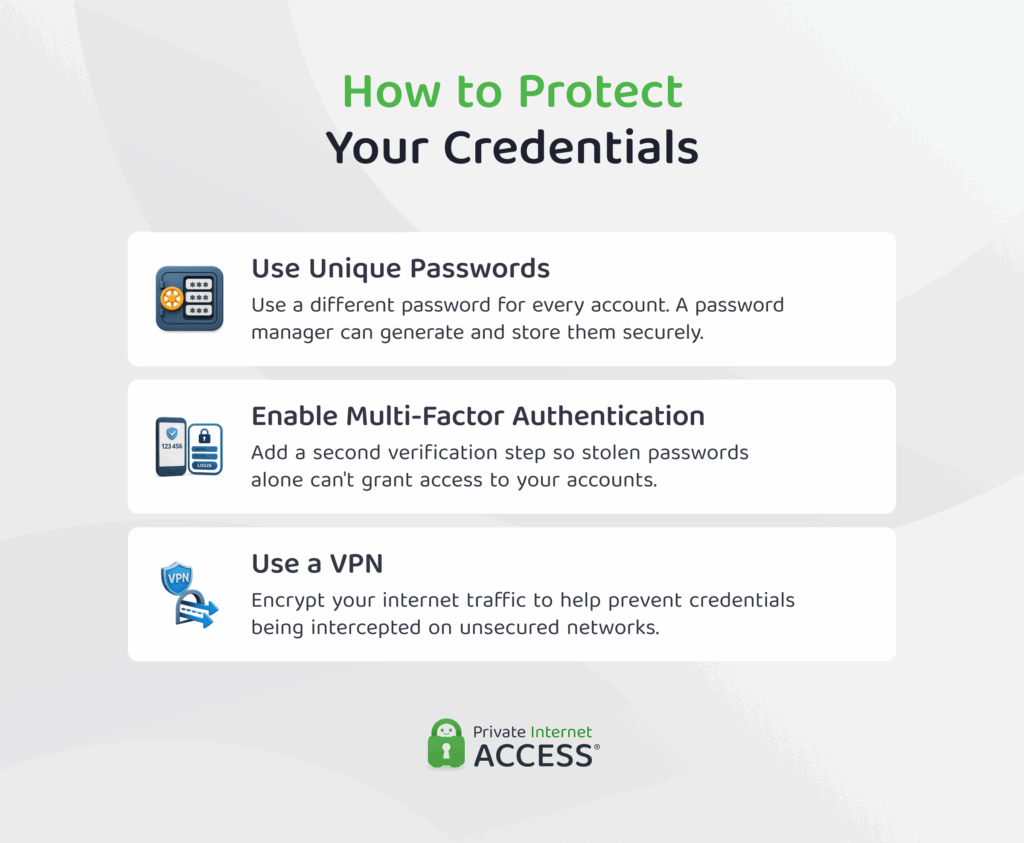
The most effective defense against credential stuffing is using unique passwords for every online account.
Attackers rely on victims reusing passwords. When you have a distinct password for every service you log into, it minimizes the chances that multiple accounts will be compromised as a result of a single attack.
That said, creating and remembering dozens of unique, complex passwords can be difficult. This is why it’s best to use a password manager. These tools generate strong, unique passwords for each account and store them securely behind a single master password.
This eliminates the temptation to reuse passwords while ensuring each credential is sufficiently complex. Most password managers also alert you when credentials appear in known data breaches, allowing you to change compromised passwords before attackers exploit them.
Multi-Factor Authentication
Multi-factor authentication (MFA) adds a critical second layer of security to your account. It requires anyone trying to access your account to verify their identity by using a secondary passcode – usually sent to a secondary device or via an authenticator app.
Even if attackers obtain valid credentials through a data breach, they would still need a second authentication factor before they’re able to gain access to your account. There are a variety of MFA options that you can add to your accounts, including SMS and biometric authentication.
VPNs
A VPN encrypts your internet traffic, preventing attackers from intercepting credentials when you log into accounts over networks with weak security. This helps to prevent credential harvesting, or the initial collection of username-password pairs that later fuel credential stuffing attacks.
While a VPN reduces the risk of your credentials being harvested, it can’t prevent credential stuffing attacks that use data that was leaked in past breaches. You need to use it in combination with strong passwords and MFA to protect your information.
For Organizations
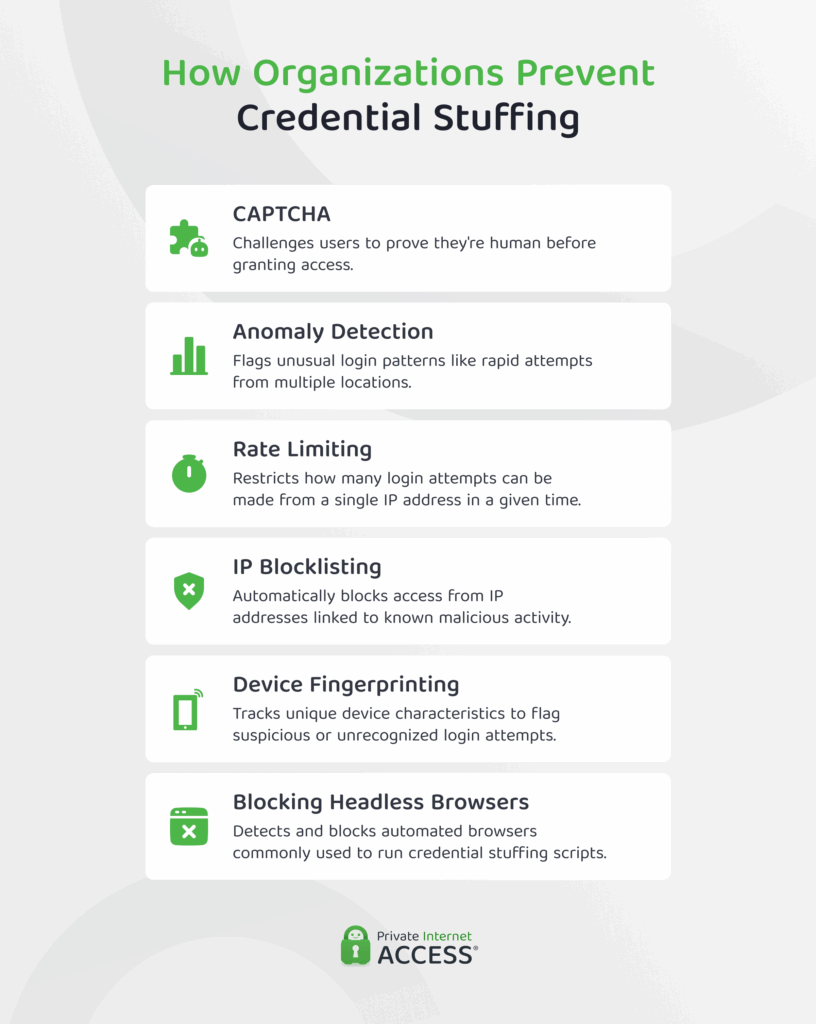
While users protect their own accounts, businesses must defend thousands or millions of user logins simultaneously. The following technical controls help detect, prevent, and mitigate automated attacks before they compromise customer accounts and business operations.
CAPTCHA
A CAPTCHA (Completely Automated Public Turing test to tell Computers and Humans Apart) challenges users to complete tasks that are easy for humans but difficult for automated bots. These tests might require identifying objects in images, solving simple puzzles, or checking a box that triggers background behavioral analysis.
When a login attempt triggers suspicion, for example where multiple rapid attempts are made or traffic comes from known bot networks, CAPTCHA forces the user to prove they’re human before proceeding.
By adding friction to the login process, it effectively disrupts the automated, high-volume nature of credential stuffing attacks. Cybercriminals that want to get around this measure either have to solve challenges manually or invest in expensive CAPTCHA-solving services that reduce their profit margins.
Monitoring and Anomaly Detection
Organizations can detect credential stuffing attacks by monitoring login traffic for patterns that deviate from normal user behavior.
Anomaly detection systems flag suspicious activity like multiple failed login attempts originating from different IP addresses within short timeframes, successful logins from geolocations where the user has never accessed their account, or sudden spikes in authentication requests that suggest automated tools rather than human users.
These systems can trigger automatic responses like requiring additional authentication, temporarily locking accounts, or alerting security teams to investigate. Plus, real-time monitoring allows organizations to identify and respond to attacks as they unfold rather than discovering breaches after accounts have been compromised.
Rate Limiting
Rate limiting restricts the number of login attempts allowed from a single IP address or against a single account within a defined time period. When attackers exceed these thresholds, the system temporarily blocks further attempts, forcing them to slow down their attack or move to a different IP address.
This defense works because credential stuffing attacks require cybercriminals to test thousands of credential pairs rapidly. By throttling the rate at which attempts can be made, rate limiting dramatically increases the time and resources attackers need to test their stolen credentials.
While determined attackers can distribute their attempts across many IP addresses using proxy networks, rate limiting still forces them to operate less efficiently and makes large-scale attacks more cost-intensive and time-consuming.
IP Blocklisting
By monitoring IP addresses and blocking those that are known to be associated with malicious activity, organizations can automatically deny access to or require additional verification from users operating on suspicious IP addresses.
Organizations often maintain lists of IP addresses linked to credential stuffing attacks, botnet infrastructure, data center proxies commonly used by attackers, or addresses that have previously triggered security alerts.
Unfortunately, IP blocklisting does have its limitations. Attackers frequently rotate through residential proxy networks that use legitimate IP addresses from real user devices, making them difficult to distinguish from genuine traffic. For this reason, IP blocklisting works best as one layer in a broader defense strategy rather than a standalone solution.
Device Fingerprinting
This technique helps organizations to identify and track the unique characteristics of devices attempting to access accounts.
The system collects data points including browser version, operating system, screen resolution, installed fonts, language settings, time zone, and hardware specifications. These attributes combine to create a distinctive “fingerprint” that remains relatively consistent across login sessions from the same device.
When a user logs in from a recognized device fingerprint, the system treats it as lower risk. Login attempts from new or suspicious fingerprints – especially when combined with other red flags like unusual locations or failed password attempts – trigger additional security measures.
While sophisticated attackers can spoof some fingerprinting signals, creating convincing fake fingerprints at scale requires additional effort and technical capability that raises the cost and complexity of credential stuffing attacks.
Blocking Headless Browsers
Headless browsers are web browsers that operate without a graphical user interface (GUI), which is the visual windows and buttons that normal users interact with.
Attackers use headless browsers to automate credential stuffing because these browsers can be controlled entirely through code, allowing scripts to fill login forms and submit credentials at high speed without human interaction.
Organizations can detect and block headless browsers by checking for characteristics that distinguish them from regular browsers.
When the system detects a headless browser attempting to log in, it can block the request, serve a CAPTCHA challenge, or flag the attempt for manual review.
Top Tools for Preventing Credential Stuffing
You can strengthen your defenses against credential stuffing by deploying specialized tools designed to detect, prevent, and mitigate these attacks:
- Password managers: These tools generate and store unique, complex passwords for all of your accounts to eliminate the password reuse that cybercriminals rely on.
- Breach monitoring platforms: The early notifications that breach monitoring platforms provide allow you to change compromised passwords before attackers exploit them.
- Authenticator apps: By generating time-based codes that serve as a second authentication factor, these apps prevent unauthorized access to your accounts.
- Bot managers: Designed to identify automated login scripts, bot managers block credential stuffing attempts by distinguishing automated bots from human users.
- Attack protection platforms: These services use rate limiting, IP reputation filtering, and behavioral analysis to protect high-traffic sites from large-scale automated attacks.
- Web application firewalls: WAFs monitor and filter HTTP traffic to web applications, detecting and blocking malicious login attempts based on predefined security rules and threat intelligence.
Credential Stuffing vs Brute Force Attacks vs Password Spraying
Credential stuffing is often confused with other password-based attacks like brute force attacks and password spraying. Understanding these distinctions helps organizations and individuals deploy the most effective defenses against each threat.
| Credential Stuffing | Brute Force Attack | Password Spraying | |
| What happens | Automated testing of stolen username and password pairs across multiple sites | Systematically trying every possible password combination against a single account | Trying a few common passwords against many accounts |
| What it exploits | Password reuse across multiple services | Weak or predictable passwords | Common passwords used across user populations |
| Defence | Unique passwords, MFA, breach monitoring, device fingerprinting | Account lockouts after failed attempts, strong password requirements, rate limiting | Password complexity policies, MFA, anomaly detection monitoring |
| Success rate | Low per attempt, but profitable at scale | Very low against strong passwords; can take years to crack complex credentials | Moderate – avoids triggering lockouts while exploiting common password patterns |
Credential Stuffing: Frequently Asked Questions
What is a credential stuffing attack and how does it work?
Credential stuffing involves cybercriminals using automated software to test large volumes of leaked login details across various online platforms. Attackers usually obtain lists of usernames and passwords from one compromised service, and systematically try those same combinations across other services.
How is credential stuffing different from credential harvesting?
Credential harvesting is the actual theft of login credentials through methods like data breaches, phishing schemes, or malware infections. Stuffing occurs afterwards, when criminals take those stolen credentials and attempt to use them on various websites and applications.
What are signs an account is being targeted by credential stuffing?
Credential stuffing warning signs include receiving alerts about access attempts you didn’t make, particularly from geographic regions you’ve never been to or unfamiliar devices. You might also notice your account has been locked due to excessive failed authentication attempts, or receive password reset messages you never initiated.
Can a VPN help reduce the risk of credential stuffing on public WiFi?
Yes. A VPN creates an encrypted connection that shields your login information from interception when using unsecured networks. This prevents your credentials from being captured and later added to databases that fuel stuffing campaigns. That said, VPNs won’t stop attacks that rely on credentials compromised through past breaches.
References:
