How to Improve VPN Speed and Keep Your Connection Fast
If your internet is slower than it used to be, you may wonder if your VPN is the problem. A VPN can reduce connection speed because of the time it takes to encrypt your connection and reroute it to a remote server. However, VPN delays are usually negligible and slow speeds may point to other reasons for a sluggish connection.
The best place to start is by comparing your internet performance with the VPN on and off under similar conditions. From there, you can work out where the slowdown is coming from and which changes are most likely to help speed it up.
Before You Start: Check Your Speeds
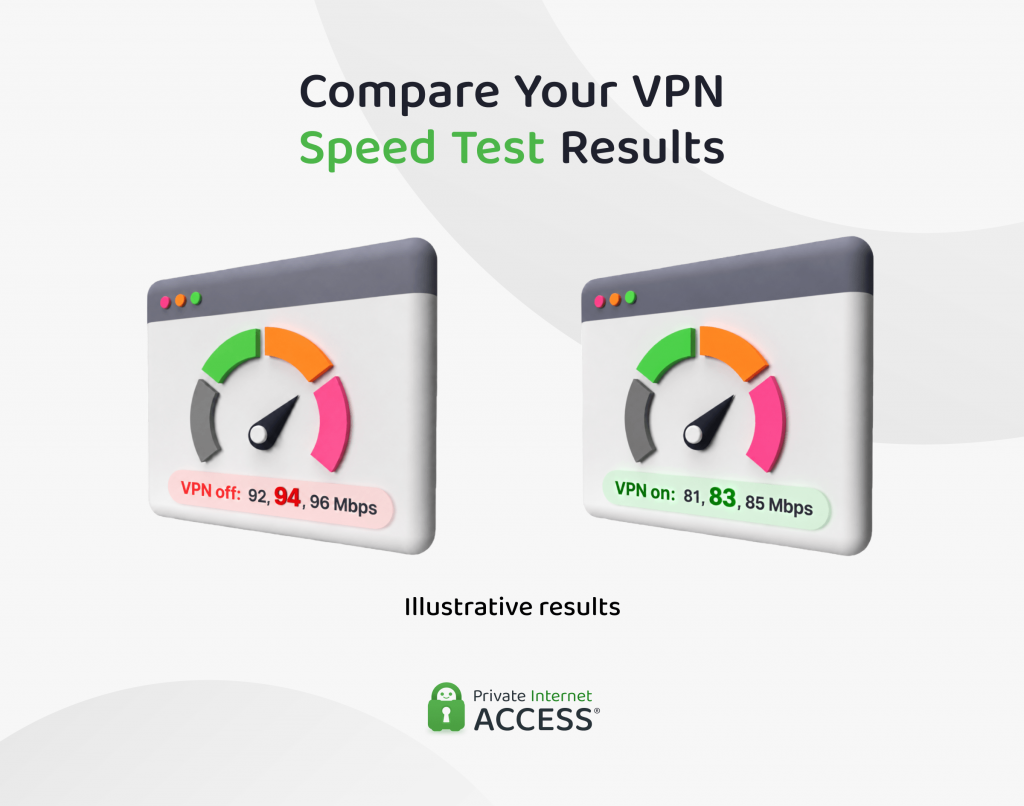
First, figure out whether it’s the VPN slowing your connection. You can check connection speeds with a free online tool like Speedtest.net.
For a fair comparison, use the same device and network throughout. Pause nonessential transfers and select the same speed test server if the tool lets you choose one.
If you use split tunneling, disable it so app-specific routing rules don’t affect the comparison. Turn off the kill switch for the disconnected tests, since it may block internet access without the VPN. Restore any settings you change afterward.
Here’s how to check your speeds:
- Get your baseline results: Turn off your VPN (VPN-off test), run a speed test, and note your download and upload speeds, as well as your ping.
- Retest with the VPN connected: Connect to a VPN server, refresh the speed-test page, run the test again, and record the results.
- Repeat three times: Alternate between connected and disconnected tests until you have three of each. For each metric, sort the connected and disconnected results separately from lowest to highest, then compare the two middle values.
Measured in megabits per second (Mbps), download and upload speeds show how quickly data moves over your connection. Ping measures the round-trip delay between your device and the test server in milliseconds (ms). A lower ping means less delay.
Once you have your results, look at the overall pattern rather than one unusually fast or slow reading.
| What You Notice | What to Check Next |
| Speeds are poor with and without the VPN | Compare another device or network using the checks below |
| Performance drops when the VPN connects | Start with the server and protocol fixes below |
| Download speeds look normal, but websites take longer than expected to load | Try the DNS checks in the advanced troubleshooting section |
Is the Problem Your Device or Network?
If the first comparison doesn’t make the cause clear, you can narrow it down by changing either the device or the network while keeping everything else as consistent as possible.
- Try another device: Connect a second device to the same network and use the same VPN location. Match the protocol settings where possible. If one device shows a much larger VPN-related slowdown, the problem is more likely tied to that device or its setup.
- Try another network: Keep the same device and VPN settings, but connect through another network, such as a mobile hotspot and run a VPN-off test as well as a regular test. If the VPN performs much better on the second network, the original connection may need further investigation.
If you use a mobile hotspot, check your data allowance first. If you don’t have another device or network available, continue with the fixes below.
10 Ways to Improve VPN Performance
When a VPN connection feels slow, the cause may be the VPN itself or the internet connection underneath it. The best place to start depends on what you found in the tests above. Try one change at a time, then test again so you can see whether it affects performance.
1. Try a Closer or Different VPN Server
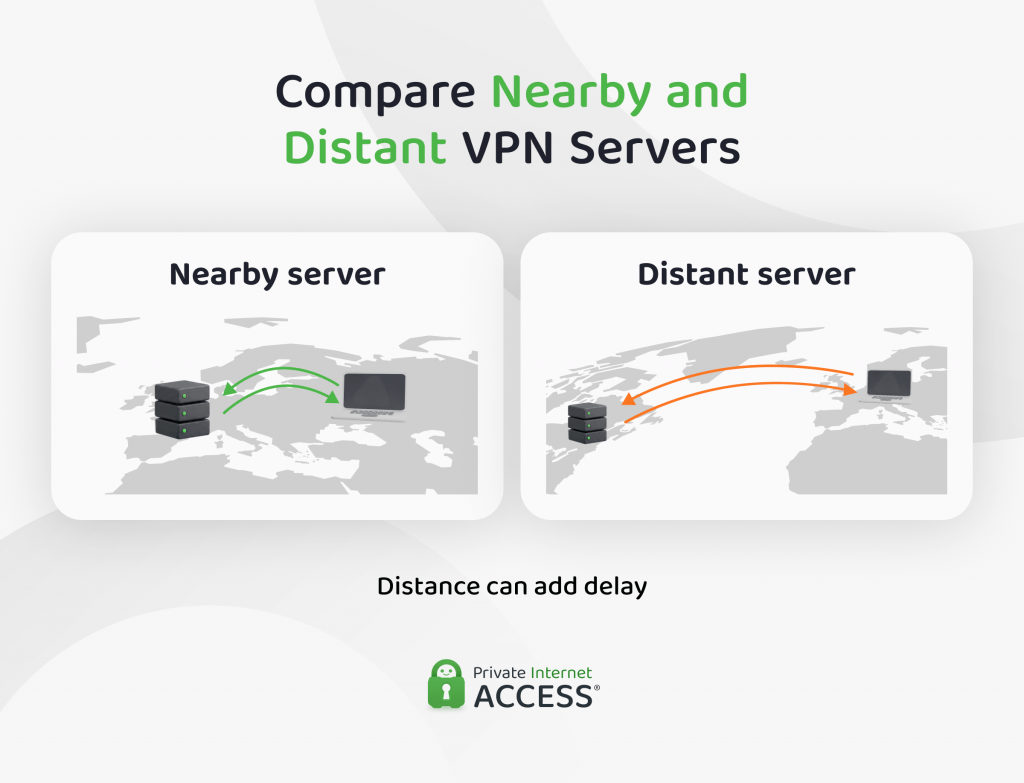
If your data has to travel some distance to reach a VPN server, you may experience latency. For example, if you’re in Europe, connecting to a server in the US will usually add more latency than using one closer to you.
Start with a nearby server. If the connection is still slow, try another location in the same area. Performance can vary because of congestion or the network route your traffic takes. If you need an IP address in a specific country, compare the available servers there.
Tech tip: If you don’t need a particular location, try PIA’s automatic server option. In PIA’s desktop app, our Choose Automatically option selects the server with the lowest measured latency, giving you a useful place to start.
2. Switch to a Faster Protocol
A VPN protocol controls how your app creates and manages the secure connection to the VPN server. If performance is poor, changing protocols is one of the easiest and most useful settings to test.
WireGuard is a good starting point because it’s lightweight and efficient. OpenVPN is another option and can send data using one of two methods: User Datagram Protocol (UDP) and Transmission Control Protocol (TCP).
| Protocol option | When to try it | What to know |
| WireGuard | You want a good starting point for VPN performance | Its lightweight design can perform well, but results depend on your setup |
| OpenVPN UDP | WireGuard performs poorly or isn’t available | It generally has less overhead than OpenVPN TCP |
| OpenVPN TCP | Other options struggle to connect reliably | It can work better on some restrictive networks, but may add more delay |
You can find these options in PIA’s desktop protocol settings. Test the options that work on your network and compare the results rather than assume one will always be fastest.
To switch to WireGuard in PIA, go to Settings > Protocols, select WireGuard, then reconnect.
If OpenVPN has trouble connecting or keeps dropping out, you can also try another supported Remote Port. Some networks restrict particular ports, so changing ports can sometimes restore a reliable connection.
3. Use Split Tunneling
Split tunneling lets you choose which apps use the VPN and which connect to the internet. For example, you could keep a streaming app on the VPN while letting a large game download use your regular connection.
This can reduce the amount of traffic your device sends through the VPN. It won’t increase the total bandwidth available from your internet connection, though, since both routes still use the same underlying connection.
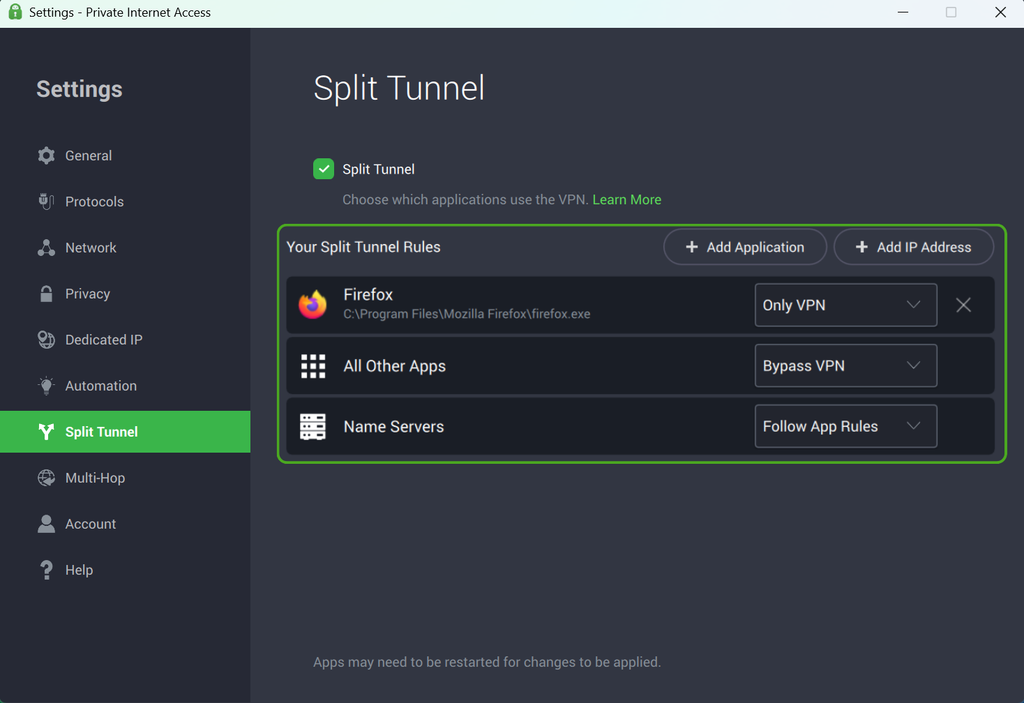
In PIA’s desktop app, open Settings > Split Tunnel, enable the feature, then choose which apps should bypass the VPN. Any excluded traffic won’t receive the VPN’s protection, so only use a direct connection for apps where that makes sense.
4. Configure and Update Your VPN App
If your VPN suddenly feels slower or less stable, check that you’re using the latest version of the app. Updates can fix bugs or compatibility problems that affect how the VPN connects.
If you’re using PIA on Windows, you can check the virtual network driver used with OpenVPN. Go to Settings > Protocols > OpenVPN, then look under Virtual Network Driver. If you haven’t selected WinTUN, it may be worth testing.
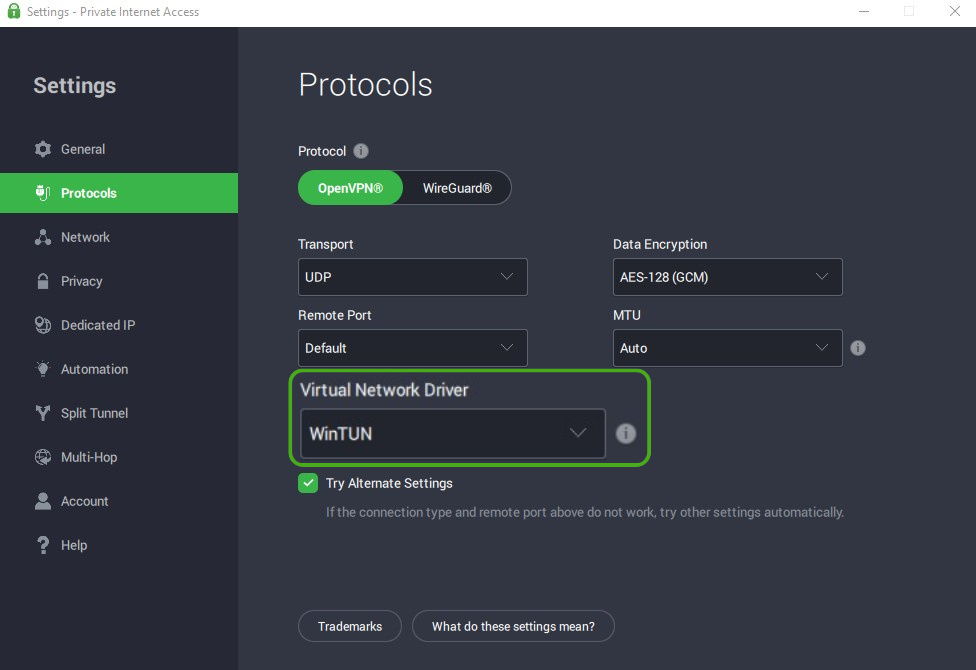
WinTUN is software that helps OpenVPN handle network traffic on Windows. If changing the driver causes connection problems, switch back to your previous setting. If you’re already using WinTUN without issues, there’s no reason to change it.
5. Restart Your Router and Device
A restart can clear interim software or connection problems. It’s worth trying if your VPN suddenly becomes slow or starts disconnecting.
Save anything you’re working on, then restart your device. You can also reboot your router using its settings page or your manufacturer’s recommended method. Avoid pressing the Reset button, since that may restore the router to its factory settings. Once your normal internet connection is back, reconnect to the VPN and test again.
6. Close Background Apps and Downloads
Apps that are transferring data can compete with your VPN traffic for the bandwidth available on your connection. Large downloads are an obvious example, but uploads can matter as much.
Pause nonessential transfers while testing, especially cloud backups or large file uploads. This can be particularly useful if video calls or other bandwidth-intensive activities are struggling.
Focus on apps that are actually using the network. Closing an idle program won’t free up meaningful bandwidth. Once you finish testing, resume anything you paused or schedule it for a more convenient time.
7. Check for Firewall or Antivirus Interference
Security software can sometimes interfere with VPN traffic. This is more likely if the problem started after you installed a new firewall or antivirus tool, changed its settings, or updated it.
Start by checking the security app for blocked-connection alerts. Then, look at its official VPN compatibility guidance to see whether any settings need adjusting.
If the software is interfering with PIA, follow the instructions from PIA or the security provider to resolve the conflict. If support asks you to disable a security feature for testing, turn it on as soon as you’ve finished the test rather than leave your devices unsecured.
8. Turn Off Multi-Hop When You Don’t Need It
Some premium VPNs, like PIA, have a feature called Multi-Hop. It sends your traffic through an additional proxy before it reaches the VPN server and it’s often useful for obfuscation. That extra route can add delay, so it may reduce performance compared to a standard VPN connection.
If you have Multi-Hop enabled and don’t need the additional routing, try turning it off. In the PIA desktop app, go to Settings > Multi-Hop, disable Multi-Hop and Obfuscation, then reconnect and test your connection again.
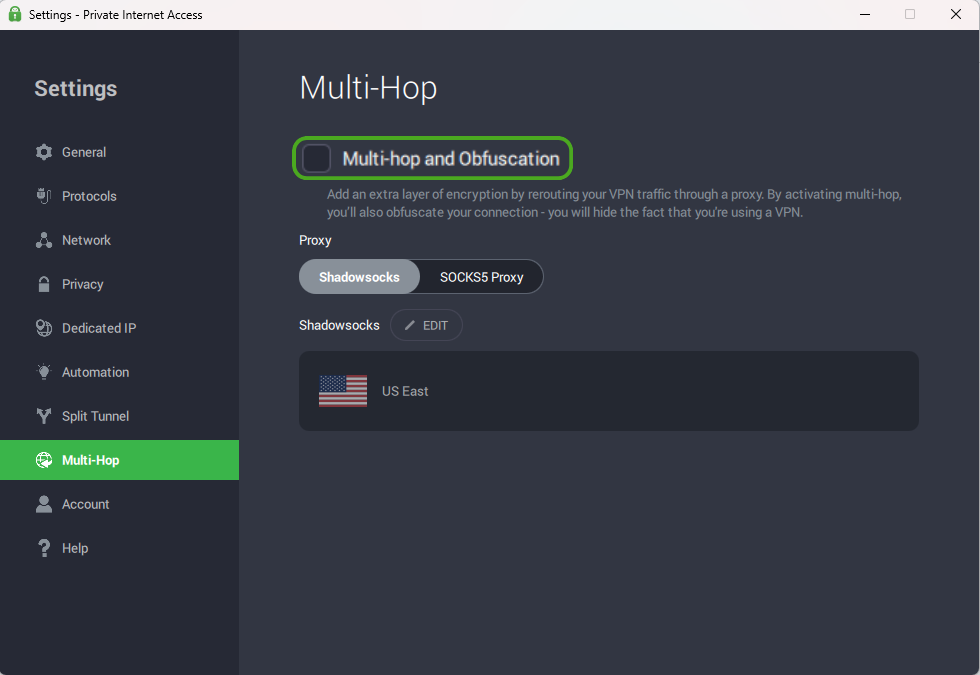
There’s one important exception. If you use Shadowsocks because your network isn’t compatible with other VPN connections, you may need Multi-Hop and Obfuscation to stay enabled for the VPN to work reliably. If you try turning it off, make sure you can still connect before leaving it that way.
9. Use Ethernet or Improve Your Wi-Fi Connection
If your Wi-Fi connection is weak or unstable, changing VPN settings may not solve the real problem. A simple way to check is to connect your device to the router with an Ethernet cable, if both support it.
Ethernet removes the wireless link between your device and router from the test. If your connection becomes more stable, the Wi-Fi connection may be contributing to the slowdown.
If Ethernet isn’t practical, try moving closer to the router and test again. Better results at a shorter distance suggest your Wi-Fi signal is part of the problem.
This check is especially useful if your earlier tests were slow both with and without the VPN.
10. Install the Latest Device Updates
Your VPN relies on the operating system and networking software already running on your device. If either has a known bug or compatibility issue, an update may fix the problem. It’s best to check the parts of your setup that affect the connection:
- Operating system: Install the latest updates available for your device.
- Network adapter drivers: On Windows, start with Windows Update. If you need a separate driver, get it from your device or network-adapter manufacturer.
- Router firmware: Check your router’s app or administration page for firmware updates, then follow the manufacturer’s instructions for your model.
Updates can resolve known networking problems, but they won’t make every VPN connection faster. Once everything is up to date, retest under the same conditions you used earlier.
Advanced Troubleshooting for VPN Speed Problems
If the fixes above haven’t helped, a few more targeted checks can help you narrow down the problem. You don’t need to try every option below. Start with the one that best matches what you’re experiencing and note your current settings before changing anything so you can easily switch back.
Test DNS When Websites Are Slow to Start Loading
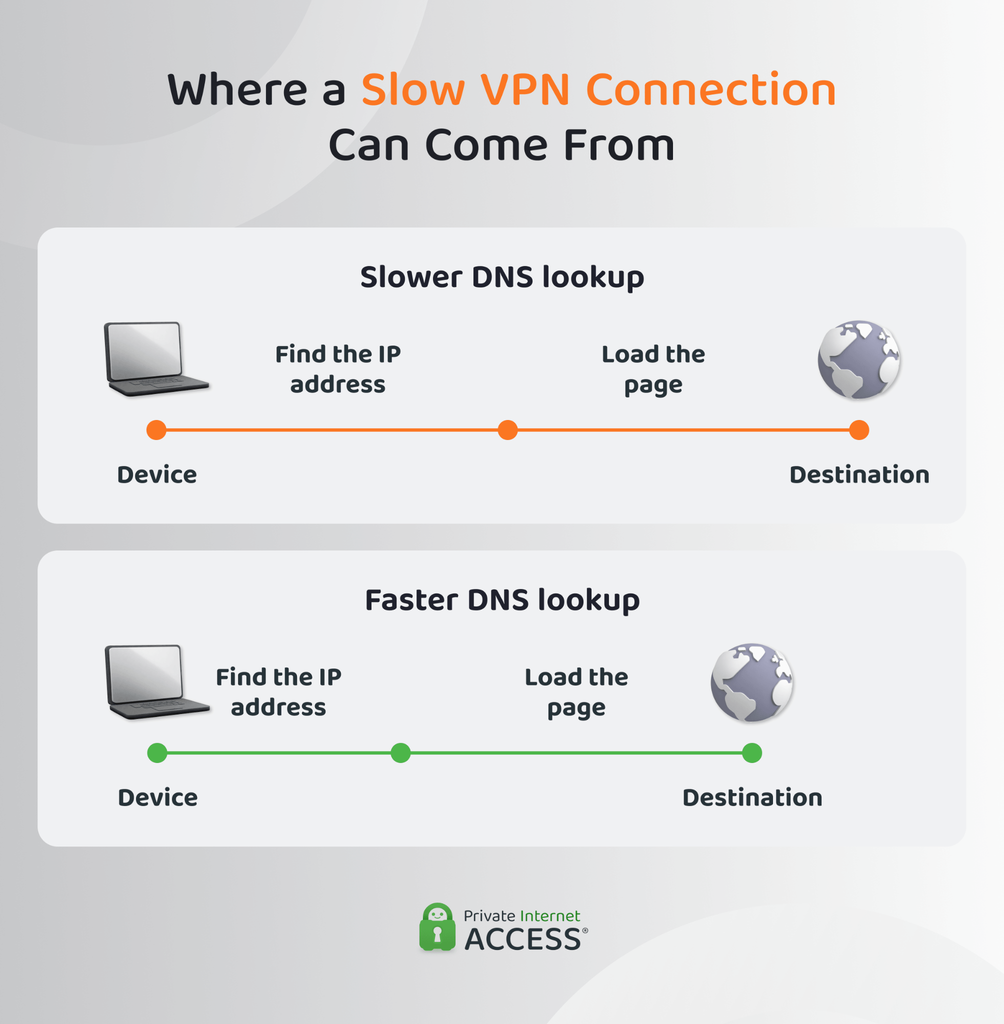
If websites take a few seconds to start loading even though your download speeds look normal, the website’s DNS may be worth checking. The Domain Name System (DNS) looks up the IP address linked to a domain name so your browser knows where to connect. If that lookup is slow or fails, the page can stall before anything appears.
You can test DNS lookups from your computer:
- Open the command window: On Windows, search for Command Prompt in the Start menu. On a Mac, search for Terminal using Spotlight.
- Look up a website: On Windows, enter nslookup example.com. On macOS, enter dig example.com. Replace example.com with the website’s domain name, without https:// or a page path.
- Compare the results: Repeat the lookup a few times with the VPN connected, then disconnected. Try another unrelated website’s domain as well.
On Windows, look for repeated timeout messages or failed lookups. The nslookup command doesn’t report lookup duration.1 On macOS, dig reports a Query time in milliseconds (ms).2
You shouldn’t read too much into a single result. DNS responses can be cached, so a domain you’ve already looked up may resolve faster the next time. Command-line tools can also behave in a different way from your browser, so you’ll have to compare the results with what you actually notice when browsing websites.
If you’ve configured a custom DNS server in PIA, try switching back to PIA DNS under Settings > Network, then reconnect and test again. This is PIA’s default DNS option. Fixing a DNS problem may shorten the delay before a page appears, but it won’t increase the maximum download speed of your connection.
Use Traceroute to Investigate Connection Delays
Traceroute is a command-line tool that can help when you’re seeing persistent delays and want a closer look at the route your connection takes. The route consists of network stops called hops, which are routers that pass your traffic to its destination.
Open Command Prompt on Windows or Terminal on macOS, then run the appropriate command:
- Windows (Command Prompt): tracert 1.1.1.1
- macOS (Terminal): traceroute 1.1.1.1
These examples trace the route to Cloudflare’s DNS service at 1.1.1.1.3 If you’re investigating a problem with a particular service, you can trace its destination IP address instead.
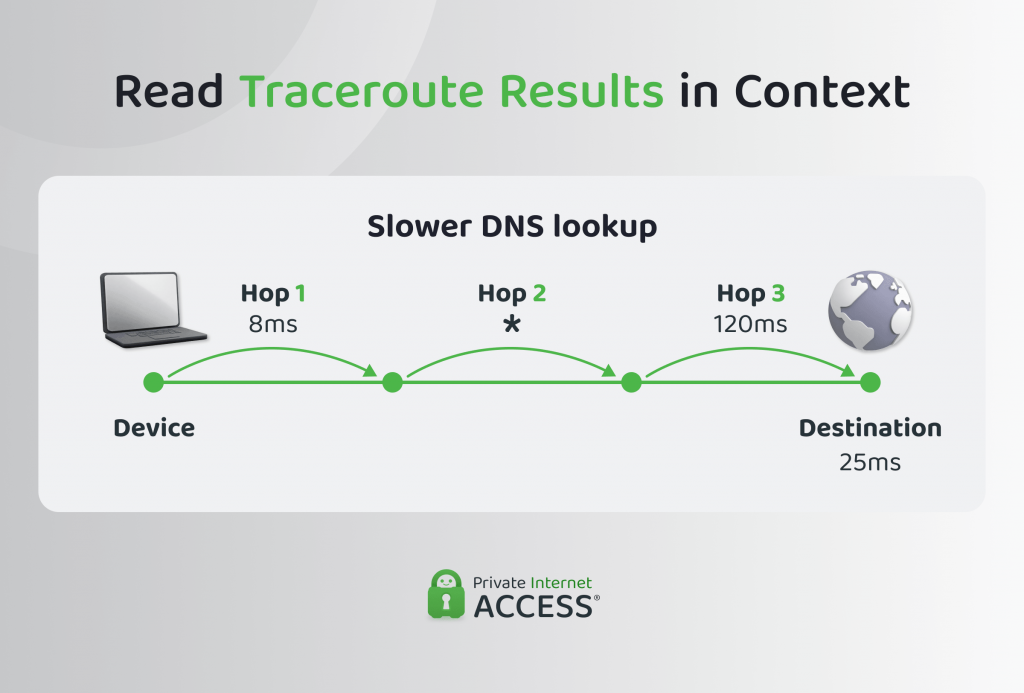
For a useful comparison, run the trace with the VPN connected and then without it. Keep the destination the same so you can see how the results change. If one trace looks particularly unique, repeat it before drawing conclusions. When you read the output, focus on two things:
- Response times: Each timing shows how long a test packet took to reach that hop and return. Consistently high response times at the final destination are more useful than one unusually slow reply from an intermediate router.
- Asterisks(*): An asterisk means that a probe didn’t receive a reply before the timeout. Some routers don’t respond to traceroute probes even though they continue forwarding normal traffic, so asterisks don’t mean you’re losing ordinary internet traffic.
A VPN tunnel can also change what the trace shows. Because your traffic travels inside the encrypted VPN tunnel, some of the underlying route may no longer be visible. IP tunneling works by carrying one IP packet inside another, so you shouldn’t expect VPN-on and VPN-off traces to look identical.
You should treat traceroute as a source of clues rather than a definitive diagnosis. It can help you spot persistent delays and give support teams useful information, but it doesn’t measure download speed or prove that your internet provider is throttling your connection.
Check Your VPN’s Packet Size (MTU)
Your connection sends data in units called packets. The maximum transmission unit (MTU) sets the largest packet size a network connection can carry at once.
VPNs add extra information to each packet. In some cases, that can make a packet too large for part of the route, which may contribute to stalled pages or transfers. MTU is worth checking when your connection works but certain transfers hang or fail.
When using PIA, you can usually leave the packet-size setting on Auto. But if you’re having problems, you can test a small MTU size:
- Open Settings > Protocols in the PIA desktop app and find the MTU setting for your selected protocol.
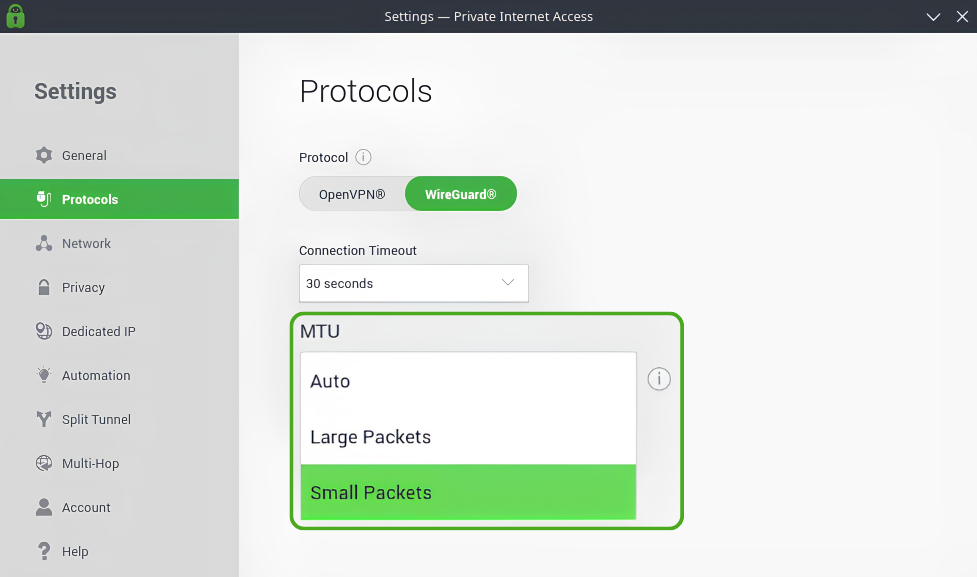
- Select Auto first if you previously changed the setting. If the problem continues, try Small Packets.
- Reconnect, then retry the page or transfer that was stalling. If there’s no improvement, switch back to Auto.
A smaller packet size can help when packet size is actually causing the problem, but smaller packets aren’t inherently faster. If changing the setting doesn’t change anything, leave it on the recommended default.
Adjust Encryption Settings (Advanced Users)
If you’re using OpenVPN and have already tried the more common fixes, you can also test another encryption setting. PIA lets you choose between AES-128 and AES-256.
Both use the Advanced Encryption Standard (AES), but with varying key lengths. AES-128 uses a shorter encryption key than AES-256, so it may use slightly less processing power on some devices.
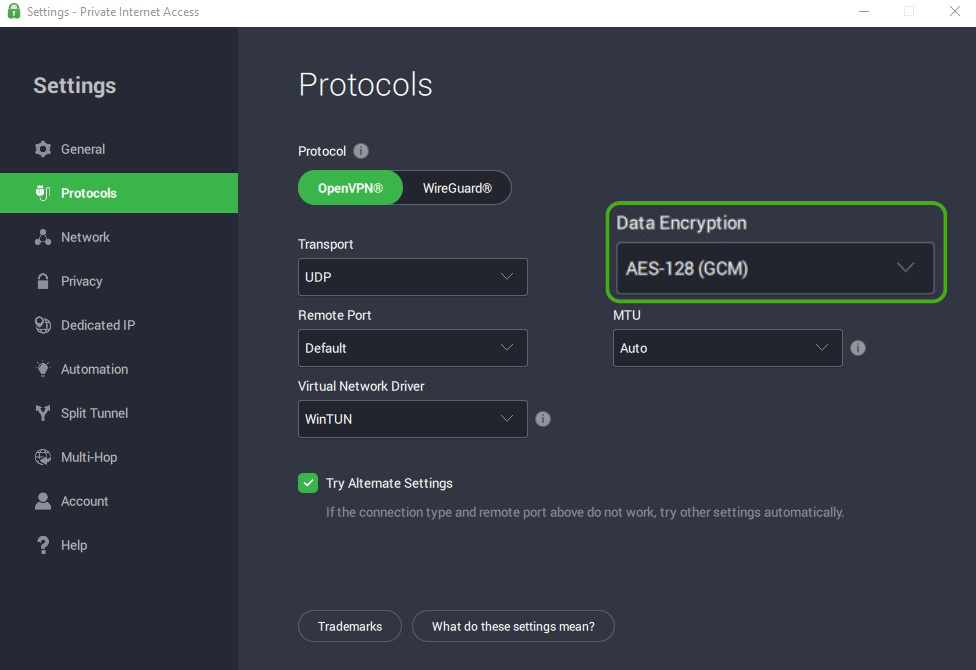
To switch encryption, first make sure OpenVPN is your selected protocol, since this setting only applies there. Then open the PIA app, go to Settings > Protocols > OpenVPN, and select AES-128 under Data Encryption.
What to Do If Your VPN Is Still Slow
If you’ve tried the relevant fixes above and your VPN is still slow, it’s worth contacting your VPN provider’s support team. The results you’ve already collected can help them narrow down the problem faster, so include the details that best show what’s happening:
- Speed-test results: Share your download and upload speeds with the VPN connected and disconnected, along with your ping. Note roughly when you ran the tests.
- Servers and protocols tested: List the VPN locations and protocols you tried, including any that performed better or worse.
- Device details: Include your device model, operating system version, and VPN app version.
- Connection setup: Mention whether you’re using Wi-Fi, Ethernet, or mobile data. Also say if the VPN runs on your device or through your router.
- Problem pattern: Explain when the slowdown started and whether it affects specific apps, websites, or types of traffic.
- Troubleshooting results: Summarize the fixes you already tried and what changed. Include DNS or traceroute results if they seem relevant or support asks for them.
If you use PIA, you can contact support through live chat or email. Support may ask you to enable debug logging in the desktop app so we can collect more detailed information about the problem.
If your connection is also slow without the VPN, especially across more than one device, the issue is more likely to be with the underlying internet connection. In that case, contact your internet provider instead.
When the VPN Provider May Be the Problem
Your VPN becomes a more likely cause when your normal internet connection performs well, but the slowdown keeps appearing whenever you connect to the VPN. That pattern is more meaningful if you see it across several VPN servers or protocols.
At that point, check whether the provider has reported a service issue and contact support with the results you collected above. You can also ask whether any account-level restrictions or service limits might apply to your connection.
If the problem continues and support can’t identify an issue, try comparing another VPN on the same device and network to see whether the problem follows the provider. Use the same test conditions so the comparison is fair.
FAQ
Does a VPN make your internet faster?
Not usually. It actually slows your connection a small amount due to the time it takes to encrypt and reroute your connection. If your internet provider slows down certain types of traffic, a VPN can make traffic harder to identify and may improve your connection speed.
Why does my VPN take so long to connect?
A VPN can take longer to connect if the server responds slowly or your network restricts certain connections. Your app may need several attempts before the connection succeeds. Try another server or protocol, then check your firewall or antivirus if the problem continues.
What affects VPN connection speed?
VPN speed depends on your normal internet connection and the route your traffic takes through the VPN. A distant or busy server can hurt performance, while your device and VPN protocol can a difference. Other traffic using your connection may slow things down, too.
How can I test VPN speeds?
Run a speed test with the VPN off, then repeat it with the VPN connected. Keep the same device and network and use the same test server where possible. Run each test several times, then compare download speed, upload speed, and latency.
How long should a VPN take to connect?
With fast VPN protocols like WireGuard, your VPN should usually connect in under 10 seconds. If it takes longer, try switching servers or checking for firewall or antivirus conflicts. A quick app update can often fix connection delays, too.
Resources:
