Zelle Scams: 11 Common Examples and How to Avoid Them
Zelle is known for its speed and convenience, but both of those things can work against you if you send money to the wrong person. Scammers use a range of tactics to exploit that speed and make payments appear legitimate, knowing that once a Zelle transfer reaches the recipient, there’s often little that can be done to reverse it.
This guide walks through what Zelle scams look like, why they work, the most common versions you’ll run into, and what to do (and who to contact) if you’ve been defrauded.
What Are Zelle Scams?
A Zelle scam is any scheme that uses the Zelle payment network to trick you into sending money to an unintended recipient or to gain access to your account so they can send it themselves.
Some of these scams are blunt: a scammer poses as a landlord, employer, or online seller and simply asks for a Zelle payment upfront. Others are more layered, relying on phishing texts, fake customer service calls, or romantic manipulation to build enough trust (or fear) that you either hand over your login details or transfer the money yourself.
Whether obvious or more inconspicuous, the outcome is the same. Once the transfer clears, the money is typically gone and the scammer disappears or moves on to their next target.
Why Scammers Use Zelle
Zelle is part of more than 2,400 banking and credit union apps, including major banks like Bank of America, Chase, Wells Fargo, and Capital One. In 2025, consumers and small businesses sent more than $1.2 trillion over Zelle across 4.2 billion transactions, moving an average of roughly $3.4 billion a day.1
As the service sits inside an app you already trust, using it to send money feels safe and secure, and users are less likely to question requests from recipients that appear to be legitimate.
Then there’s the matter of what happens after the money moves. Zelle transfers usually can’t be reversed once they’re sent, so scammers who convince you to make a payment knowing there’s little chance you’ll get your funds back.
How Zelle Scams Work
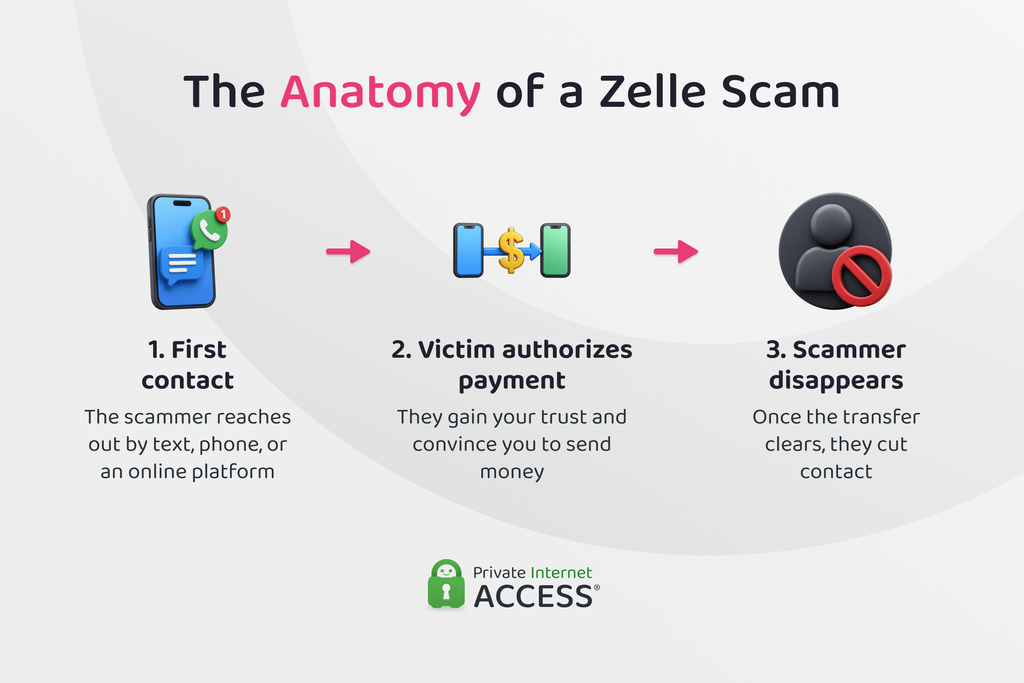
So how do Zelle scams work, exactly? Despite the variety, most follow the same basic sequence. First, the scammer makes contact, often through a text, a phone call, a social media message, or a listing on a marketplace or dating app.
Next, they’ll use social engineering strategies (like confidence tricks) to earn your trust or create enough urgency that you’ll make a transfer without hesitation. Once they know you trust them, they’ll request the payment.
As soon as the transfer clears, the scammer will disappear and become uncontactable. The issue here is that you’ve authorized the payment, so payment fraud laws don’t cover these transfers and they’re generally not recoverable.
Current Common Zelle Scams
Most of the scams that cybercriminals run on Zelle are ones that you’ve likely heard of before (think romance cons, government impersonation, and marketplace fraud). Scammers simply adapted the scams to work through the platform.
Account Takeover Scams
Rather than relying on convincing you to send money to a scammer, account takeover scams involve the cybercriminal getting into your actual bank or Zelle account and moving the money themselves, usually after tricking you into handing over your login details.
Zelle email scams are a common point of ingress. A phishing message that looks like it’s from your bank lands in your inbox, warning of suspicious activity or a locked account, and pushing you to click a link to verify your details.
When you click it, the link leads to a fake login page and, once you enter your username and password, the scammer has everything they need to log into your real account and send Zelle payments to themselves.
Safety tip: Never log in to Zelle through a link in a text or email. Go to your bank’s app or type its web address in yourself. Turn on multi-factor authentication for both your banking and Zelle logins, and treat any unexpected “urgent account” message as suspicious until you’ve verified it independently.
Zelle Business Account Scams
Zelle business account scams typically target people selling something online, like small businesses, freelancers, and individuals who regularly sell goods on marketplaces.
The scammer poses as a Zelle employee, sending an email or text message notifying you that you need to upgrade your personal Zelle account to a “business” Zelle account – and pay the associated fee – to unlock and receive the funds going forward.
The scammer depends on the fact that many targets don’t know that Zelle doesn’t offer business accounts, so individual users don’t need to be migrated into or pay to unlock the service. Clicking the link in the message typically leads to a fake login page that steals your credentials, while the upgrade fee goes straight to the scammer.
Safety tip: Treat any message about a business account issue as a red flag, avoid clicking links in those messages, and report them to Zelle and your bank.
Impersonation Scams
With impersonation scams, the scammer assumes someone else’s identity to appear more credible to their target.
A common version of these scams starts with a message from what looks like a friend or family member’s number or email (which they usually spoof), asking for an urgent Zelle transfer to cover an emergency.
Another version has the scammer posing as customer service for a company you already do business with, claiming there’s an issue with a recent order or subscription that can only be resolved by sending a Zelle payment directly.
Safety tip: Confirm unusual requests through a separate channel, like calling the person or business using a number you already have, not one provided in the message. Be especially cautious with requests that stress urgency and discourage you from double-checking.
Accidental Transfer Scams
This scheme starts when you receive a payment you didn’t request or expect. A scammer sends you money through Zelle and then contacts you, often within minutes, claiming they sent it by mistake and asking you to send it back.
The problem here is that the scammer usually makes the original payment with a stolen account or stolen card details. That means that once the real account holder reports the unauthorized transaction, the bank reverses it. This leaves you having sent your own money to the scammer while the original “accidental” deposit disappears from your balance.
Safety tip: Don’t return a Zelle payment because someone asks. Contact your bank to confirm the payment is legitimate and let them handle any reversal. If someone insists on being repaid to a different account than the one that sent the money, treat that as a strong warning sign.
Marketplace Scams
Marketplace scams show up on platforms like Facebook Marketplace, Craigslist, Etsy, and ticket resale sites, and they can come from scam sellers and buyers.
As a buyer, you might pay a seller through Zelle for an item that never materializes. As a seller, a buyer might send a fake payment confirmation screenshot or email and ask you to ship the item before you’ve verified the money actually landed in your account.
Safety tip: Treat Zelle like handing over cash and only buy from or sell to people you can verify. It’s also best to meet in person for local sales when possible and confirm payments through your own banking app before handing the goods over.
Account Verification Scams
This scam starts with a fraud alert that looks like it’s from your bank or from Zelle itself, warning that the system detected suspicious activity on your account.
The message, or a follow-up phone call, instructs you to verify your account by sending a Zelle payment to yourself, framed as a security step that confirms you’re the real account holder. In reality, the scammer has changed the linked contact details behind the scenes, so the payment you send to yourself actually lands in an account they control.
Safety tip: No legitimate bank or Zelle security process ever asks you to send yourself money to verify your identity. If you get an alert like this, log into your account the way you usually would to see your notifications or call your bank to verify.
Romance Scams
Romance or online dating scams are some of the most common cyber scams out there. The scammer usually initiates contact on dating apps or social media before moving to private messaging over weeks or months.
They’ll invest real time in the relationship and share photos and personal details, often stolen from someone else’s profile, to build a believable connection. Once they establish trust, the requests for money start, usually framed as emergencies: a medical bill, a stuck shipment, a plane ticket to finally meet in person.
A Zelle transfer is a common request because it’s instant and doesn’t attract the same scrutiny as a wire transfer. Victims often send money more than once, since the relationship and the excuses continue after each payment.
Safety tip: Be cautious of any online relationship that moves toward requests for money, especially if you’ve never met in person. Run a reverse image search on their profile photos and treat any excuse for why they can’t video call as a red flag rather than bad luck.
Employment and Education Scams
Both employment and education scams target people who are looking to improve their circumstances, whether through a new job or a new qualification. And they both rely on getting an upfront payment for something that never materializes.
In the employment version, a recruiter will offer a job seeker a remote job, often with little to no interview process, before asking the potential employee to Zelle money for training materials, background check fees, or home-office equipment they promise to reimburse.
In the education version, a fake course or certification program will ask the student for payment for course materials or exam fees before you can access nonexistent course content.
Safety tip: Legitimate employers don’t ask new hires to pay for their own equipment or training upfront, and legitimate schools have standard, verifiable payment channels. Research the company or program independently, and treat any job or course that requires a Zelle payment before you’ve started as a serious warning sign.
Rental Scams
Looking for a new place to stay in a big city is stressful – mostly because it’s expensive and highly competitive. Scammers leverage this to execute rental scams and get their hands on security deposits.
One strategy they use is listing properties for what seems like a great deal. They’ll then note that the landlord is out of town or overseas, unable to meet or show you the property in person. They may even tell you that paying the security deposit or first month’s rent will guarantee you’ll receive the lease.
Of course, once the payment clears via Zelle, the listing disappears and the landlord or estate agent stops responding.
Safety tip: Never pay a deposit before viewing a property in person or verifying the landlord actually owns or manages it. Be wary of listings priced well below similar properties nearby and treat any request to pay before signing a lease as a reason to walk away.
Investment Scams
Investment scams promise unusually high, guaranteed returns, often tied to cryptocurrency, forex trading, or an “exclusive” investment opportunity.
Early on, the scammer may show you a small profit to build confidence, sometimes letting you withdraw a modest amount to prove the investment is real. Once you’ve invested more via Zelle, your account might disappear, along with the platform or contact who was managing it.
Safety tip: Be skeptical of any investment that guarantees returns or pressures you to act quickly, since legitimate investments never promise fixed profits. Verify that anyone offering investment advice belongs to a financial regulatory authority like SEC or FINRA. Avoid sending money to an individual’s personal Zelle account for what’s presented as a pooled investment.
Authority Scams
Where many other Zelle scams rely on trust-building, government authority scams rely on fear. A scammer might pose as the IRS, a utility company, or local police to threaten immediate consequences (think an arrest, a fine, or shutting off your utilities) unless you pay right away.
The urgency is the point here. Scammers count on the panic those threats cause to stop you from checking whether the demand is legitimate.
Safety tip: Hang up and contact the agency or company using a number from an official bill or website, not one given by the caller. Real government agencies and utility companies don’t demand instant payment over the phone through Zelle, and they don’t threaten arrest over an unpaid bill.
How to Avoid Zelle Scams
Zelle says it uses billions of what it calls Trust Signals to spot patterns, identify criminals, and block scammers from the network.2 That system catches a meaningful amount of fraud, but it isn’t foolproof, and it can’t stop someone from trying to trick you into authorizing a payment yourself.
There are, however, habits that you can form to use Zelle more securely and potentially avoid scams related to the payment platform:
- Treat Zelle like cash: Once a payment clears, it’s usually gone for good. It’s the same as handing someone physical bills.
- Only send money to people and businesses you know: Use Zelle to pay people you already trust, not strangers you’ve met online or over the phone.
- Double-check details before sending: Confirm the recipient’s name and the amount before you hit send.
- Question urgent requests: Verify any emergency payment request through a number or channel you already trust, rather than one supplied in the request itself.
- Never share your login or one-time passcodes: No legitimate bank, business, or Zelle representative will ever ask for these.
- Monitor your account regularly: Catching an unauthorized transaction as soon as possible improves your odds of resolving it.
- Enable transaction alerts: Turn on SMS or email alerts so you know immediately if money moves without your authorization.
What to Do If You’ve Been Targeted By Zelle Payment Scams
Federal law in the US requires your bank to reimburse you for genuine unauthorized transactions, which covers true account takeover cases. Laws don’t guarantee the same protection for money someone tricked you into sending. Taking immediate action once you realize you may have been scammed gives you the best chance of a resolution either way.
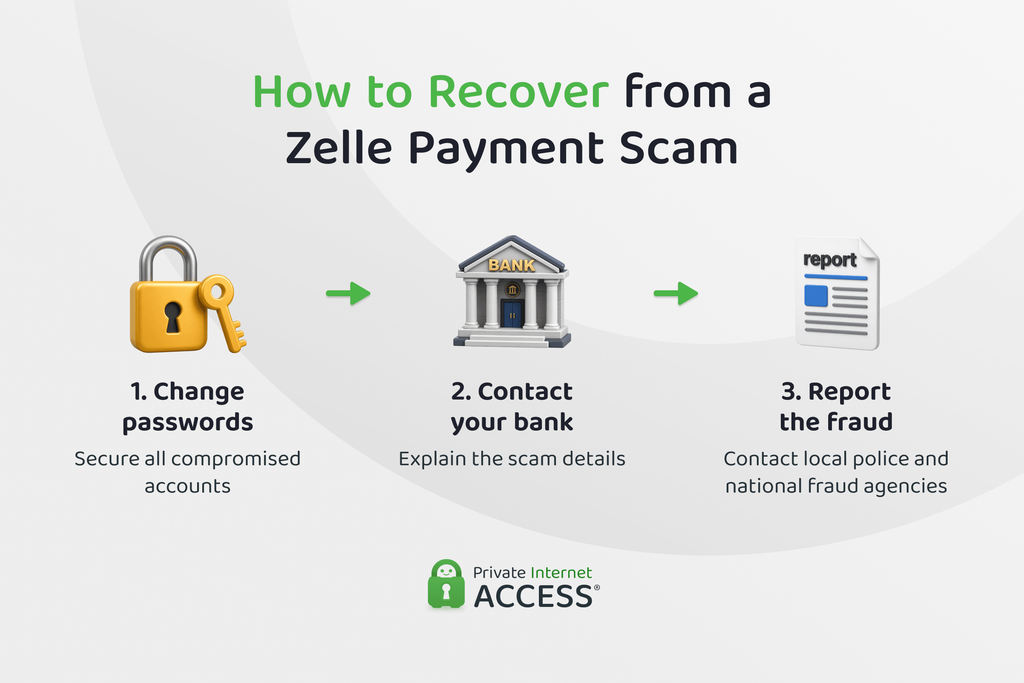
1. Change Your Passwords
If you suspect someone compromised any part of your bank or Zelle login, change both passwords immediately. Use a new, strong password for each account and enable multi-factor authentication (MFA) if you haven’t already.
With MFA, there’s a second checkpoint that helps to stop scammers from logging in to your account even if they’ve already got your password. This is extra important for account takeover situations where your credentials would have been stolen.
2. Contact Your Bank
As soon as you notice an unauthorized or potentially scam transaction, call your bank’s fraud department using the number on its official website or your card. The faster you report it, the more options your bank has to investigate or attempt to recover the funds.
Explain whether you didn’t authorize the payment (i.e., if someone accessed your account without your knowledge) or whether someone deceived you into sending it yourself. Your bank handles each situation in a different way.
3. Report the Fraud
A formal fraud claim often requires a police report, so you’ll want to file one at your local police department. You should also report the scam to the Federal Trade Commission (FTC) at reportfraud.ftc.gov and to the Federal Bureau of Investigation’s (FBI) Internet Crime Complaint Center (IC3) at ic3.gov.
These reports don’t guarantee that you’ll get your money back, but they help investigators track patterns across victims, and having a report on file can support your case if you dispute the transaction with your bank.
Zelle Scams Refund Process
Most completed Zelle transfers can’t be refunded, since the whole point of the platform is that money moves instantly.
There are exceptions, though. Pending payments that haven’t gone through because the recipient hasn’t finished registering with Zelle yet may be considered differently. Some imposter scams and confirmed fraud cases have a path to reimbursement, though Zelle doesn’t guarantee it.
The process starts with reporting what happened, either to your bank (if you access Zelle via your bank’s app) or to Zelle if you use its standalone app. From there, the platform investigates and makes a decision.
Unfortunately, the fraud claim and investigation processes aren’t especially transparent, and there’s no fixed timeline or guaranteed outcome.
FAQ
Does Zelle protect against scams?
Zelle uses fraud-detection technology it calls Trust Signals to flag suspicious activity and block known scammers. However, that system can’t stop someone from tricking you into authorizing a payment yourself, so recognizing common scam tactics is your strongest protection.
Can I be scammed if someone sends me money on Zelle?
Yes. In accidental transfer scams, someone will send you money (often using a stolen account) before asking you to send it back. The original payment can be reversed because it’s fraudulent, leaving you out of pocket after you’ve already sent the money back.
Can a scammer reverse a Zelle payment?
Zelle payments generally can’t be recalled once they’ve cleared, which is exactly why scammers favor the platform. Rather than reversing the payment, scammers trick you into sending money to them after making an “accidental transfer.”
Why do banks not like Zelle?
Banks don’t generally dislike Zelle, but there have been some issues around fraud liability that might make it less attractive for banks to offer. Criticism and regulatory pressure around reimbursing scammed customers coerced into sending money are some of the main reasons for this.
Will Zelle refund my money if I’m scammed?
It depends on the situation. Zelle and your bank must reimburse genuine unauthorized transactions, like an account takeover, under federal law. If someone deceived you into sending the payment yourself, Zelle doesn’t guarantee reimbursement, though some banks review these cases individually. Either way, reporting the scam immediately gives you the best chance.
References:
