CEO Fraud: What It Is, How to Spot It, and Prevention Tips
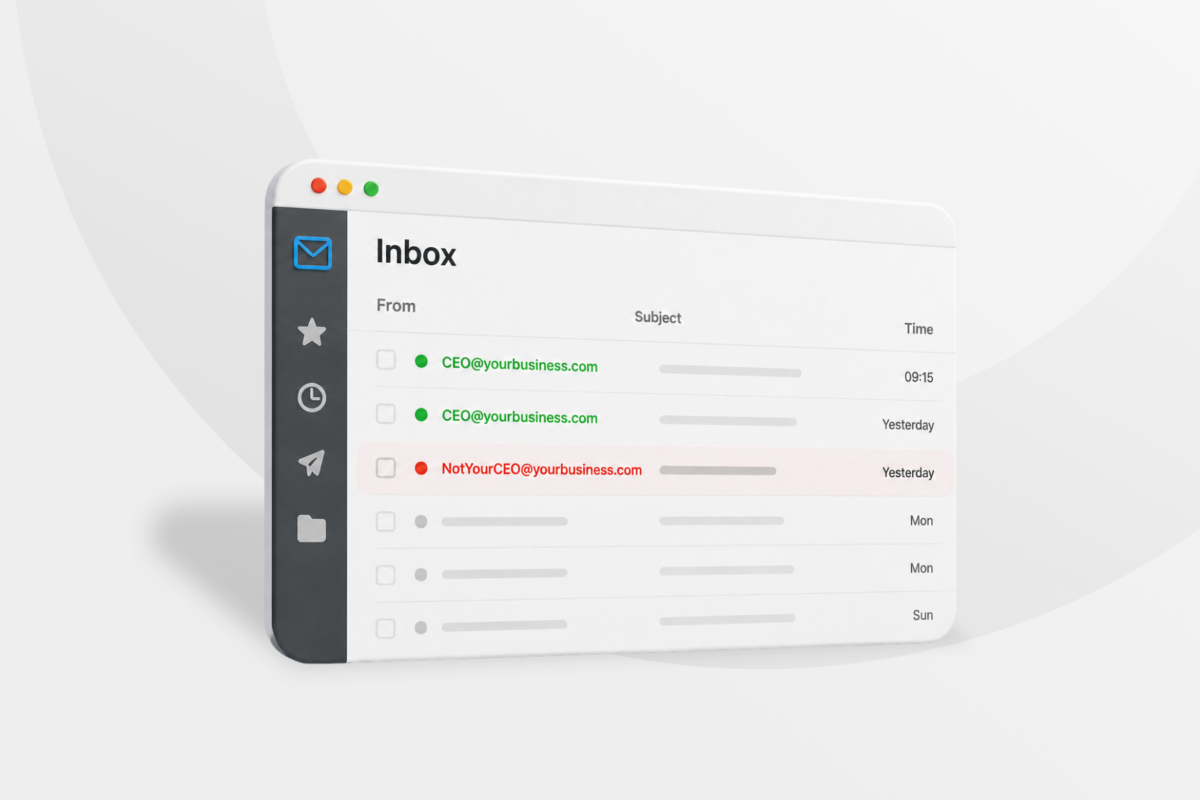
When carried out successfully, CEO fraud can cost a company millions of dollars and incur reputational damage that takes years to repair.
The good news is that this scam follows recognizable patterns. Once you understand how it’s built and what it looks like in practice, you’re in a much stronger position to catch one before it does any damage.
This guide covers what CEO fraud is, how attackers pull it off, who they often target, and the practical steps you and your organization can take to prevent it.
What Is CEO Fraud?
Also known as executive impersonation fraud, CEO fraud is a type of social engineering scam in which a cybercriminal poses as a company’s CEO or another C-suite executive to manipulate an employee into acting against the company’s interests.
Email is the primary way these scams reach their targets, since a message that appears to come from a trusted leader is far less likely to raise red flags than one from an unknown sender.
The scam can happen in a few different ways. It might show up as invoice fraud, where an “executive” instructs someone in finance to pay a fake invoice or redirect a legitimate payment to a new account. There are also cases where they even ask outright for a direct wire transfer.
Account takeovers are another variant. In these instances, attackers gain access to a real executive’s inbox and send requests from the genuine address. They may also solicit an employee to send them sensitive data that can be sold or used to plan further attacks.
The impersonated person’s authority is what makes this type of scam so effective, and not necessarily its technical sophistication. Employees may be conditioned to respond quickly to requests from leadership and attackers exploit that instinct rather than any weakness in a company’s systems.
How Does CEO Fraud Affect Companies?
According to the FBI’s Internet Crime Complaint Center, there were 24,768 complaints of business email compromise scams (the broader category this type of fraud falls under) in 2025, amounting to more than $3 billion in losses.1
One of the most prominent cases involved Austrian aerospace parts manufacturer FACC.2 In 2016, the company lost around $47 million after an employee wired funds to an attacker-controlled account, following an email that appeared to come from the CEO. The company recovered only a fraction of the money and fired its chief executive over the incident.
In 2024, engineering firm Arup lost $25.6 million after an employee at its Hong Kong office joined a video call with AI-generated deepfakes of the company’s CFO and several colleagues, all fabricated from publicly available footage.3
Beyond the direct financial hit, companies also have to pay legal fees associated with resolving the issue, might endure lasting damage to their reputation that can negatively affect their ability to attract new business, and face increased regulatory scrutiny.
Business Cyberscams: CEO Fraud vs. Business Email Compromise vs. Whaling
People often use CEO fraud, business email compromise, and whaling interchangeably online, but they’re not quite the same thing.
Business email compromise, or BEC, is an umbrella term for any scam that uses a compromised or impersonated business email account to commit fraud, while whaling targets the executive as the victim of a highly personalized phishing attempt.
| Attack Profile | CEO Fraud | Business Email Compromise | Whaling |
| Who’s impersonated | A CEO or senior executive | Any trusted party, such as an executive, vendor, or partner | Any employee or executive |
| Who’s targeted | Employees, often in finance, HR, or IT | Employees, vendors, or customers | An executive |
| Most common attack vector | Spoofed or compromised executive email | Spoofed or compromised email from any trusted party | Spear-phishing emails |
| Primary goal | Trick employees into transferring funds or data | Financial gain through email-based deception | Compromise or extort the executive |
The Anatomy of a CEO Fraud Attack
Most executive impersonation attempts follow the same basic playbook, from understanding who to target (and who to pretend to be) to deploying the attack and gaining access to the funds or information they’re after.
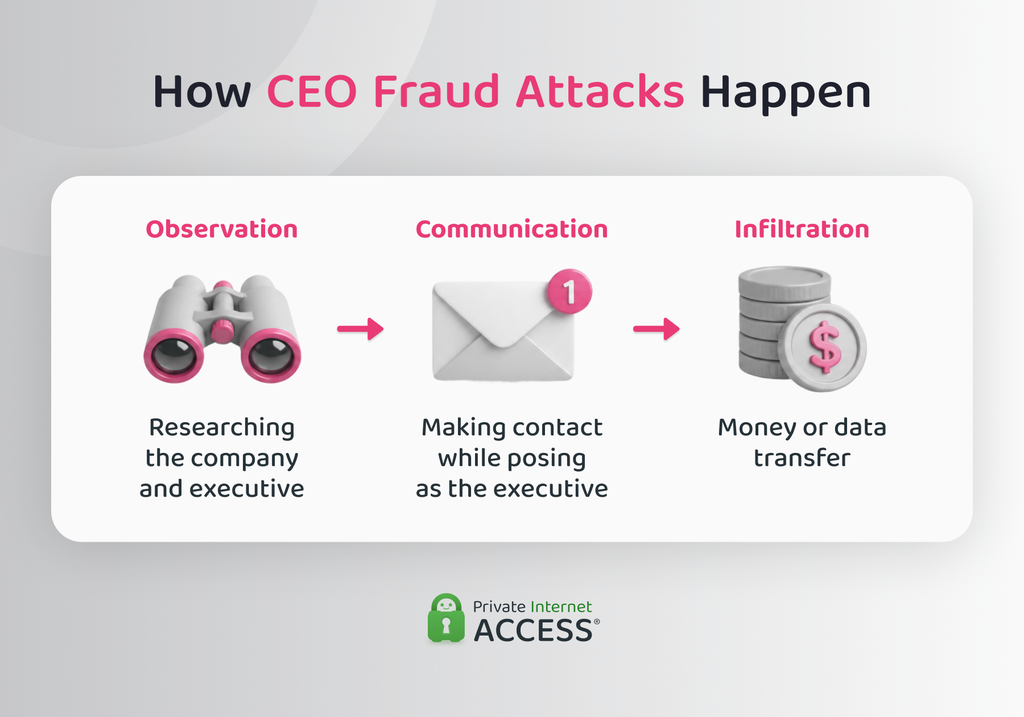
1. Observation
Before they send a single email, attackers invest a lot of time into researching their target and working out the best way into a business’s ranks.
Company websites, business profiles, and press releases reveal who holds which title, the organization’s structure, and who reports to whom. Social media (think LinkedIn) often fills in the rest: Travel plans, writing style, and even the tone an executive uses when addressing staff.
There’s also plenty to gain from data breaches. If an executive’s old password or email metadata has surfaced in a previous breach, attackers can use it to make their approach more convincing. In more advanced cases, they’ll use it to access the executive’s real inbox.
Attackers also look for the employee to target in this attack. They’re trying to figure out who’s most likely to act on a request without pushing back – for example, someone new to the company or someone who reports directly to the person they’re spoofing.
2. Communication
With the groundwork in place, the attacker makes contact. Contact often happens by email, though a phone call or text message sometimes follows to add pressure or reinforce the story.
The attacker might send an email from a spoofed address or, if they can gain access to it via credential stuffing or another type of automated cyberattack, from the executive’s email. The message goes to the employee identified during the observation stage, usually someone in a position to act on the request.
Whichever channel they use, the goal at this stage is the same: get in touch with an employee who’s most likely to transfer funds, share sensitive information, or click a link that hands over further access.
3. Infiltration
Getting an employee to respond to these fraudulent emails is only half the job in an executive impersonation scheme. To get them to actually comply, attackers need to create perceived psychological pressure.
A deadline that can’t wait discourages an employee from taking the time to double-check the request. An instruction to keep the matter confidential removes the natural instinct to loop in a colleague or manager. And because the request appears to come from someone the employee reports to, pushing back can feel like a career risk rather than a reasonable precaution.
Once the employee complies by approving a transfer, sharing sensitive data, or granting system access, the attacker has what they need.
Top CEO Fraud Attack Methods
These are some of the most common points of ingress cybercriminals rely on:
- Spoofing: Disguising an email address, domain, or phone number so it appears to come from a legitimate source.
- Pretexting: Inventing a false scenario, like a confidential acquisition or an urgent legal matter, to justify an unusual request.
- Phishing: Fraudulent emails designed to trick recipients into clicking a link, downloading an attachment, or handing over information. CEO fraud can fall under spear phishing, a targeted version of this attack aimed at a specific person.
- Vishing: Voice phishing, where an attacker calls an employee posing as the CEO to add urgency or “verify” a fraudulent request.
- Smishing: Phishing carried out over text message, sometimes used to reach an employee outside normal email channels.
Most CEO fraud attempts use a combination of these methods to convince employees that they’re business executives.
Who Gets Targeted by CEO Fraud?
Despite what the name might imply, CEOs are rarely the ones deceived by executive impersonation fraud. The attacker poses as the CEO, but the actual victims are the employees positioned to act on the request.
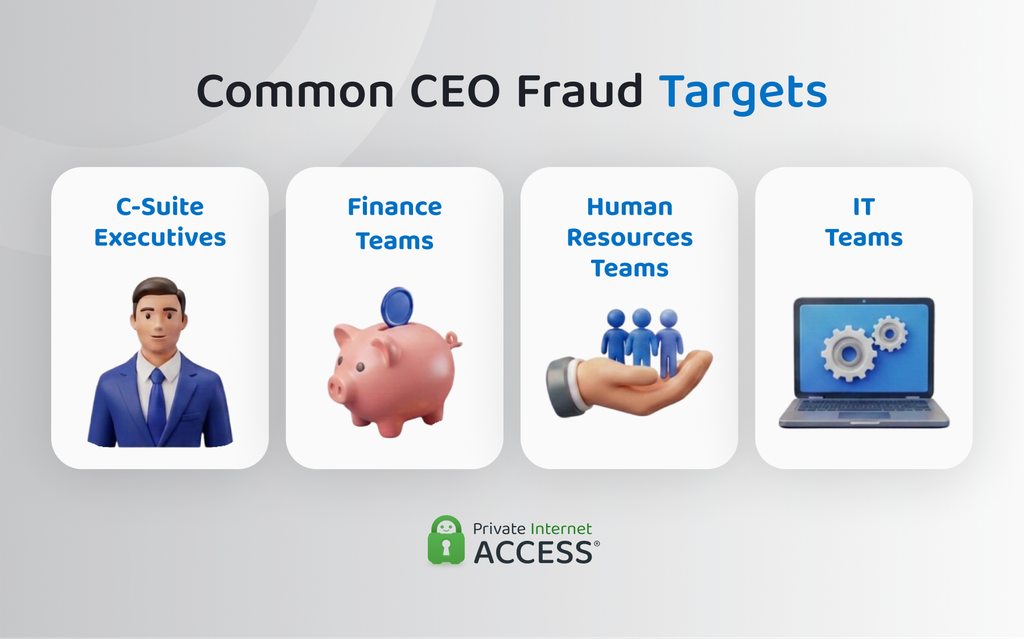
C-Suite Executives
Other C-suite leaders, particularly CFOs and COOs, are common targets of CEO fraud because they normally have the authority to approve large payments without additional sign-off.
A fraudulent request that lands with someone who can move money without having to loop in anyone else is exactly what attackers are looking for.
Finance Teams
Finance and accounts payable staff handle wire transfers and vendor payments as a routine part of their job, which makes an urgent request from “the CEO” feel unremarkable rather than suspicious.
Attackers often time these requests around fiscal deadlines, mergers, or other events where a same-day payment wouldn’t necessarily raise questions.
Human Resources Teams
Attackers target human resources staff less for money and more for data. As they manage employee records, attackers pretending to be executives might request tax forms, personal details, or payroll information under the guise of an urgent internal review. That information can be used to fuel identity theft or make future scams more convincing.
IT Teams
Technical and IT staff face yet another type of risk. Rather than vying to get money out of these individuals, cybercriminals are opting to obtain system access.
An attacker might request a password reset, a new admin account, or remote access to a system, all framed as an urgent fix needed outside normal hours. Handing credentials or access rights over can give an attacker a foothold well past a single account, letting them bypass other security controls or quietly set up access they can use again later.
How to Spot a CEO Fraud Attempt
Most executive impersonation attempts are sneakier than you might expect, so it’s good to know what to look out for.
Keep in mind that seeing one of the red flags below doesn’t automatically mean fraud, but two or three together might make it worth verifying whether the person sending the message is actually the CEO.
- Unexpected requests: A request for a wire transfer, gift cards, or sensitive data that has never come up before, especially from someone who doesn’t normally contact you.
- Urgent requests: Pressure to act immediately, often paired with a reason that can’t be easily verified (think a confidential acquisition or a big, impending deadline).
- Email address inconsistencies: A message from a personal account, a domain that doesn’t match the company one, or a display name that doesn’t match the address in the sender field.
- Unusual communication style: Tone, phrasing, or a level of detail that doesn’t match how that person normally writes.
- Off-hours messages: Requests sent late at night, early in the morning, or on weekends. Attackers time these to reach recipients when they’re less likely to double-check whether something’s wrong with a colleague.
- Requests for secrecy: An instruction to keep a payment or request confidential, even when it falls within normal limits.
- Mismatched account details: Payment instructions that don’t match a vendor’s usual account or a last-minute change to banking information.
- An unreachable sender: A message from someone who insists that email is the only channel where they can be reached even though there might be other contact details available for them on company internet.
Top tip: If something feels off, it’s best to verify the request through a separate channel, like a call to a phone number on file, rather than replying to the first communication.
5 Methods for CEO Fraud Prevention
There isn’t a single security tactic that will work to combat CEO impersonation completely. Stopping this type of fraud requires a layered response and effort from executives, employees, and IT teams alike.
1. Train Staff and Executives
The first line of defense against any type of cyberattack is awareness. Employees who understand how these scams work are far less likely to act on a fraudulent request, regardless of how convincing it looks.
Training should cover the specific red flags outlined above (e.g., urgency, secrecy, unusual account details, and requests that bypass normal approval steps). It should also establish a clear rule: employees must verify any unusual payment or data request through a second channel before processing the request.
Executives should also receive training about CEO fraud. Since they’re the ones the fraudsters are impersonating, understanding how attackers research and mimic their communication style helps them spot early attempts and warn staff before a scam spreads further.
2. Implement Technical Controls
Email authentication protocols like Sender Policy Framework (SPF), DomainKeys Identified Mail (DKIM), and Domain-based Message Authentication, Reporting, & Conformance (DMARC) verify that a message actually came from the domain it claims to be from, making it much more difficult to forge a CEO’s email domain.
Flagging external emails is another simple, effective step. When a message comes from outside the organization, an automatic banner warning employees to double-check the sender’s real address helps to close one of the most common weaknesses attackers exploit.
Advanced email filtering covers a third angle. Deceptive look-alike domains (e.g., ones registered to look as similar to the legitimate domain name as possible) might get past authentication protocols, but advanced filtering tools can be built to spot that difference and flag or quarantine suspicious communications instead.
3. Follow Finance Best Practices
Strong financial controls should direct employees to verify payment information and authorization before releasing any funds from the business’s account.
Requiring multi-factor authentication, including via a phone call, push notification, or a second executive, for any transfer above a set threshold is a smart move for minimizing potential financial damage due to illegitimate transfers.
Regularly auditing financial operations and transaction logs also helps catch anything that might have slipped through, whether that’s an unusual destination account or a payment that didn’t follow the normal approval chain. The sooner a company flags a fraudulent transfer, the better the odds of recovering some or all the funds.
4. Restrict Network Access
Limiting which devices and accounts can access sensitive systems reduces how much damage a single compromised account can do.
Segmenting the network can keep finance systems separate from general company infrastructure. This helps to reduce the likelihood that attackers will be able to reach payment systems or other sensitive records when they manage to get a foothold elsewhere.
It’s also a good idea to have clear policies about which devices can access company systems. For example, an employee checking email on a personal phone or laptop, outside the company’s security controls, is a much easier target for account takeover than someone working within managed company systems.
5. Continuous Monitoring and Maintenance
Attackers refine their tactics constantly, which means business defenses need regular attention. Reviewing email security settings, updating training materials with recent examples, and adjusting verification thresholds as the company grows all help keep pace with how these scams evolve.
It’s also worth running periodic phishing simulations, since they show which employees and departments might need additional support before a real attempt tests them instead.
What to Do If You’re a Target of CEO Fraud
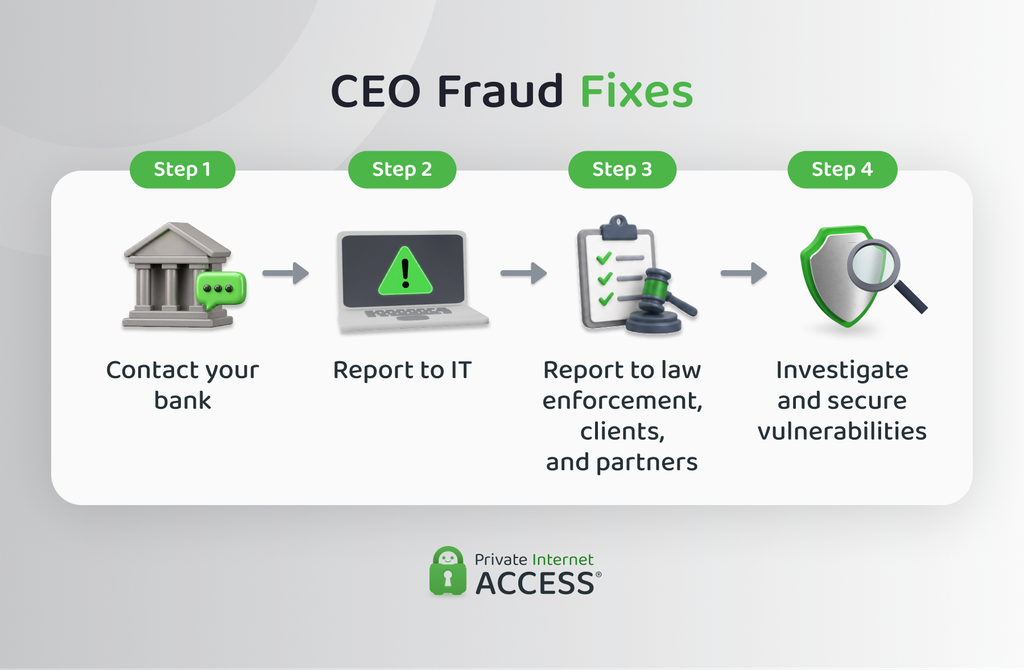
If your company falls victim to executive impersonation fraud, speed matters. You should contact your bank to try to freeze or reverse the transfer.
After contacting the bank, report the incident internally to your IT and security teams so they can isolate any compromised accounts, devices, or systems before the attacker can do further damage.
Externally, report the fraud to law enforcement (in the US, that means filing a complaint with the FBI’s Internet Crime Complaint Center) and notify any clients, partners, or stakeholders whose information or funds might have been affected.
Once that’s underway, the incident should be thoroughly investigated by the IT team to determine exactly how the attacker gained access and figure out how to close the specific security gap that scammers exploited.
FAQ
What is an example of CEO fraud?
A classic example of CEO fraud is where an employee receives an email that looks like it’s from the company’s CEO, requesting an urgent, confidential wire transfer for a fake acquisition. The 2016 FACC case is a real-world example, where the aerospace manufacturer lost $47 million as a result of one of these impersonation schemes.
What is another name for CEO fraud?
This scam is also known as executive impersonation fraud or CEO impersonation. It’s often used interchangeably with business email compromise (BEC) and whaling, but those terms describe related, rather than identical, attacks.
What type of crime is CEO fraud?
CEO fraud is a form of social engineering, specifically a type of business email compromise. Attackers exploit trust and authority rather than software vulnerabilities, which is why security awareness and verification habits are almost more important than technical defenses.
Who do CEO fraud scams typically target?
Finance and accounts payable staff are the most common targets of CEO fraud since they can authorize payments. Scammers often target human resources teams for sensitive data and IT staff for system access.
What’s the difference between CEO fraud and regular phishing?
Regular phishing casts a wide net, sending generic messages to as many people as possible, whereas executive impersonation is more targeted, built from research on a specific company and executive to bypass normal skepticism.
References:
