Computer Network Exploitation (CNE): Process, Risks, and Protection

Computer network exploitation (CNE) is a coordinated effort to break into a network undetected and silently pull data out of it. It’s a form of digital espionage that seeks to slip in, observe, and extract intelligence without the target ever knowing.
For decades, intelligence agencies have relied on it to collect information for national security purposes.1 But the same techniques are available to criminals and other bad actors chasing sensitive data of their own.
This guide breaks down how computer network exploitation works, the tools and techniques behind it, real-world examples, where it stands legally, and the steps you can take to defend against it.
Table of Contents
What Is Computer Network Exploitation?How Computer Network Exploitation Works
Computer Network Exploitation Tools and Techniques
Examples of Computer Network Exploitation
Computer Network Exploitation and the Law
Defending Against Computer Network Exploitation
FAQ
What Is Computer Network Exploitation?
A US Department of Defence (DoD) definition removed in 2012 described CNE as enabling operations and intelligence collection capabilities conducted through the use of computer networks to gather data from target or adversary automated information systems or networks.
In simpler terms, CNE is a method of covertly interfering with electronic equipment to identify targets, observe them, and extract data from their equipment. The aim is to enable and maintain access, monitor activity, and exfiltrate data without ever tipping off the target.
The interference usually involves accessing a target network or system rather than acquiring physical storage such as a hard drive or USB stick, which falls under a more traditional definition of espionage. Network-based attacks are much more common today.
While it may deploy other cyber threats such as trojans and spyware, a well-run CNE operation leaves the target infrastructure working normally without the owner ever realizing that someone compromised their systems.
CNE, CNA, and CND: The Cyber Operations Triad
CNE is one part of a broader computer network operations framework, which categorizes these operations according to what the operator is trying to achieve:
- CNE: Operators access a target’s systems to gather data and track activity, with the goal of observing over time without disrupting anything or revealing that they were ever there.
- Computer network attack (CNA): Rather than watching, the aim is to disrupt, deny, degrade, or destroy. Think corrupting data, knocking systems offline, or damaging the network itself.
- Computer network defense (CND): The converse of CNE and CNA, this defensive operation monitors, detects, and responds to unauthorized activity to keep systems safe from the other two.
How Computer Network Exploitation Works
Every CNE operation moves through the same stages, from finding a target to monitoring it undetected. These operations start with an advanced persistent threat (APT) and a well-resourced attacker, often state-backed, that can slip into a network unnoticed.
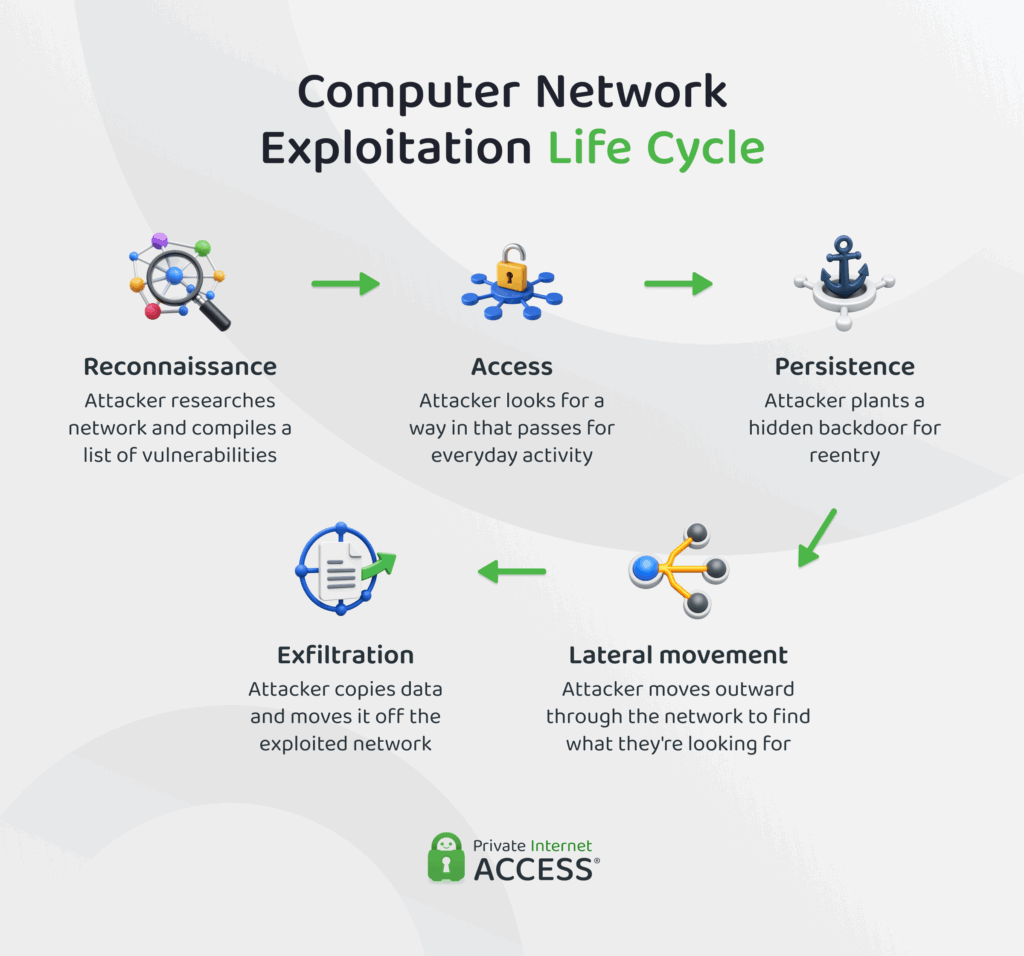
Phase 1: Reconnaissance
Reconnaissance is where the attacker builds a map of the target before making a move to access the network. This stage assembles a detailed picture of the target’s infrastructure by piecing together open-source intelligence (OSINT), which is data already sitting in public view.
Domain and DNS records reveal network architecture and IP ranges, while company websites and employee profiles expose names, roles, and email formats. A breach dumps surface-level leaked credentials and some specialized scanners can flag servers and services left exposed to the open web.
When combined, this is enough to produce a shortlist of the target’s weakest, least-guarded entry points.
Phase 2: Gaining Access to the System
Armed with a shortlist of weak points, the attacker looks for a way in. The best method here will depend on what reconnaissance turned up. Some routes target a machine and the flaws in its software, while others persuade a person to provide an opening.
The tactics vary, but they all share one trait: stealth. An obvious operation will get spotted and shut down, ending the exploit before it starts. So attackers favor methods that pass for ordinary activity – think a routine login or a familiar-looking email – to get the lasting access everything after this stage depends on.
Phase 3: Establishing Persistence
Gaining entry is one thing, but keeping it is something completely different. The first connection to a system is fragile. A reboot, a password reset, or a routine patch could sever it in an instant, so the exploiter needs to establish a way to consistently access the target network.
The usual approach is to plant a backdoor. This is a hidden foothold that can reopen a connection automatically, so the attacker can come and go at will without having to break in again and risk detection.
Many backdoors hide inside legitimate system processes or scheduled tasks, which makes them far harder to find and remove.
Phase 4: Navigating the Network and Collecting Data
Valuable data rarely lives at the initial point of entry. The first machine an exploiter accesses is usually a doorway, so they have to work outward. This lateral movement process reaches the systems that hold the data worth taking.
The challenge here is moving stealthily across the target infrastructure. Exploiters tend to use credentials already harvested along the way, logging into other machines the way a real employee would.
Legitimate logins raise no alarms, so the intruder can drift from server to server, escalating access and pinpointing valuable assets like financial records, intellectual property, and communications while looking like normal traffic the entire time.
Phase 5: Data Exfiltration
This is the final stage for CNE and it involves moving the stolen data onto the exploiter’s own systems. After locating the target assets, the exploiter sends copies to infrastructure they control.
Exfiltration is usually slow and deliberate. Data is often trickled out in small batches, encrypted or disguised as ordinary traffic to blend in and avoid triggering any alerts about the outbound traffic. When done well, the copied files are long gone before anyone realizes what happened and the exploiter maintains access for their next CNE operation.
Computer Network Exploitation Tools and Techniques
There are plenty of tools available to exploiters. Some methods pick apart technical flaws in software or hardware, others manipulate the people who use it, and many combine those to execute CNE.
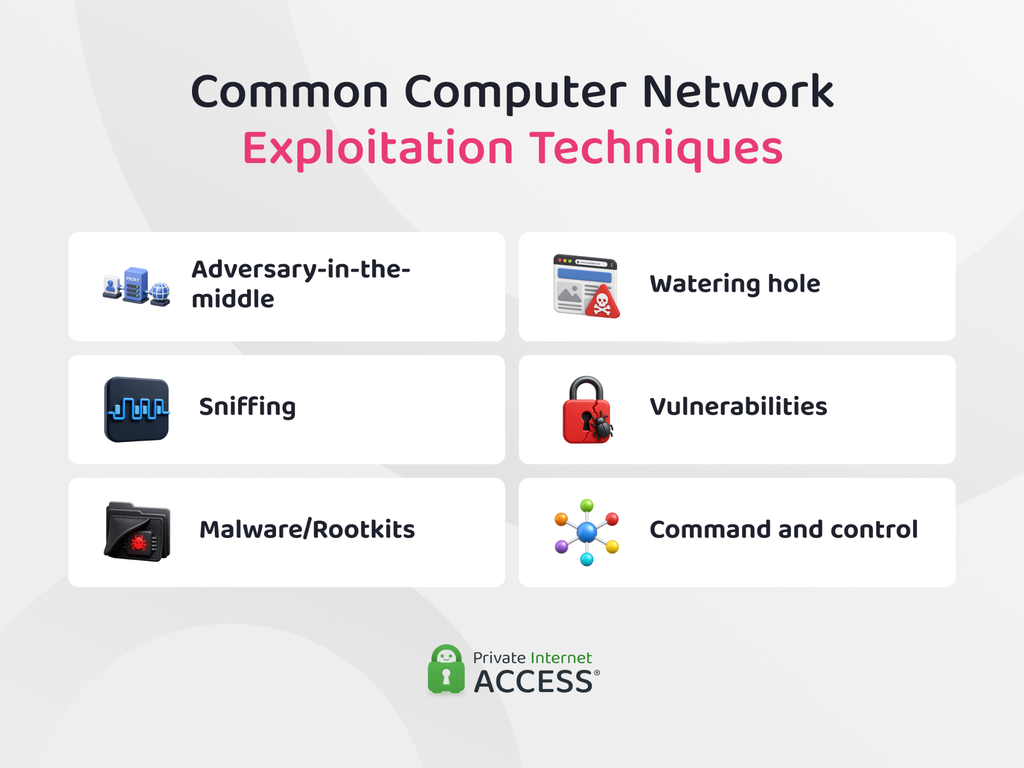
Harnessing Software and Hardware Vulnerabilities
Every device runs on software and hardware, and any part of that stack can carry flaws. The most prized are zero-day exploits. These are vulnerabilities the vendor doesn’t yet know about, which means no patch exists to close them. With no fix available, a zero-day can hand over access for weeks or months before anyone catches on.
Other attacks target the network itself, tampering with the routes data takes between machines to quietly reroute or intercept it in transit.
Adversary-in-the-Middle Attacks
An adversary-in-the-middle attack places the exploiter between the victim and a legitimate login page using a reverse proxy that relays traffic in real time, capturing their credentials and the session token issued after authentication.
The attacker can discreetly collect the target’s username, password, and even the multi-factor code, but the real prize is the session token. With this, the exploiter can enter the account without tripping another security check to turn one round of credential hunting into lasting access.
Watering Hole Attacks
Rather than lure a target somewhere new, a watering hole attack compromises a legitimate site you already visit and trust like an industry forum, a government portal, or a niche news source.
Attackers plant malicious code on the page and when a user from the target group browses the site as usual, malware loads onto their device. The “watering hole” name comes from a predator that waits at the watering hole and never has to chase its prey.
Packet and Network Sniffing
Packet sniffing captures the data flowing across a network. Using specialized software or a dedicated hardware tap, an exploiter can record the individual packets moving between devices and reassemble them to read what’s inside.
When traffic isn’t encrypted, there’s a chance of traffic exposure. Login credentials, private messages, and session tokens become readable, along with the internal addresses and software versions that reveal how an organization configures the network.
Custom Malware, Spyware and Rootkits
While someone could use them to gain access, malware, spyware, and rootkits are effective post-access tools. They’re deployed once the exploiter is already inside to keep control and collect data.
Spyware uses surveillance, logging keystrokes, screen captures, and file and communications copying. Rootkits go deeper, burrowing into the operating system to grant privileged control while concealing their own presence and any other malicious tools running with them.
Off-the-shelf malware is easy for security tools to recognize, so serious exploiters often rely on custom-built code, written for a single target and unknown to any signature database. This lets it slip past standard defenses.
Command-and-Control Servers
A command-and-control server is the remote hub an exploiter uses to manage compromised machines. Malware on an infected device checks in with the server to report that it’s still active and collect its next instructions.
To avoid notice, malware disguises those check-ins as routine web traffic, so they blend into normal network noise instead of standing out as a connection to a suspicious address.
Examples of Computer Network Exploitation
Computer network exploitation isn’t a new form of cyber warfare. Intelligence agencies have been quietly collecting data this way for decades, evolving from Cold War signals interception to the precise network intrusions of today.
- Moonlight Maze: One of the first known state-sponsored cyber-espionage campaigns, active from 1996 to 1998. Intruders seemingly linked to Russia siphoned huge volumes of sensitive data from US military, government, and research networks.2
- Flame: Modular espionage malware uncovered in 2012 and used mainly across the Middle East. It could record audio, capture screenshots, log keystrokes, and copy files.3
- Regin: A stealthy surveillance platform revealed in 2014 and attributed to the Five Eyes. Leaked intelligence documents described the framework behind it as a CNE platform, used to spy on telecoms, governments, and individuals.4
- GhostNet: A cyber-espionage network exposed in 2009 that infected roughly 1,300 computers across 100+ countries, with embassies and foreign ministries among them. It could even switch on an infected device’s webcam and microphone.5
- Sunburst: The 2020 SolarWinds breach, where Russia’s foreign intelligence service hid a backdoor in a trusted software update, reached some 18,000 organizations, including US federal agencies.6
Computer Network Exploitation and the Law
As these techniques have long been tools of statecraft, their legal status is murkier than ordinary cybercrime. The same intrusion that would be a criminal offence for anyone else can be lawful when an intelligence agency carries it out under proper authority.
In the UK, for example, the security services don’t hide that they use this strategy. MI5 openly acknowledges using equipment interference7 (a legal term for CNE) to access devices and gather intelligence.
However, the power comes with tight controls. Each operation needs a warrant signed by a Secretary of State and approved by an independent judge. Also, the Investigatory Powers Act governs every action8 and its equipment interference code of practice. The standard is that any intrusion should be necessary and proportionate to a genuine national-security aim.
Defending Against Computer Network Exploitation
No single tool can stop computer network exploitation, but layered defenses make it far harder to pull off:
- Zero-trust network architecture: This treats every request as untrusted until verified, so one stolen credential can’t unlock free movement across the network once an attacker is inside.
- Threat and vulnerability awareness: Hunting for unusual activity instead of waiting for alerts shrinks the months of undetected access that CNE relies on.
- Updates and patch management: Most intrusions exploit known, unpatched flaws, so keeping devices and software current closes the easy entry points.
- Multi-factor authentication: Makes a stolen password far less useful on its own. Phishing-resistant methods like hardware keys hold up even against the real-time credential theft that defeats basic MFA.
- Limit public discoverable data: Reconnaissance feeds on public information, so the less employee details, forgotten servers, and leaked credentials you share, the less sensitive information you’ll expose online.
- Use a VPN: This privacy tool encrypts your traffic so interception on an untrusted network turns up nothing readable. It also hides your IP address from the passive recon that maps a target. It won’t stop malware already on your device, but it adds a layer of security and privacy to your everyday browsing.
FAQ
What is computer network exploitation?
Computer network exploitation is a form of digital espionage where the exploiter interferes with computers, phones, or servers undetected to identify targets, monitor them, and extract data without the owner ever noticing.
What are common computer network exploitation techniques?
Common computer network exploitation techniques include exploiting software flaws such as zero-days, adversary-in-the-middle attacks, watering hole attacks, and packet sniffing. Attackers also deploy custom malware and rootkits, routing stolen data through command-and-control (C2) servers they operate.
What are the main tools used in computer network exploitation?
Some of the main tools used in computer network exploitation are custom malware, spyware, rootkits, packet sniffers, and command-and-control servers that manage compromised machines and collect stolen data.
How does computer network exploitation differ from computer network defense?
Computer network exploitation is offensive intelligence work: Accessing systems to gather data and monitor activity undetected. Computer network defense is defensive, covering the monitoring, detection, and response used to keep intruders out.
Can a VPN protect against computer network exploitation?
Only partly. A VPN can’t stop the endpoint side of CNE, like phishing or malware already on your device. What it can do is encrypt your traffic to minimize interception and hide your IP address. Some VPNs, like PIA VPN, come with Identity Guard, which can flag your email if it surfaces in a breach dump.
How is VPN technology used to reduce the risks of computer network exploitation?
A VPN sends your internet traffic through an encrypted tunnel. This helps prevent snoops from seeing what you’re sending and receiving across a network. For an extra layer of protection, PIA VPN can connect automatically whenever you join an unknown network.
References:
- Computer network exploitation (CNE) – NIST
- S.Hrg. 106-858 — CRITICAL INFORMATION INFRASTRUCTURE PROTECTION: THE THREAT IS REAL – Library of Congress
- Kaspersky Security Bulletin 2012. Cyber Weapons – Kaspersky
- Source code reveals link between NSA and Regin cyberespionage malware – PCWorld
- Tracking GhostNet: investigating a cyber espionage network – University of Oxford
- Active Exploitation of SolarWinds Software – CISA
- Equipment interference – MI5
- Equipment interference code of practice (accessible) – GOV.UK
