Private Proxies: Types, Use Cases & Security Considerations
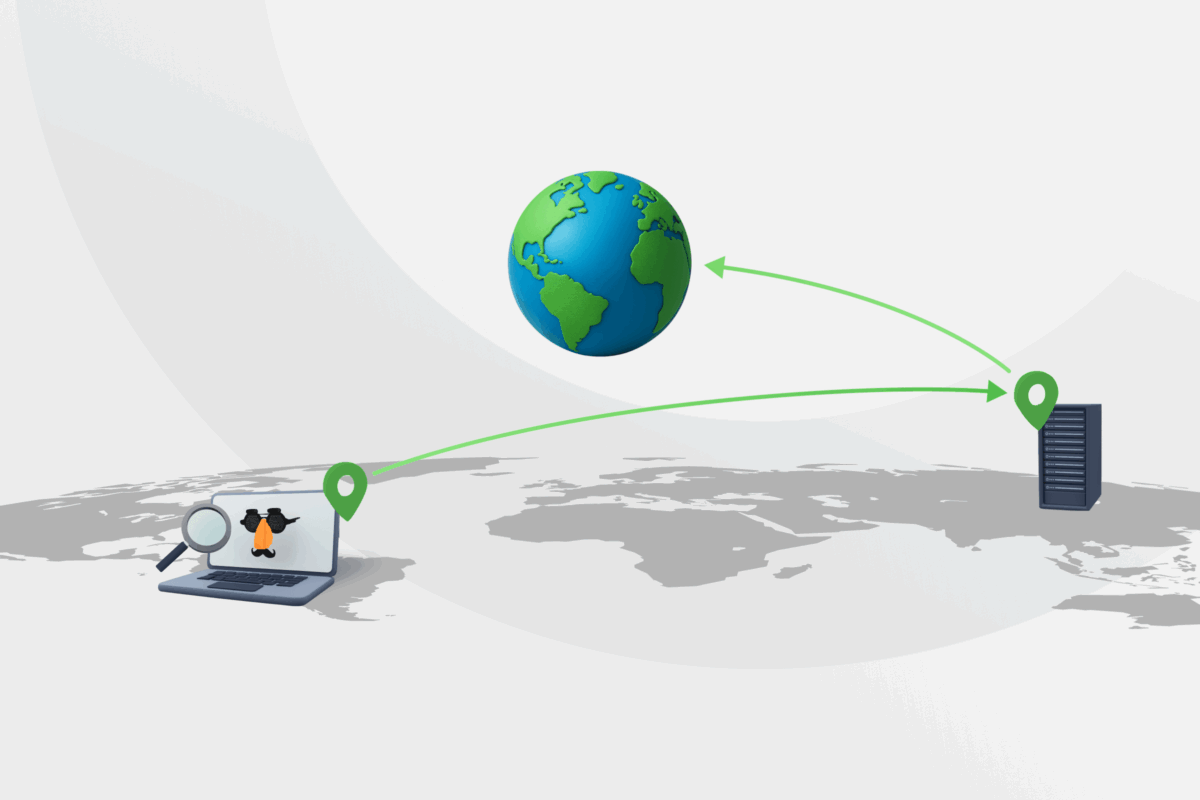
A private proxy sounds like a simple answer to a big problem: you need to be online and your IP address, which is visible to every website you visit, can reveal information about your general location and possibly contribute to IP tracking.
A private proxy seems like an ideal solution. It hides your real IP address by connecting to a dedicated proxy server, so websites see the proxy IP address instead of your own. This makes your connection harder to trace.
But here’s the catch: a private proxy only goes so far. It hides your IP, but it doesn’t encrypt your traffic. That means your internet provider, network admins, and anyone with the right tools can still see what you’re doing. Find out if a private proxy is right for you or if you need a more powerful privacy tool instead.
Table of Contents
What Is a Private Proxy?Private Proxy Service: What You’re Actually Getting
Private Residential Proxy
Are Private Proxies Safe?
Private Proxy vs. VPN
A Simple Rule of Thumb
FAQ
What Is a Private Proxy?
A private proxy, which is also known as a dedicated proxy, is a remote server reserved for a single person’s use. Unlike a shared or public proxy, where many users funnel their traffic through the same IP address, you get one that isn’t shared with anyone else.
That exclusivity is the difference between a shared and dedicated IP address. When no one else is using the same IP address, you get faster speeds, fewer blocks or CAPTCHAs, and more consistent performance. It also reduces the risk of another user’s suspicious activity compromising your IP reputation.
Private proxies come in different forms:
- An HTTP proxy works at the browser level, handling web traffic like websites and apps that use HTTP or HTTPS.
- A SOCKS proxy is more versatile, routing different kinds of traffic, including email, file transfers, and gaming apps, through the proxy server.
- Residential proxies borrow IP addresses from real households, so your connection looks like it’s coming from an ordinary home user.
No matter the type, the goal is the same: you’re masking your real IP with one that looks clean and legitimate.
When Private Proxies Make Sense
A private proxy is great in some situations, but it’s not a one-size-fits-all solution. If you’re a remote worker who needs to secure company data, or you’re shopping online while connected to public Wi-Fi, a proxy won’t protect you. In these types of cases, a VPN is a better fit.
Where proxies do shine is in tasks that only require IP masking, not full encryption. Here are a few common examples:
Personal Uses
Private proxies aren’t built for every situation, but in certain scenarios they can be quite helpful. Here are some examples:
- Social media management: If you have multiple accounts on the same social network platform, you can get flagged if you log in from the same IP address. With a private proxy, each account can connect through a unique IP, reducing the chance of lockouts or bans.
- Online gaming: Some players use private proxies to connect to servers in different regions or to help reduce lag if the proxy routes traffic through a faster server. It can also mask their home IP address if they’ve experienced a DDoS attack. Using a proxy doesn’t prevent attacks to the proxy server itself, though.
- Everyday browsing: Websites track your location and behavior through your IP address. A private proxy hides your real IP, so you can browse without revealing exactly where you are or building up as much trackable history.
- Online shopping: Some sites adjust prices based on your location or browsing history. A private proxy helps mask your IP so you can avoid inflated costs and sometimes access better deals.
Business and Research Scenarios
Private proxies aren’t limited to gamers or social media influencers. There are several use cases when a private proxy is important in a professional setting:
- Ad verification: Companies check how their ads appear in different countries to ensure accuracy. A private proxy lets them view campaigns from multiple regions without skewed results.
- Market research: Researchers and businesses use proxies to see localized search results or competitor pricing. By appearing to browse from a specific location, they get a clearer picture of what local customers actually see.
Advantages and Disadvantages of Private Proxies
While private proxies have their uses, there are also some tradeoffs to consider.
| Pros | Cons |
| ✅ Since you’re not competing for resources, your connection usually runs smoother. | ❌ Exclusivity comes with a higher price tag than shared proxies. |
| ✅ You know the IP is yours alone, which reduces the risk of someone else’s activity compromising its reputation. | ❌ Some private proxy services aren’t truly private because they resell shared IPs and call them dedicated. |
| ✅ Websites see the proxy IP address, not your actual one, which helps to improve your online privacy. | ❌ Even with speed and anonymity, the traffic isn’t encrypted. Your ISP or anyone snooping still sees what you’re doing. |
Private Proxy Service: What You’re Actually Getting
When you buy a private proxy service, you’re paying for access to one or more dedicated IP addresses that no one else can use. Instead of setting up your proxy server, the provider runs the servers, manages uptime, and provides user-friendly admin tools.
Most services include:
- Dedicated IP addresses: Assigned to you only, often in multiple regions.
- IP pools: Rotate between several addresses for different tasks (available on select plans).
- Geo-targeting: Ability to choose an IP address in a specific country or city.
- Control panels or dashboards: Swap IPs, check usage, and manage settings.
This convenience means you don’t have to configure or maintain anything on your own. You pick a service, log in, and start routing traffic through a clean, private IP address.
For example, a marketing team might use a private proxy service to rotate IP addresses while checking how their ads appear in different countries, while a small business could use geo-targeted IPs to test how their website loads abroad.
The compromise is price. Reliable private proxy services aren’t cheap, and the more locations or IP addresses you want, the higher the cost. And no matter how advanced the features sound, your traffic still isn’t encrypted.
Private Residential Proxy
A private residential proxy works the same way as any other proxy, but instead of using datacenter IPs, it routes your traffic through an IP address that comes from a real household internet connection. To websites, your traffic looks like it’s coming from an ordinary home user rather than a server rack in a data center.
Because these IP addresses look authentic, residential proxies usually carry a higher price tag than standard private proxies. And while they might boost anonymity by blending in with regular users, they still carry the same privacy limitations.
They’re often used for activities where looking “natural” matters, like:
- Sneaker and ticket reselling: Avoiding single IP rate limits or IP reputation-based restrictions when buying limited releases.
- Web scraping: Collecting data without triggering anti-bot protections.
- Bypassing stricter filters: Getting around systems that blacklist obvious datacenter IPs.
While these are common applications of residential proxies, some may breach a website’s terms of service or raise legal issues, depending on how and where they’re used.
Datacenter vs. Residential Private Proxies
| Feature | Datacenter Proxy | Residential Proxy |
| IP source | Data center servers | Real household internet connections |
| Detection risk | Easier to spot and block | Harder to detect, looks like a real user |
| Speed | Typically faster and more stable | Slightly slower depending on household ISP |
| Cost | Lower | Higher |
| Best for | General browsing, gaming, basic tasks | Sneaker bots, scraping, IP-based filtering |
Are Private Proxies Safe?
Private proxies are safer than public or free proxies, but they’re not foolproof. Since you’re the only one using the IP address, you don’t have to worry about someone else’s online activity getting that address blacklisted. You also avoid many of the performance and security issues that come with shared proxies.
The problem is that proxies don’t encrypt your traffic. Your browsing may look anonymous to the websites you visit, but your ISP, your network admin, or anyone monitoring the connection may still be able to see your connection metadata. Depending on whether HTTPS and encrypted DNS are in use, this can include the proxy IP address, DNS requests, or the sites you connect to. If the proxy provider keeps logs, they may also have a record of your activity.
Private proxies are fine for quick IP swaps and low-risk browsing, but they’re not a full privacy or security solution. If your priority is protecting data or staying secure on public networks, you’ll want a VPN.
Private Proxy vs. VPN
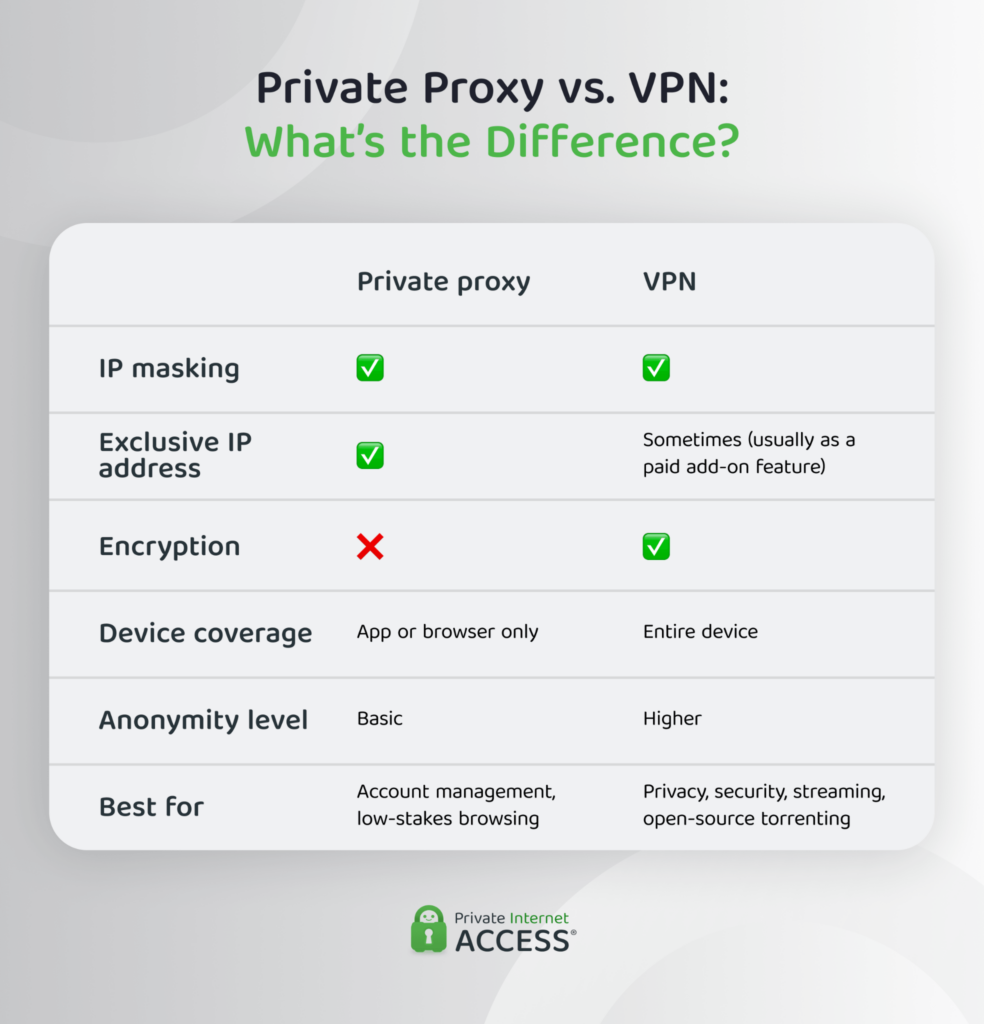
Virtual Private Networks (VPNs) are similar to private proxies because they mask your IP address and reroute your internet connection to a remote server. Some even offer a dedicated IP address.
But that’s where the main similarities end. While a VPN does everything a proxy does, it also adds an important online security component. When it routes your internet connection to its server, it creates a tunnel that encrypts your data and adds a layer of privacy to your online activity. That means your ISP, hackers on public Wi-Fi, or anyone monitoring the network has a harder time reading your data or tracking your online activity back to you.
Here’s a side-by-side view:
Dedicated IP Addresses With VPNs
The main benefit of a private proxy is that you have an exclusive IP address. While the standard VPN provider has a server network that any subscriber can connect to, some offer a Dedicated IP address as a premium feature. For activities that require consistency, like remote work logins, online banking, or running a personal website, a VPN that offers a dedicated IP address offers the best of both worlds: reliability and security.
Performance Considerations
People sometimes choose a proxy over a VPN for speed. Because there’s no extra processing with encryption, proxies can offer slightly lower latency for single, lightweight tasks like logging into an account or loading a webpage.
But that advantage is narrow. Top VPNs balance speed and security with optimized VPN protocols that keep connections fast even while encrypting your data, so any latency is minimal. In practice, a good VPN gives you both privacy and performance, which can make the “VPNs are always slower” argument less effective.
When to Use a Private Proxy or VPN
Private proxies shine in situations where speed and IP masking are enough. For example, marketers managing multiple social media accounts often rely on them to avoid lockouts and gamers may use them to sidestep lag or connect to servers in different regions. If the only thing you need is a clean IP address that’s not shared with strangers, a private proxy gets the job done.
The moment you care about more than just your IP address, a VPN takes over. By encrypting your traffic, a VPN helps to protect sensitive data from your internet provider, cybersnoops, and anyone else trying to monitor your activity. Instead of a single app or browser, it encrypts the traffic for your entire device, which can boost your security whenever you go online.
A Simple Rule of Thumb
Deciding between a proxy and a VPN boils down to what you need. If you want to mask your IP address for one-off, low-stakes tasks, a private proxy is enough. But if you care about encrypting your connection, adding more data privacy when you connect to the internet, and having the flexibility to cover your entire network, using a VPN like Private Internet Access (PIA) is the smarter long-term choice.
FAQ
What is a private proxy?
A private proxy is a remote server that gives you an IP address no one else shares. Unlike public or free proxies, it’s reserved for your exclusive use. This makes a private proxy faster and more reliable. Websites are also less likely to flag the IP address because of fraudulent use by someone else sharing your IP.
What is a private proxy server?
A private proxy server is the machine or service that handles your connection when you use a private proxy. You connect to the proxy server first, and then it connects to the site you want to visit. As a result, the site only sees the proxy’s IP address, not your own.
What is a private proxy service?
A private proxy service is a provider that sells access to private proxies. They manage the servers, route your traffic through proxy IP addresses, and often include tools for switching IPs or choosing locations. It’s a convenient way to use proxies without running your own hardware.
How does a private proxy VPN work?
People often refer to a private proxy VPN, which isn’t really a thing. A proxy only swaps your IP address with its own, while a VPN masks your IP address and encrypts your traffic. If you want both privacy and security, a VPN is the tool you’re looking for.
What is Private Proxy WinGate ME?
Private Proxy WinGate ME refers to older proxy server software that provided users with a way to route traffic through a dedicated proxy. While it was popular years ago, it’s largely outdated today. Modern proxy services and VPNs offer far stronger security and easier setup.
What is a private residential proxy?
A private residential proxy uses IP addresses from real household internet connections instead of data centers. That makes your traffic look like it’s coming from a regular home user, which is harder for websites to block.
