What Is Swatting? Definition, Dangers, and How to Protect Yourself
It might sound like something you’d do to a fly that’s buzzing around your kitchen while you’re cooking dinner, but swatting is actually a serious cybercrime.
So, what is swatting, exactly? It’s the process of tricking emergency responders into believing a serious crime is unfolding at someone else’s address, usually to harass or intimidate them.
This guide will help you to understand exactly how these attacks come together, why certain people end up in the crosshairs, and what to do if you ever find yourself on the receiving end of a swatting attack.
What Is a Swatting Cyber Attack?
Swatting is a harassment technique that uses emergency services as a weapon. The person carrying it out deceptively reports that the victim is committing a serious crime, often something like a mass shooting, a hostage situation, or a bomb threat, usually by calling 911 or another emergency line.
Dispatchers have no way of knowing the call is fake, so they respond accordingly. This can result in a large number of responding officers – sometimes including Special Weapons and Tactics (SWAT) teams – descending upon the victim’s home. This is exactly where the attack gets its name from.
How Does a Swatting Attack Work?
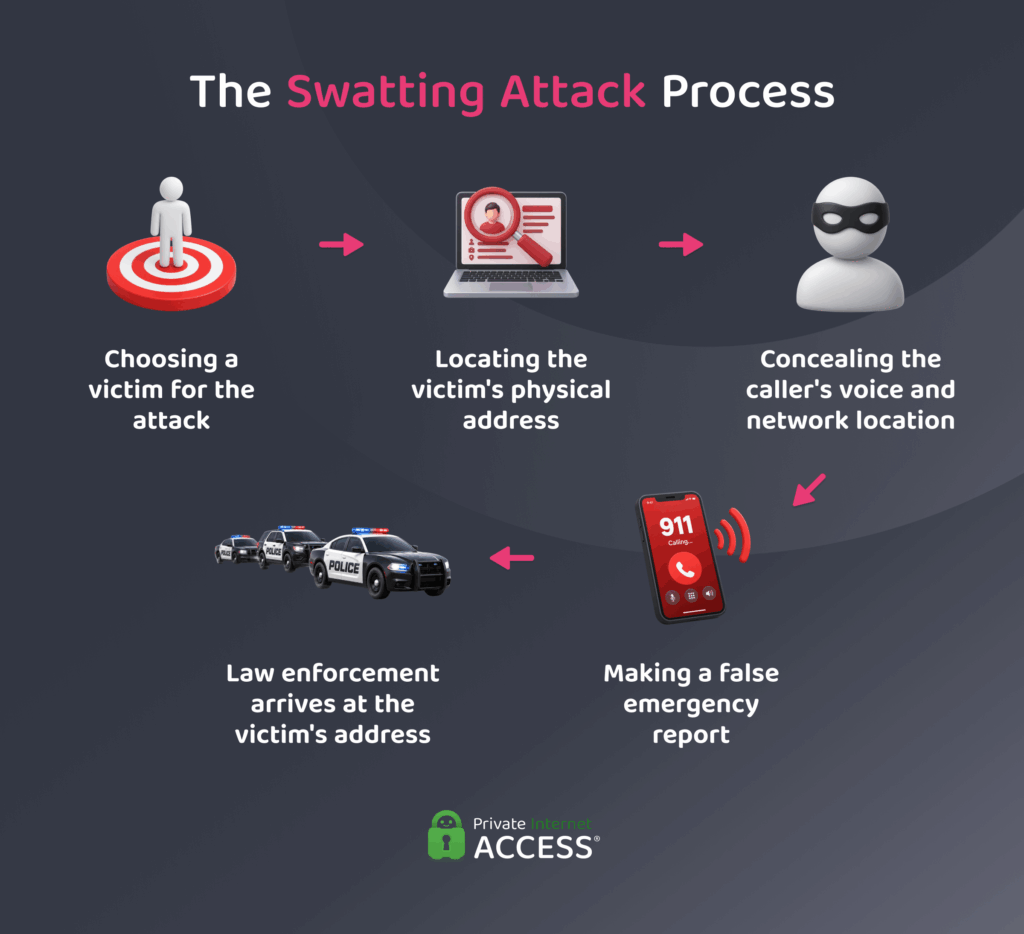
Swatting isn’t a new phenomenon. The FBI has been aware of the practice since 2008 and the anatomy of a typical attack hasn’t changed much in the interim.1 Most incidents move through the same five stages, regardless of who’s behind them or their targets.
1. Identifying the Target
The victim might be a streamer with a rival, a public figure with outspoken critics, or someone who lost an argument online. It could even be someone caught in the crossfire of a dispute they aren’t involved in.
The attacker doesn’t need to have a personal vendetta against the victim, but they do want to cause chaos for whoever happens to be in their sights.
2. Gathering Information
Once the attacker chooses a target, they need one crucial piece of information to make the report believable: an address.
Unfortunately, whether they’re swatting, stealing an identity, or committing other online crimes, attackers have no shortage of ways to figure out a victim’s address. They can use a variety of tactics like combing through old social media posts, accessing databases on dark web marketplaces, or by asking around.
3. Identity Masking
Before making the call, the attacker needs to ensure that they won’t be identified by the authorities or they’ll risk potentially harsh consequences. They can use a variety of tactics to do this:
- Caller ID spoofing: Fakes caller ID details and makes the call appear to come from a different number or location.
- Voice-changing software: Alters pitch and tone of the caller’s voice enough to throw off any attempt to identify them later.
- Call re-routing: Some attackers route calls through relay services or Voice over Internet Protocol (VoIP) apps to further obscure where they’re actually calling from.
This gives the caller anonymity and buys them time to further conceal their identity once the fallout begins.
4. Making a False Report
With their identity obscured, the attacker can place the call itself. They’ll contact emergency response services, making claims of an active shooting, a hostage situation, or a bomb threat.
These types of crimes are particularly popular with swatters because they encourage dispatchers and law enforcement to act with enough urgency that they may not question the story. The more convincing and specific the details, mentioning weapons, injuries, or a body count, the faster and larger the response tends to be.
5. Law Enforcement Response
From here on, the situation is out of the victim’s hands. Patrol cars, and in more extreme cases full tactical teams, descend on an address where nothing is actually wrong.
For someone inside, the first sign of trouble comes when officers are already surrounding the house with weapons drawn, shouting commands, or breaching the door. There’s often no warning call and no chance to explain the confusion, only the sudden reality of authorities treating you as a dangerous suspect in your own home.
Who Gets Targeted by Cyber Swatting?
Every swatter has their own reasons for choosing a victim, but there are a few patterns that have emerged from the records of swatting attacks.
Schools and gaming communities show up disproportionately often. The former because a single call can disrupt hundreds of students at once, the latter because online disputes between players can escalate fast and anonymously.
Online personalities – think streamers, professional gamers, and influencers – are frequent targets. This is partly because a well-timed swatting incident during a livestream guarantees an audience and partly because their personal information can be easy to find.
Celebrities and other public figures are two more favorite targets of swatters. There’s a long history of swatters targeting these individuals because their names and faces are well known or because they’ve said or supported the “wrong” thing.
Private individuals account for another significant share of victims. They may be targeted as a result of online disputes in gaming sessions, social media posts, or their point of view. Journalists and activists make the list, too. They’re sometimes swatted to intimidate them out of continuing their work.
Occasionally, the victim hasn’t done anything to attract the swatter’s attention at all. Mistaken identity, a shared name, or a data leak tying the wrong address to the wrong person is enough to put someone in danger.
Motivations track as broadly as the victims themselves. Racial, political, and other forms of hatred drive a meaningful share of attacks. Some attackers are after straightforward harassment or revenge, while others might crave the attention, notoriety, and potential payoff that comes with pulling off a high-profile incident like this.
How Do Swatters Find Their Victims?
Many swatters aren’t complete strangers to their victims. They’ve often interacted with the person they target at least once, even if that’s in a comment section, a match lobby, or an online forum. Once they know who you are, they can use a variety of tactics to get your address:
- Hacking: Breaking into email, social media, or cloud accounts to access a target’s home address, phone number, or calendar.
- Social engineering: Posing as a trusted contact, company representative, or acquaintance to trick someone into sharing personal details.
- Doxing: Compiling personal information from multiple public sources and publishing it (often on forums built for exposing people).
- Data leaks: Pulling home addresses, phone numbers, and other identifying details from breached databases exposed by retailers, service providers, or other platforms.
- Manual location tracking: Scanning photos, check-ins, and background details in shared images to pinpoint where someone lives or spends time.
- IP tracking: Using tools that reveal a device’s IP address to narrow down a target’s general location or internet provider.
Safety tip: PIA VPN reroutes your connection through a remote VPN server, masking your real IP address in the process. Together with other factors, such as protecting your online identity and practising good security hygiene, this can help reduce your attack surface and make it more difficult to target you with a swatting attack.
The Effects of Swatting
Imagine being home on an ordinary evening when you suddenly hear pounding on your door. When you open it, you find several armed officers, guns raised and shouting for you to get on the ground.
You have no idea why this is happening – as far as you know, you haven’t done anything wrong. But emergency services have received a report that you’re holding people hostage or planning a mass shooting, and now responders are treating you as the threat.
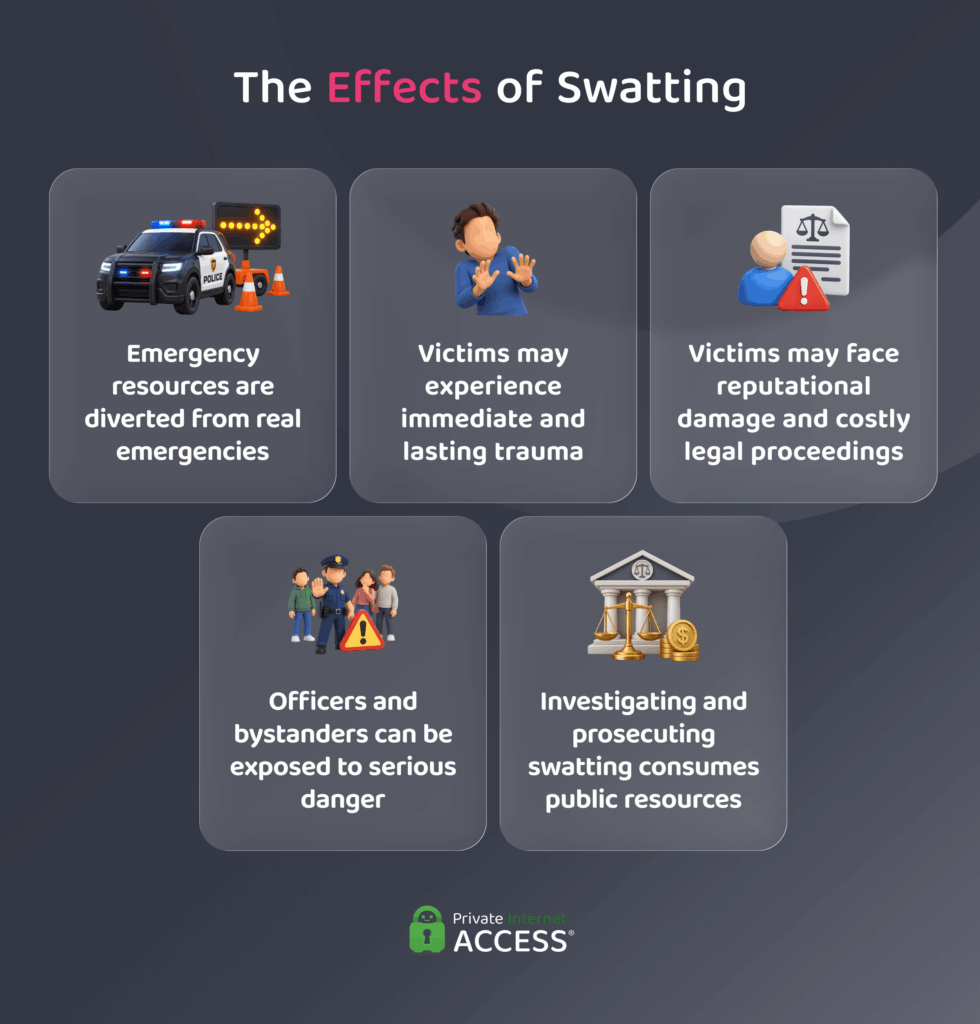
A lot of fallout comes from scenarios like this. One of the most immediate effects is the diversion of emergency resources from actual emergencies. Every officer, vehicle, and minute spent responding to a fabricated crisis is time and money taken away from real crises happening somewhere else.
At the same time, the victim may be immediately and severely traumatized. The fear of wrong suspicion, the disorientation of an unannounced armed response, and a lingering wariness about their personal safety can all last long after the incident itself.
They may face lingering reputational damage if authorities don’t immediately recognize the incident as a hoax. Plus, pursuing legal recourse (like compensation for property or reputational damage) can turn into an expensive and stressful legal process.
Officers responding to a call can also face genuine danger walking into a situation they think could turn violent, and bystanders nearby can end up caught in the confusion, too. For instance, some swatting incidents have ended in serious injury and a small number have proven fatal.
Prosecuting the person responsible also carries a cost. Investigating and pursuing swatting charges draw on public resources and taxpayer money, on top of what’s already spent responding to the hoax itself.
As a result, many jurisdictions treat swatting as a serious criminal offense, and convictions have led to lengthy prison sentences, restitution orders, and civil lawsuits from victims seeking damages.
Examples of Cyber Swatting Attacks
Swatting has played out in courtrooms across the country for over a decade, with cases ranging from celebrity pranks to attacks that turned fatal.
The Kutcher and Bieber Celebrity Swattings
In October 2012, a hoax 911 call sent dozens of armed officers to actor Ashton Kutcher’s Los Angeles home. The caller claimed armed intruders were inside and they had shot people. As it turned out, someone had fabricated the whole story.
The caller, a 12-year-old boy, later admitted to targeting both Ashton Kutcher and Justin Bieber with these false reports. The incident was part of a wider wave of celebrity swattings around the same period that also affected Tom Cruise, Miley Cyrus, and Russell Brand.2
The Wichita Swatting Incident
A dispute over a $1.50 wager in an online Call of Duty match ended with an innocent man losing his life in December 2017. Casey Viner asked Tyler Barriss, another player, to swat match opponent Shane Gaskill.
Unfortunately, Viner had the incorrect address for Gaskill, and the swatting incident ended up with police arriving at the home of 28-year-old Andrew Finch, who had no connection to the disagreement.
When police arrived and Finch stepped onto his porch, an officer shot and killed him. Tyler Barriss received a sentence of 20 years in federal prison.3
A Nationwide Spree Using Hacked Ring Cameras
Over a single week in November 2020, a group of attackers gained unauthorized access to Ring home security cameras across the US and used location information to place hoax emergency calls related to the addresses. One call falsely claimed a hostage situation and rigged explosives at a Florida home, while another triggered an armed response elsewhere.
The attackers livestreamed the police responses on social media, in some cases taunting responding officers in real time. Authorities gave one participant, Kya Christian Nelson, a sentence of 44 months in federal prison after pleading guilty to conspiracy and unauthorized computer access charges.4
A Swatting-for-Hire Business Targeting Schools and Places of Worship
Between 2022 and 2024, an American teenager turned swatting into a paid service, making more than 375 hoax calls to schools, colleges, religious institutions, and government offices across the country.
Alan Filion, who was still a minor for part of the spree, later admitted online that he’d started swatting for fun before deciding to charge for it. After threatening a Florida mosque with a fabricated active shooter claim, authorities arrested him in 2024. The next year, at age 18, they sentenced him to four years in federal prison.5
How to Reduce Cyber Swatting Risk
No strategy makes you swatting-proof. That said, reducing the amount of personal information floating around about you online can make you a much harder target to find in the first place.
- Avoid oversharing: Keep personal details, like your address, workplace, or daily routine, off public posts and profiles wherever you can, to minimize your digital footprint.
- Adjust your privacy settings: Review who can see your posts, photos, and personal information across every account and device you use, and lock down anything set to public by default.
- Protect your online identity: Use handles and usernames that don’t hint at your real name, location, or other identifying details.
- Use strong, unique passwords: This matters for all accounts, but you should pay special attention to those that store your address (e.g., e-commerce sites and delivery services), since a breached password there can give an attacker exactly what they need.
- Enable multi-factor authentication: Adding a second verification step to your login process means a stolen password alone isn’t enough for someone to break into your accounts.
- Scrub your data where you can: Request removal from data broker sites and delete old accounts you no longer use, since both can hold onto years-old personal details.
- Consider anti-doxing services or a swatting registry: Some organizations and local police departments let at-risk individuals flag their address in advance, though these programs aren’t universal and won’t guarantee protection.
- Use a VPN: a VPN masks your real IP address, closing off one of the direct routes attackers can use to trace an online identity back to a physical location.
What to Do If You’ve Been Swatted
All swatting events look different and can unfold in extremely unpredictable ways. While we outline some commonsense measures that may safely de-escalate the situation, unfortunately there’s no one-size-fits-all playbook to guarantee safety if you’re a swatting target.
- It would be completely natural to panic if armed officers show up at your door claiming you’ve done something you haven’t. But the safest thing you can do is stay calm and comply immediately.
- Keep your hands visible, avoid sudden movements, and follow whatever instructions you’re given, even if they seem confusing or unfair in the moment. Complying can help to ease the tense situation and give you the chance to explain yourself once things settle down.
- Once the scene is secure, calmly explain that you believe you’ve been the target of a swatting call and that no emergency actually exists.
- From there, ask for a copy of the incident report for your own records, and if your local police department offers a swatting registry or similar protective program, it’s worth signing up in case it happens again.
- If you’re threatened by the swatter or find any leads about who may have perpetrated the crime, you can submit a tip to tips.fbi.gov or file a complaint with the FBI Internet Crime Complaint Center (IC3) at www.ic3.gov.6
FAQ
What is a cyber swatting incident?
A cyber swatting incident is a false report made to trick emergency services into sending an armed response to an innocent person’s home, often a claimed shooting, hostage situation, or bomb threat. The goal is to harass, intimidate, or endanger the victim using law enforcement as the weapon.
Is swatting illegal?
Yes. Lawmakers in most places prosecute swatting as a serious crime, often under existing laws covering false emergency reports and cybercrimes related to data access. Convictions can carry lengthy prison sentences.
Why is swatting dangerous?
Swatting puts real people in real danger. Armed officers responding to a fabricated emergency have no way of knowing it’s fake, which creates a volatile situation for the victim, the officers, and anyone nearby. Some incidents have led to serious injury and, in rare cases, death. Swatting may also divert resources from other, real events that require law enforcement attention.
Why do people engage in swatting incidents?
Motivations vary. Some swatters are after revenge or want to harass someone they have a grudge against, while others are chasing attention or notoriety. A growing number of financially motivated swatters offer swatting as a paid service.
Can police trace swatting calls?
Swatting calls can be traced, though it can be challenging. Spoofed caller ID and voice-masking tools make tracing difficult to track callers in the moment, but investigators can often work backward through phone carriers, IP logs, or online activity tied to the call. Authorities identified and convicted many swatters this way.
References:
- Don’t Make the Call: The New Phenomenon of ‘Swatting’ – The Federal Bureau of Investigation
- Boy Admits ‘Swatting’ Ashton Kutcher, Justin Bieber – CNN
- Ohio Gamer Sentenced In Deadly Swatting Case – United States Attorney’s Office: District of Kansas
- Wisconsin Man Sentenced to More Than 3½ Years in Prison for ‘Swatting’ Spree that Hacked Doorbell Cameras to Livestream Police Response – United States Attorney’s Office: Central District of California
- California Teenager Sentenced to 48 Months in Prison for Nationwide Swatting Spree – Office of Public Affairs: US Department of Justice
- Ongoing Threats of Swatting and Indicators for Community Members – FBI Internet Crime Complaint Center
